
died 401·Feast January 31
St. Julius of Novara
Missionary priest and builder of a hundred churches
Overview
Julius of Novara, in Italian Giulio di Orta and in the Greek tradition Julius of Aegina, was a missionary priest who evangelized the highlands of the Novarese around Lake Orta in northern Italy, dying in 401. Few facts of his career are certain. The earliest Life of the saint, written no earlier than the eighth century and as legendary as it is historical, intertwines his story with that of his brother Julian, a deacon whose name so closely resembles his own that the two were long suspected of being one man — though recent archaeological finds in the former parish church of San Lorenzo at Gozzano have confirmed that both existed. According to the tradition, Julius and Julian were Greeks, possibly of Aegina, who passed through Rome before settling beside Lake Orta, where their pagan parents' teaching had formed them in the Christian faith. The legend makes them agents of Theodosius I, ordered to tear down pagan altars and sacred groves and to raise Christian churches in their place — a hundred in all. The ninety-ninth, at Gozzano, was dedicated to Saint Lawrence, where Julian was buried; the hundredth Julius built alone on the island in the lake that has borne his name since at least the eighth century, now Isola San Giulio, where his relics rest in the crypt of the basilica dedicated to him. His feast is kept on 31 January.
The Complete Life
A Greek Among the Lombard Hills
The origins of Julius of Novara lie half in history and half in the golden mist of legend, and the honest account must say so. He is called by the Greeks of the East Julius of Aegina, and the tradition recorded in the Great Synaxaristes venerates him as a priest from that island; it seems that he and his brother Julian may have been Greeks who traveled first to Rome before turning north to the lake country of the Novarese highlands. Their earliest biography, which cannot be dated earlier than the eighth century, tells that the brothers received their Christian formation from their mother and father — a detail the hagiographer thought worth recording, as though the first church they built was the household in which they were raised. For centuries the brotherhood itself was doubted: Julian's name is so close to Julius' that scholars suspected a single figure split in two by popular devotion. Excavations beneath San Lorenzo, the old parish church of Gozzano, have now shown that both men were real and were remembered separately there. Whatever the precise truth of their Greek birth, the two priests gave themselves wholly to the mountain country between Novara and the Alps, where their names remain fixed in stone and water to this day.
§ Julius of Novara
One Hundred Churches
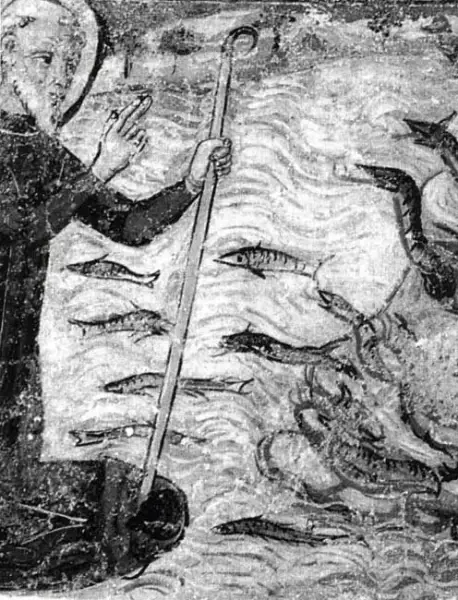
The work for which legend and memory honor Julius is a campaign of building: the tradition states that Theodosius I charged the brothers with tearing down pagan altars and holy groves and raising churches of Christ in their place. According to their legend the brothers raised one hundred churches across the lake country. The number is the hagiographer's perfect sum, yet it preserves the memory of a genuinely systematic mission — the replacement of the sacred groves of the hills with parish churches at a pace that would imprint the Christian map of the Novarese for good. Of the hundred, two are named. The ninety-ninth church was built at Gozzano and dedicated to the deacon martyr Saint Lawrence, and there Julian, the brother whose name almost merged with the saint's own, was buried at his church. The hundredth was Julius' work alone, raised on the small island that lay off the shore of what is now Orta San Giulio: an island which, the legend says, was full of serpents until the saint arrived, sailing to it over the water on his own cloak. He dedicated the island church to Saints Peter and Paul, and that foundation became the heart of his cult and the goal of pilgrims ever since.
§ Julius of Novara
The Island That Bears His Name
Julius died in 401, and the island in Lake Orta has carried his name since at least the eighth century, when Paul the Deacon already referred to it as the island of the saint. Isola San Giulio remains the still center of his cult: in the crypt called the scurolo of the basilica dedicated to him, his presumed relics are preserved, and the little island — one chapel of silence amid the waters — has drawn pilgrims for more than a millennium. The saint's memory lives in the very geography of the region, in the town that calls itself Orta San Giulio and in the highland parishes descended from his legendary hundred churches. His liturgical commemoration is kept on 31 January by both the Roman Catholic Church and the Orthodox Church, and the Great Synaxaristes records him among the saints of Greece as well as Italy. It has been said that his name was recited in the Ambrosian Rite as early as the fifth and sixth centuries, though others have argued that the Julius of those ancient texts was Pope Julius I rather than the priest of Lake Orta — one more question that centuries of devotion have left suspended. His image is fixed in art as an old priest with his staff, crossing the lake upon his cloak.
§ Julius of Novara
The Record
- Major works
- One hundred churches across the Novarese, including the church of Saint Lawrence at Gozzano and the island basilica dedicated to Saints Peter and Paul
- Patron of
- Lake Orta and the Novarese highlands
- Symbols
- An old priest with his staff·Sailing on his cloak over the lake to the island full of serpents
- Canonization
- Pre-congregation canonization; his cult at Lake Orta is attested from at least the eighth century.
Prayer
Bibliography
Show 4 sources
- Great Synaxaristes (in Greek): Ὁ Ἅγιος Ἰούλιος ὁ Πρεσβύτερος ἐξ Αἰγίνης. 31 Ιανουαρίου. ΜΕΓΑΣ ΣΥΝΑΞΑΡΙΣΤΗΣ.
- San Giulio: Apostolo dell'Alto Novarese (in Italian)
- Saints of January 31: Julius of Novara
- Paul the Deacon, referring to the island as sancti Iuliani
Profile text adapted from the Wikipedia article, licensed CC BY-SA 4.0.
Pray with this saint every day
Save St. Julius of Novara to your favorites, read the full profile, and get feast-day reminders in the Saints app.
Get the Saints AppFree on the App Store for iPhone and iPad