
255 – c. 304·Feast May 27
St. Julius the Veteran
Soldier-martyr of Durostorum under Diocletian
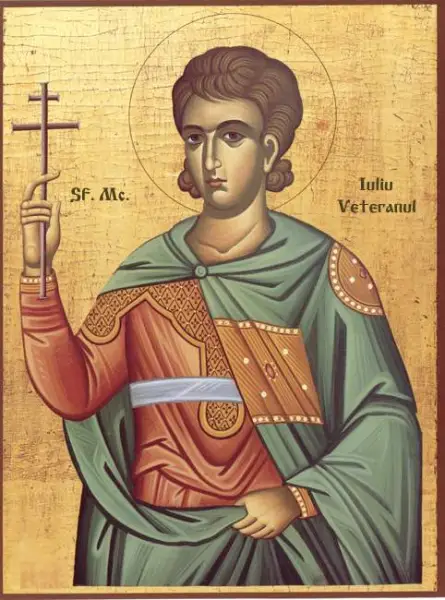
Overview
Julius the Veteran, also called Julius of Durostorum, was a Roman soldier of the late third century whose long military career and unshaken faith met their test in the last and greatest persecution of the ancient Church. Born to pagan parents in 255, he was converted to Christianity at an unknown date yet served in the Roman army his entire working life: twenty-seven years as a soldier, first as a conscript and later as a veteran, through seven military campaigns. The scholar Herbert Musurillo, judging from the years and places of his service, believed he served in the Eleventh Claudian Legion, stationed on the Danube frontier. Under the fourth edict of Diocletian's persecution he was arrested by the staff soldiers of the prefect Maximus for refusing to offer public sacrifice to the Roman gods. At his trial the prefect, moved by gratitude for Julius' long service, offered him a remarkable bargain: immunity from blame for the sacrifice, freedom, a ten-year bonus of pay, and freedom from future charges. Julius refused, and was executed by the sword at Durostorum, the legionary camp in Moesia Inferior, in the first months of 304. He is venerated as a military saint, with his feast on May 27.
The Complete Life
A Pagan-Born Soldier Who Served Christ
Julius was born in 255 at Durostorum, the Danube camp in the province of Moesia Inferior that gives him his other name, Julius of Durostorum, and his parents were pagans. The date of his conversion to Christianity is unknown; what the acts of his martyrdom make unmistakable is that whenever it occurred, it changed nothing in his outward profession. Julius served as a Roman soldier for twenty-seven years, entering the ranks as a conscript and leaving them as a veteran, and in the course of that long service he took part in seven military campaigns. He was, in other words, a Christian throughout his entire military career, carrying the faith through the hardest and most compromising profession the empire offered. From the dates and theaters of Julius' long service, the Jesuit scholar Herbert Musurillo judged it most likely that his legion was the Eleventh Claudia, the force standing guard on the Danube against the peoples beyond the river. In him the Christian community of the frontier provinces saw a striking figure: a man who paid Caesar's taxes in obedience and Caesar's campaigns in sweat, yet reserved his ultimate loyalty, quietly and without scandal, for the King who would one day ask it of him in public.
§ Life
The Prefect's Bargain and the Martyr's Refusal
The storm broke with the fourth edict of the Diocletianic persecution, which ordered all subjects of the empire to sacrifice to the gods. Julius was arrested by the staff soldiers of the prefect Maximus for refusing the public sacrifice, and brought before the prefect for trial. Something in the encounter was unusual. When Maximus heard the record of Julius' service — the twenty-seven years, the seven campaigns — he complimented the old soldier as a wise and serious man, and instead of threats he offered gratitude. If Julius would perform the sacrifice, the prefect promised to take the blame for the sin of it upon himself, and to give the veteran his freedom, a bonus payment covering ten additional years of service, and immunity from any future charge. It was an offer designed to let a loyal soldier keep his conscience intact on a technicality, and Julius declined it. For his refusal the sentence of death was pronounced, and between January and March of 304 he was killed by the sword at Durostorum, in the very camp where his legion kept the frontier. The Church has never hesitated over his title: he is widely considered a martyr, and his cult spread through the Eastern Orthodox, Roman Catholic, and Anglican traditions.
§ Life
Timeline
- 255
Born to pagan parents at Durostorum on the Danube frontier.
§ Life
- 304
Arrested for refusing public sacrifice under the fourth edict of Diocletian's persecution and brought to trial before the prefect Maximus.
§ Life
- 304
Declined the prefect's offer of freedom and pay, and was put to death by the sword at Durostorum between January and March.
§ Life
The Record
- Patron of
- Soldiers (honored as a military saint)·The Church in Bulgaria
- Symbols
- Martyr's cross
- Canonization
- Pre-congregation; venerated as a martyr by the Eastern Orthodox, Roman Catholic, and Anglican Churches
Prayer
Bibliography
Show 2 sources
- L. Arik Greenberg: My Share of God's Reward. Exploring the Roles and Formulations of the Afterlife in Early Christian Martyrdom, Studies in Biblical Literature, volume 121, Lang, New York, Bern, Berlin, Bruxelles, Frankfurt am Main, Oxford, Vienna 2009, ISBN 978-1-4331-0487-9, pp. 195–198
- Musurillo, Herbert (1972). The Acts of the Christian Martyrs. Oxford: Clarendon Press. p. xxxix, 260–265. ISBN 0198268068
Profile text adapted from the Wikipedia article, licensed CC BY-SA 4.0.
Pray with this saint every day
Save St. Julius the Veteran to your favorites, read the full profile, and get feast-day reminders in the Saints app.
Get the Saints AppFree on the App Store for iPhone and iPad