
born 486·Feast October 16
St. Junian
Hermit of the Limousin and Father of Saint-Junien
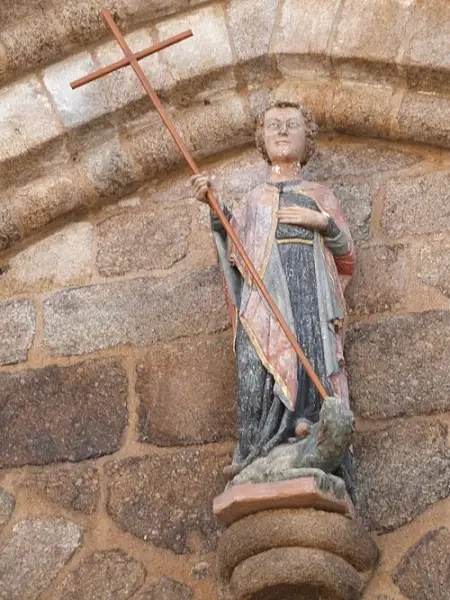
Overview
Saint Junian was a fifth- and sixth-century hermit of the Limousin, the man after whom the town of Saint-Junien in Haute-Vienne is named. According to the tradition that preserves his memory, tradition makes him a child of the Count_of_Cambrai's house, born in 486 while Clovis_I reigned over the Franks and baptized at the same font as the great Saint_Leonard. At the age of fifteen he left his father's house and journeyed south to the Limousin, a district celebrated for its severity of life and for the crowd of holy solitaries it had sheltered, seeking out a solitary named Amand whose disciple he wished to become. A first night at the hermitage door, in a snowstorm during which the snow miraculously spared him, opened a formation that lasted until Amand's death. After burying his master, Junian settled at the spot where the collegiate church of Saint-Junien stands today, and there his cult took root. His feast is kept on October 16.
The Complete Life
A Count's Son of the Age of Clovis
The tradition of the Limousin traces Junian's origins to a noble household of the north: he is said to have come from the household of the Count_of_Cambrai, his birth falling in 486, while Clovis_I ruled the Franks. These were the decades in which the Frankish kingdom was being welded together and, under Clovis, brought to the Christian faith, and Junian's generation was among the first to grow up wholly within a baptizing Christendom. The tradition adds a detail treasured by the hagiographers of the region: the child was baptized at the same time as Saint Leonard, the great hermit and patron of prisoners, so that the two future saints entered the church in a single washing. Of his childhood and education at his father's court nothing further is recorded, but the story presupposes the ordinary formation of a noble boy of the age, and it explains the ease with which the fifteen-year-old later set out on the roads of Gaul, a journey few but the well-born could safely undertake. Whether the count's household was already Christian when Clovis himself was baptized, or received the faith in the wave of conversions that followed the royal example, the tradition does not say; it remembers only that the boy was given to Christ in baptism in the company of a future saint.
§ Introduction
The Snowstorm at Comodoliac
At the age of fifteen Junian left his father's world and journeyed to the Limousin, a region that enjoyed a double reputation: for the austerity of its life and for the multitude of saints and hermits who had settled in its woods and valleys. Among these solitaries was one called Amand, whose disciple Junian wished to become. Amand lived in a small hermitage at Comodoliac, at the confluence of the Vienne and Clain rivers, a place that Ruricius, bishop of Limoges, had given him. According to the story the tradition tells, Junian arrived very late at night and knocked at the hermit's door, but Amand, fearing that a demon stood outside, would not answer, and the boy was left to sleep in the open through a violent snowstorm. By morning the miracle was plain: the snow had fallen all around the sleeper but not upon him. Amand received him, and the youth who had been sheltered by God was accepted into the master's school of prayer and discipline. The confluence of two rivers made Comodoliac a natural hermitage, watered, secluded and remote from the roads, exactly the kind of gift a bishop of the period delighted to make to a holy solitary.
§ Introduction
Disciple of Amand
Junian's formation in the hermitage at Comodoliac joined him to one of the characteristic figures of early Christian Gaul: the desert father of the West, whose cell attracted disciples as the cities once had attracted students of rhetoric. Under Amand he learned the discipline of the solitary life, the round of prayer, fasting and manual work by which the eremitical movement of the Limousin sustained itself. The master-student relationship was the chief vehicle of monastic tradition in that age; rules were few and books fewer, and the young religious was formed by living beside a proven elder. That Junian crossed half of France as a boy to bind himself to one particular hermit shows how highly such teachers were esteemed. The tradition preserves no writings from his hand and no sayings, only the shape of a life given to apprenticeship in holiness, first at the door of Amand in the snow and then for long years at his side in the cell by the rivers. The snowstorm at the door became, in the memory of his disciples, the first lesson of that apprenticeship: that God guards those who seek him, and that the harshness of the eremitical life is answered by a grace proportioned to it.
§ Introduction
Where the Collegiate Church Stands
When Amand died, Junian did not return to the north or wander in search of another master. He took up his dwelling at a place in the Limousin where, in later centuries, the great collegiate church of Saint-Junien would rise, and there he lived out the remainder of his life in the manner his formation had taught him. The site of a hermit's cell was, in the religious geography of medieval France, a natural center of pilgrimage and prayer, and in time a church grew where the holy man had lived, and a town grew around the church. The date of Junian's death is not recorded in the source material, but the devotion that followed it never ceased: the place itself took his name, and Saint-Junien remains among the notable towns of Haute-Vienne, a permanent monument to the count's son who became a hermit on the banks of the Vienne. The hermit's grave, like his cell, has disappeared beneath the church that covers the spot, but the continuity between his settlement and the sanctuary built over it has never been doubted in the Limousin.
§ Introduction
Cult in the Limousin
Junian was honored as a saint by the uninterrupted devotion of the Limousin, without any formal act of canonization. His feast is kept on October 16, and his cult is centered on the town that bears his name, where the collegiate church of Saint-Junien, one of the great Romanesque and Gothic churches of the region, succeeded the hermitage in which he lived. He belongs to the distinguished company of Limousin solitaries, the forerunners of Saint Stephen of Muret and the eremitical tradition that made the region famous for holiness. The memory of his baptism beside Saint Leonard linked him in local piety with one of the most beloved saints of France, and the story of the snowstorm that spared him gave the people of the Vienne valley an image of their patron that has endured for fifteen centuries. That a whole community should take the name of a hermit who left no writings and founded no order testifies to the force of personal holiness in the religious imagination of early Gaul.
§ Introduction
A Town That Bears His Name
Junian's chief monument is geographic. The commune of Saint-Junien in Haute-Vienne, with its collegiate church set above the Vienne, preserves the name and the site of the hermit who settled there in the sixth century, and few French saints have given their names to a place of comparable size and antiquity. Through the medieval centuries the collegiate church that rose on his dwelling place made the town a center of religious life in the Limousin, and the story of his youth, his journey south, his night in the snow at Amand's door and his long apprenticeship at Comodoliac was retold as part of the region's own history. He is remembered by scholars of the local church as one of the first eremites of the Limousin, standing at the head of the line of solitaries that runs through the region's hagiography down to Saint Étienne de Muret and the Grandmont tradition. In the town's name, renewed every day in ordinary speech, his vocation has proved more durable than any written chronicle. The church that stands where his cell stood has been rebuilt and enlarged across the centuries, but it has never moved, so that the town remains, in the most literal sense, built upon the place where Junian prayed.
§ Introduction
The Record
- Patron of
- The town of Saint-Junien, Haute-Vienne
- Symbols
- Hermit's habit·Snow falling around but not upon him
- Canonization
- Pre-congregation; ancient cult in the Limousin centered on Saint-Junien
Prayer
Bibliography
Show 1 sources
- Fougerat, Michel (n.d.). "Les premiers ermites limousins, ou les précurseurs de saint Étienne de Muret". Retrieved May 7, 2009.
Profile text adapted from the Wikipedia article, licensed CC BY-SA 4.0.
Pray with this saint every day
Save St. Junian to your favorites, read the full profile, and get feast-day reminders in the Saints app.
Get the Saints AppFree on the App Store for iPhone and iPad