
1713 – 1784·Feast August 28 (July 1 in the United States)
St. Junípero Serra
Franciscan Missionary and Founder of the California Missions
Overview
Junípero Serra Ferrer, born Miquel Josep Serra i Ferrer on the island of Mallorca, was a Spanish Franciscan priest and missionary whose thirty-five years of labor in New Spain earned him the title Apostle of California. A brilliant student who held the Duns Scotus chair of philosophy at Palma, he gave up a prestigious scholarly career at thirty-five to serve the missions of the Americas. In the Sierra Gorda of Mexico he worked among the Pame people for eight years, founding five missions and defending their converts against Spanish settlers. In 1769, at fifty-five and already lame, he joined the overland expedition to Alta California and over the next fifteen years founded nine of the twenty-one Spanish missions that stretch from San Diego to San Francisco, including the first, Mission San Diego de Alcalá, and his headquarters at Mission San Carlos Borromeo de Carmelo. He died at Carmel in 1784. Beatified in 1988 by Pope John Paul II, he was canonized by Pope Francis in 2015 amid protest from Native American groups who accuse him of presiding over a brutal colonial system, a controversy that continues to mark his memory.
The Complete Life
A Farm Boy of Petra
Miquel Josep Serra i Ferrer came into the world at Petra, a village of Mallorca in the Balearics, on November 24, 1713. His father, Antonio Nadal Serra, and his mother, Margarita Rosa Ferrer, had married in 1707, and from the age of seven the boy worked the family fields, helping to cultivate wheat and beans and to tend the cattle. Yet his childhood gravitated to the Franciscan friary of San Bernardino scarcely a block from the family house. Attending the friars' primary school, he studied letters, arithmetic, Latin, doctrine and sacred chant, and his natural gift for music made him a welcome, if unofficial, addition to the community choir at great feasts. Father and son often visited the friary for friendly conversation with the Franciscans. At sixteen his parents sent him to the Franciscan college in Palma de Majorca to study philosophy; within a year he was asking to enter the order as a novice. The island of his birth, its villages and its friaries, formed the only world he knew until he was nearly forty. The drought and plague that later struck Petra touched his own family; on his visits home from Palma he supported his aging and eventually separated parents, anointed his dying father, and found his younger sister Juana María near death on one of his last returns. The warmth of that Mallorcan household never left him.
§ Early life
Friar, Professor, Missionary
On September 14, 1730, two months before his seventeenth birthday, Serra entered the Franciscan Order at Palma, joining the Alcantarine reform of the Friars Minor. He received the religious name Junípero in honor of Brother Juniper, an early companion of Francis of Assisi, and professed with his fellow novices contempt for possessions and ease, binding himself to lifelong chastity. Ordained a priest in 1737, he earned a license to teach philosophy and for three years lectured to more than sixty students, among them Francisco Palóu and Juan Crespí, who would become his fellow missionaries. Considered intellectually brilliant by his peers, he took a doctorate in theology from the Lullian College in Palma and occupied its Duns Scotus chair of philosophy. In 1748, at thirty-five, the two friars discovered in one another the same longing for the missions, and Serra, who had his career assured at home, applied to the colonial bureaucracy in Madrid for a foreign assignment. In 1749 they landed at Veracruz and made their way to Mexico City, where Serra, declining the horse offered to him, walked the royal road and suffered the leg injury that tormented him for the rest of his life.
§ Joins Franciscan order
Apostle of California
Assigned to the Sierra Gorda in 1750, Serra spent eight years among the Pame people, reviving the mission of Jalpan, involving his parishioners in dramatic liturgy, organizing their agriculture and trades, and defending their lands against Spanish settlers in a long legal struggle that the friars finally won in 1755. He oversaw the construction of the great church at Jalpan, carrying beams and mortaring stone with his own hands. On July 16, 1769, after the expulsion of the Jesuits had opened the Californian missions to the Franciscans, he founded Mission San Diego de Alcalá, the first of the California chain, having trekked nine hundred miles from Loreto on an infected leg he refused to let stop him. On Pentecost 1770 he founded Mission San Carlos Borromeo at Monterey, moving it to Carmel as his headquarters. Under his presidency eight further missions rose, from San Antonio de Padua and San Gabriel Arcángel to San Francisco de Asís, San Juan Capistrano, Santa Clara and San Buenaventura. When conflicts with the military commander Pedro Fages demanded it, he walked and rode to Mexico City itself to plead the cause of the missions and the natives, drafting the Representación of thirty-two articles on which the viceroy ruled in his favor.
§ Missions founded
Penance, Mortification and Inquisition
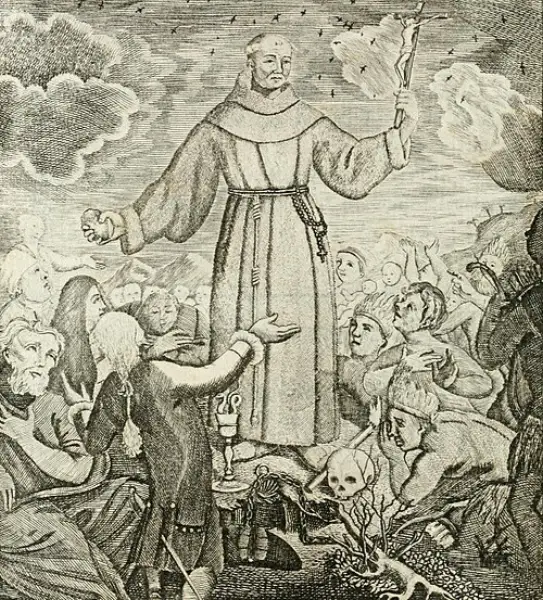
Serra's piety was formed in the austere Alcantarine reform, and he practiced penance with a severity that startled even his contemporaries. Emulating the missionary saint Francisco Solano, he wore a sackcloth garment spiked with bristles or interwoven with broken wire beneath his habit, and kept a chain of sharpened iron links hanging by his bed for nightly self-discipline. In the pulpit his sermons on repentance could turn physical: he would beat his chest with a stone while clutching a crucifix, or sear his flesh with a candle flame while preaching on hell, once reducing an entire Mexico City congregation to tears until a penitent seized the chain from his hand. In his letters he styled himself nothing but a sinner and a priest unworthy of his office; he ate sparingly, and served tables with the lay brothers when he returned to the college that expected his professorship. Alongside this asceticism stood the harsher instruments of his era: during his Sierra Gorda years he was appointed inquisitor for the region and in 1752 filed a report on sorcery among the mission's Christian settlers, a document that remains the only surviving letter from his eight years there.
§ Penance and mortification
Confirmation to the Last Mission
In his final three years, though his leg was crippled and his chest failing, Serra undertook a final tour of every mission between San Diego and San Francisco — a journey of more than six hundred miles — so that the baptized might receive confirmation at his hands; 5,309 received it, nearly all of them California Indian neophytes converted during the fourteen years since 1770, and refused remedies that might have eased his journey. He returned to his headquarters at Carmel, where on August 28, 1784, he died of tuberculosis at the age of seventy, in the mission he had founded fourteen years before. He was buried there under the sanctuary of the church of San Carlos Borromeo, where his remains lie still. The Franciscan mission of Alta California then came under the direction of Fermín Lasuén, who carried the mission chain forward under the system Serra had built. The chapel he knew at San Juan Capistrano, completed in 1782 and known ever since as Father Serra's Church, survives as the oldest standing building in California and the sole church still standing where he is recorded to have offered the church's rites; he confirmed 213 souls there across two days of October 1783. At Carmel, the sculptor Jo Mora finished in 1924 a bronze and marble tomb carved with episodes of the friar's career, though his body was never transferred into it.
§ Death
From Servant of God to Saint
His cause began on October 21, 1951, when the diocesan process conferred on him the title Servant of God. Beatification followed on September 25, 1988, when Pope John Paul II declared him blessed before a crowd of twenty thousand, extolling the friar who planted the faith in a New World transformed by the Europeans' coming. Questions about the treatment of Indians under the mission system, first raised as early as 1783, accompanied the process; historians gave evidence for the cause in 1948 and again in 1986. On September 23, 2015, Pope Francis raised him to the altars at the Washington, D.C. basilica during the pontiff's American journey — the first time a canonization had ever been held on United States ground. The pope described him as a founder-father of the American nation and a particular patron of its Hispanic people. Native American tribes objected to the honor, and protests attended the ceremony; other Native Californians, including members of the Juaneño Acjachemen Nation and the Ohlone, supported it and took part in the canonization Mass.
§ Veneration
Contested Memory of the Apostle of California
Serra's imprint on California is physical, institutional and controversial. The missions he founded shaped the settlement of the Pacific coast, produced the colony's cattle and grain, and gave California the Mission grape of its first sustained vineyard, planted at San Diego in 1779, which made him known as the Father of California Wine. Streets, boulevards, mountains and schools across the state bear his name, both Spain and the United States have honored him on postage stamps, and Serra International, a global lay organization promoting vocations, was named for him. Since his canonization his memory has been fiercely contested: critics, among them many Native American historians, charge that the missions imposed forced labor, corporal punishment and cultural destruction on the Indians, citing Serra's own instruction to whip and shackle runaways; defenders answer that he also protected natives from soldier abuse, secured written rights for them in the Representación, and must be judged within his century. Statues of Serra have been toppled and decapitated, schools and university buildings renamed, while thousands of Native Californians remain Catholic and some honor him. His grave at Carmel remains a place of pilgrimage and dispute alike.
§ Legacy
Timeline
- 24 Nov 1713
Is born at Petra on the island of Mallorca and baptized Miquel Josep Serra i Ferrer
§ Early life
- 14 Sep 1730
Enters the Franciscan Order at Palma, taking the religious name Junípero
§ Joins Franciscan order
- 1737
Is ordained a Catholic priest
§ Joins Franciscan order
- 1740
Earns an ecclesiastical license and begins three years teaching philosophy at the Convento de San Francisco
§ Joins Franciscan order
- 1743
Ends his philosophy course, having taught among others the future missionaries Francisco Palóu and Juan Crespí
§ Joins Franciscan order
- 1748
Resolves with Palóu to become a missionary and obtains permission for the foreign missions
§ Joins Franciscan order
- 1749
Lands at Veracruz with the Franciscan missionary team and insists on walking the Camino Real to Mexico City, an injury to his left leg plaguing him for life
§ Ministry in the Americas
- 1750
Begins mission work among the Pame people in the Sierra Gorda, where he and Palóu revive the mission at Jalpan
§ Mission in the Sierra Gorda
- Sep 1752
Is appointed inquisitor for the Sierra Gorda and reports on witchcraft to the Holy Office in Mexico City
§ Work for the Inquisition
- 1755
The Pames and the friars recover their lands after a legal struggle against Spanish settlers
§ Mission in the Sierra Gorda
- 1758
Returns to the College of San Fernando, serving for nine years as administrator, missionary and inquisitor across central New Spain
§ Work for the Inquisition
- Jul 1767
Is appointed president of the missions of Baja California after the expulsion of the Jesuits
§ President of missions of the Californias
- 14 May 1769
Founds Mission San Fernando Rey de España de Velicatá, his first mission, on Pentecost
§ Founding Mission Velicatá
- 1 Jul 1769
Arrives in San Diego with the Portolá expedition after a 900-mile overland trek from Loreto
§ Arrival in San Diego
- 16 Jul 1769
Founds Mission San Diego de Alcalá, the first of the twenty-one California missions
§ Mission San Diego de Alcalá
- 3 Jun 1770
Founds Mission San Carlos Borromeo at Monterey on Pentecost Sunday
§ Monterey
- 14 Jul 1771
Mission San Antonio de Padua is founded under his presidency; he relocates his headquarters to Carmel
§ Missions founded
- 1773
Travels to Mexico City and drafts the Representación in 32 articles against military commander Pedro Fages; the viceroy rules largely in his favor
§ Missions founded
- 29 Jun 1776
Mission San Francisco de Asís is founded under his presidency
§ Missions founded
- 1 Nov 1776
Mission San Juan Capistrano is founded under his presidency
§ Missions founded
- 12 Jan 1777
Mission Santa Clara de Asís is founded under his presidency
§ Missions founded
- 1778
Receives dispensation, though not a bishop, to administer the sacrament of confirmation in California
§ Missions founded
- 1779
Missionaries under his direction plant California's first sustained vineyard at Mission San Diego de Alcalá
§ Missions founded
- 31 Mar 1782
Founds Mission San Buenaventura, the last mission established in his lifetime
§ Missions founded
- 28 Aug 1784
Dies of tuberculosis at Mission San Carlos Borromeo de Carmelo at the age of 70
§ Death
- 21 Oct 1951
His cause for beatification is formally opened and he is declared a Servant of God
§ Veneration
- 25 Sep 1988
Is beatified by Pope John Paul II in Saint Peter's Square
§ Veneration
- 23 Sep 2015
Pope Francis inscribes him among the saints at the Washington, D.C. basilica during his American journey — the first canonization rite ever held on United States soil
§ Veneration
In Their Own Words
I desire nothing more from you than this, that when the news of my death shall have reached your ears, I ask you to say for the benefit of my soul: 'May he rest in peace.'
God ... has given me the strength to come so far. ... Even though I should die on the way, I shall not turn back. They can bury me wherever they wish and I shall gladly be left among the pagans, if it be God's will.
That spiritual fathers should punish their sons, the Indians, with blows appears to be as old as the conquest of the Americas; so general in fact that the saints do not seem to be any exception to the rule.
The Record
- Major works
- Missions of the Sierra Gorda, Querétaro, Mexico (five missions, 1750-1760)·Misión San Fernando Rey de España de Velicatá, Baja California (1769)·Nine of the twenty-one Spanish missions of California, 1769-1782·Representación in 32 articles (1773)·Diario of the journey from Loreto to San Diego
- Patron of
- Vocations·Hispanic Americans·California
- Symbols
- Franciscan habit·Large crucifix·Accompanied by a young Native American boy
- Canonization
- Beatified by Pope John Paul II on 25 September 1988; canonized by Pope Francis on 23 September 2015, the first canonization celebrated on American soil
Prayer
Bibliography
Show 8 sources
- Hackel, Steven W. Junipero Serra: California's Founding Father. New York: Hill and Wang, 2013. ISBN 978-0-8090-9531-5.
- Geiger, Maynard. The Life and Times of Fray Junípero Serra, O.F.M.: The Man Who Never Turned Back. Academy of American Franciscan History, 1959.
- Beebe, Rose Marie, and Robert M. Senkewicz. Junípero Serra: California, Indians, and the Transformation of a Missionary. University of Oklahoma Press, 2015.
- Geiger, Maynard (1948). "The Franciscan 'Mission' to San Fernando College, Mexico, 1749." The Americas 5 (1): 48-60. doi: 10.2307/978132.
- "St. Junípero Serra". Encyclopaedia Britannica.
- "Catholic Encyclopedia: Junipero Serra". newadvent.org.
- Serra, Junípero. Writings of Junípero Serra. Ed. Antonine Tibesar, O.F.M. Academy of American Franciscan History, 1955.
- Fogel, Daniel. Junipero Serra, the Vatican, and Enslavement Theology. San Francisco: ISM Press, 1988. ISBN 978-0-910383-25-7.
Profile text adapted from the Wikipedia article, licensed CC BY-SA 4.0.
Pray with this saint every day
Save St. Junípero Serra to your favorites, read the full profile, and get feast-day reminders in the Saints app.
Get the Saints AppFree on the App Store for iPhone and iPad