
268/270 – 287·Feast July 19 (July 17 in the medieval Hispanic liturgy)
St. Justa and St. Rufina
Sister Potters and Martyrs of Seville
Overview
Justa and Rufina were sisters of third-century Seville, born in 268 and 270 respectively to a poor but pious Christian family of the Triana district, who earned their living as potters of fine earthenware. Their refusal to sell vessels for use in a pagan festival provoked a riot in which their wares were smashed; their retaliation, breaking the image of a pagan goddess, brought them before the prefect Diogenianus. Imprisoned, racked and tortured with iron hooks, marched barefoot to the Sierra Morena and starved in prison, neither sister yielded. Justa succumbed first; the prefect had her corpse cast into a well, from which Bishop Sabinus later retrieved it. Rufina, thrown to the lions in the amphitheatre, was spared by beasts that would not attack her, and was killed by order of the prefect, who had her neck broken and her body burned. Sabinus recovered and buried her remains beside her sister's. Their cult in Seville is ancient and strong, honored in the Mozarabic Liturgy and spread across Spain, and the two potters became the beloved patron saints of Seville and of potters everywhere, credited with protecting the Giralda and the cathedral in the Lisbon earthquake of 1755.
The Complete Life
Potters of Triana
The sisters Justa and Rufina were natives of Seville, said in their legend to have lived in the quarter of Triana across the river from the city. Justa, the elder, was born in 268, and Rufina followed in 270, both daughters of a family that was poor in goods but rich in faith, professing Christianity at a time when the empire had not yet ceased to persecute it. Their trade was the making of fine earthenware, and by it the two women supported themselves and found means to help many of the poor of the city. Like other merchants of their day they sold their pottery from open-air booths where passers-by could see the wares displayed, and their craft brought them into daily contact with the religious life of pagan Hispalis, its festivals and its idols. From this ordinary workshop life, of clay, kilns and market stalls, the tradition draws the whole drama that followed: two Christian tradeswomen whose conscience about the use of their own handiwork set them against the city's gods. The name Justa appears in the early sources with variants, sometimes given as Justus in the oldest manuscripts, and the family's Christianity in that generation of the church marked them as members of a community that met in the houses of the faithful and buried its dead in the Christian cemeteries outside the walls.
§ Hagiography
Faith in the Workshop
Christianity shaped every part of the sisters' lives, and their legend presents their piety as inseparable from their trade. The charity they practiced from their earnings marked them as women who took seriously the demands of their baptism, and the account of their lives suggests that their workshop was known in Triana as a Christian household. Their refusal, at the pagan festival, to sell pots and dishes destined for idolatrous celebrations was an act of conscience about the destination of their own work: they would earn their bread from the city but not serve its gods. When their neighbors, enraged, smashed every dish and pot in their booths, the sisters answered in kind, breaking an image of the goddess Venus. This act of defiance was deliberately provocative in a city given over to the old cults, and it brought the magistrates at once. Arrested on the spot, they were handed to the prefect Diogenianus, whose duty was precisely to compel subjects to honor the imperial religion, and whose methods were the standard ones of rack and hook and prison. In the eyes of their neighbors the refusal was a provocation and the smashing of the goddess an outrage; in the memory of the church it was the moment when two ordinary tradeswomen chose the first commandment over their livelihood, and everything that followed flowed from that choice made at a market stall.
§ Hagiography
Trial Before Diogenianus
Diogenianus, the city's prefect, ordered the two sisters imprisoned and, failing to shake their constancy by argument, resorted to torture. They were stretched on the rack and torn with iron hooks, and when these torments produced no renunciation of their faith they were subjected to further trials: a forced march, barefoot, to the Sierra Morena, and then confinement without water or food. Each stage of the punishment was designed not merely to punish but to break, and each failed. The courage with which the sisters bore their sufferings became the heart of the story Seville told of them, a witness offered not in a single heroic moment but stretched across days of escalating cruelty. Nothing in their conduct was political; their entire offense lay in their loyalty to Christ and their contempt for idols, and their entire defense was the faith they would not abandon. The legend presents a contest between the machinery of Roman coercion and two potters' daughters, and the machinery found them unbreakable. The legal and religious machinery of a Roman city had at its disposal a full repertoire of pressures, from imprisonment to public spectacles of punishment, and the account of the sisters' passion shows each instrument tried in turn against them, and each turned instead into evidence of their constancy.
§ Hagiography
Two Deaths, One Witness
Justa died first, in prison, worn out by her torments; the prefect cast her body into a well to deprive the Christians of her relics, but Bishop Sabinus recovered it. Diogenianus counted on her death to crush her sister's resolve, and when Rufina remained unmoved he condemned her to the beasts. In the amphitheatre, the tradition relates, the lions refused their role, fawning about the condemned woman as docile as house cats rather than attacking her. Infuriated, the prefect ordered a baser death: Rufina's neck was broken and her body burned, an attempt to erase her memory as her sister's body had been hidden in a well. Sabinus defeated that design too, recovering the remains and burying them beside those of Justa. Thus the sisters died as they had lived, together, the elder first and the younger following her, and the bishop who gathered their bones ensured that the Christian community of Seville would have a grave at which to remember them. The bishop's recovery of both bodies, one from the well and one from the fire, completed the story the city would tell: the empire could kill the sisters and even deny them burial, but it could not separate them from each other or from the community that treasured their graves.
§ Hagiography
Ancient Witnesses of the Spanish Church
The sisters belong to the oldest stratum of Spanish saints, honored by the church long before any formal canonization existed. Justa, sometimes called Justus in early manuscripts, is named alone in the Martyrologium Hieronymianum, the most ancient of the martyrologies; Rufina joined her in the later historical martyrologies, which follow the legendary Acts of the two saints. At Seville their cult was both old and vigorous, and from there it moved across the rest of Spain, and the two martyr potters hold an honored place in the Mozarabic Liturgy, the ancient rite of the Visigothic church that survived the Islamic conquest. The Roman Martyrology commemorates them on July 19, the date still observed as their feast, while the medieval Hispanic calendars, including that of the Antiphonary of León, kept it on July 17. They are counted among the virgin martyrs of the Catholic Church, and the Antiochian Orthodox Christian Archdiocese likewise keeps their memory, a rare instance of devotion shared across the Catholic and Orthodox worlds for saints of Roman Spain. That the earliest martyrology records one sister and the later tradition insists on both has caused scholars to weigh the historical kernel of the Acts carefully, but the antiquity and continuity of the cult at Seville have never been in doubt.
§ Veneration
Patrons of Seville and of Potters
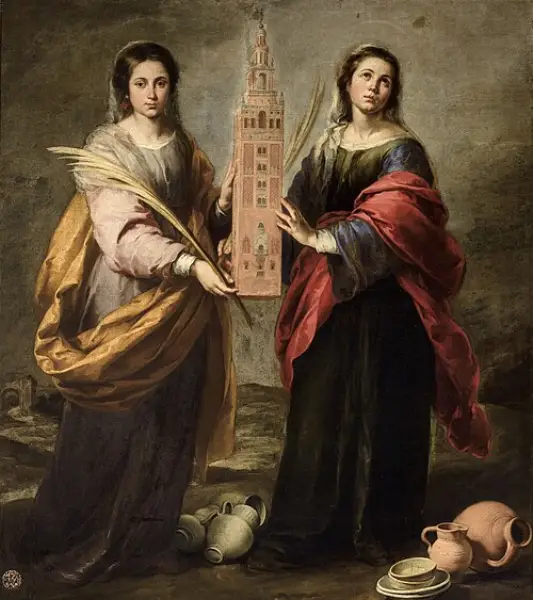
No saints of Spain have entered the civic and artistic life of their city more deeply than the two potters of Triana. Seville chose them as its patron saints, and by tradition they are the special protectors of the Giralda and the cathedral, which they are said to have preserved unharmed in the Lisbon earthquake of 1755. They are also patrons of the city of Orihuela, where a parish church stands on the site of a Visigothic church later used as a mosque, and of potters and the pottery guilds, the alfareros and cacharreros, whose trade they shared. Chapels and shrines honor them from Zaragoza, where La Seo Cathedral has a chapel of the two saints, to Agost in Valencia and Alicante, where a three-day July fiesta celebrates them. Spanish painters returned to them for centuries: the earliest known depiction is a retable of 1540, and Murillo, Zurbarán, Velázquez, Goya and Francisco Camilo all painted the sisters, usually as young women with uncovered heads, their clay pots at their sides, palms in their hands, and a lion licking Rufina's foot, flanking the tower they saved. Their images stand in the cathedral treasury of Spanish art not as remote symbols but as working women with their wares about them, and that combination of martyr's palm and potter's stall is what has made them, for four centuries of painters and for the guilds that claimed them, the most approachable of patrons.
§ Iconography
Timeline
- 268
Justa is born at Seville into a poor but pious Christian family of the Triana district
§ Hagiography
- 270
Rufina, the younger sister, is born at Seville
§ Hagiography
- 287
The sisters are martyred at Hispalis (Seville) under the prefect Diogenianus
§ Hagiography
- 1540
The earliest known retable depicting the two saints is produced
§ In art
- 1644
Francisco Camilo paints the saints, joining a Spanish artistic tradition that includes Murillo, Zurbarán, Velázquez and Goya
§ In art
- 1755
By tradition the sisters protect the Giralda and the Cathedral of Seville during the Lisbon earthquake
§ Patronage
- 1821
A hermitage dedicated to the sisters is built at Agost, in the province of Valencia
§ Veneration
The Record
- Patron of
- Seville·Orihuela·Potters, and the guilds of alfareros and cacharreros·Protectors of the Giralda and the Cathedral of Seville
- Symbols
- Model of the Giralda·Earthenware pots, bowls and platters·Books bearing two lumps of potter's clay·Palms of martyrdom·Lion licking Rufina's foot
- Canonization
- Pre-congregation; Justa appears in the Martyrologium Hieronymianum and both sisters are honored in the Mozarabic Liturgy
Prayer
Bibliography
Show 8 sources
- "Ss. Justa & Rufina, Virgin-Martyrs, at Seville, Spain". Antiochian Orthodox Christian Archdiocese. Archived from the original on April 6, 2018.
- Stracke, Richard. "Rufina and Justa". Christian Iconography, 2015-10-20.
- Kirsch, Johann Peter. "Sts. Rufina." The Catholic Encyclopedia, Vol. 13. New York: Robert Appleton Company, 1912.
- Monks of Ramsgate. "Justa and Rufina". Book of Saints. 1921. CatholicSaints.Info, 27 November 2013.
- "Justa and Rufina | Saints Resource". saintsresource.com. Retrieved 2021-10-29.
- "Roman Martyrology, July 19". Archived (PDF) from the original on 2016-01-17.
- Farmer, David. "Justa and Rufina", The Oxford Dictionary of Saints (5 rev). Oxford University Press, 2011. ISBN 9780199596607.
- "Saints Justa and Rufina - The Collection - Museo Nacional del Prado". museodelprado.es. Retrieved 2021-10-29.
Profile text adapted from the Wikipedia article, licensed CC BY-SA 4.0.
Pray with this saint every day
Save St. Justa and St. Rufina to your favorites, read the full profile, and get feast-day reminders in the Saints app.
Get the Saints AppFree on the App Store for iPhone and iPad