
c. 100 – 165·Feast June 1 (April 14 in the Roman Calendar of 1882-1969)
St. Justin Martyr
Philosopher, Apologist and Martyr of the Early Church
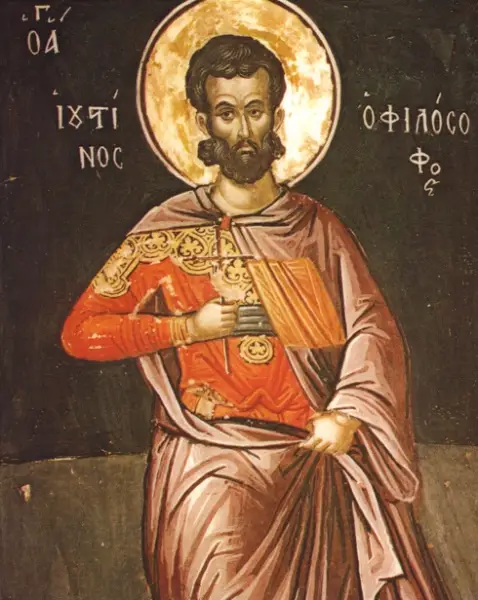
Overview
Justin, remembered by the church as Justin Martyr and called Justin the Philosopher in his own day, stands among the leading apologists and philosophical minds of second-century Christianity, born around the year 100 into a Greek-speaking pagan family at Flavia Neapolis in Samaria. After a restless search through Stoic, Peripatetic, Pythagorean and Platonic teaching, an encounter with an aged Christian by the seashore turned him to the prophets and to what he called the true philosophy of Christ. He adopted the philosopher's cloak and taught as an itinerant Christian intellectual, opening a school at Rome under the emperor Antoninus Pius. His First Apology, addressed to the emperor and the Senate, defends the morality of Christian life and argues that the seeds of the divine Logos were sown among the Greek philosophers, so that Socrates and Heraclitus could be called Christians before Christ. His Dialogue with Trypho expounds the relation of the Christian faith to the Hebrew scriptures. Denounced after a dispute with the Cynic philosopher Crescens, Justin stood trial with six companions before the urban prefect Junius Rusticus and went to beheading around the year 165. He is venerated across the Catholic, Orthodox, Lutheran and Anglican traditions as the patron of philosophers.
The Complete Life
A Pagan Youth of Neapolis
Justin was born around the year 100 into a Greek family at Flavia Neapolis, the city built near the ruins of ancient Shechem in Samaria, known today as Nablus. He belonged wholly to the Greco-Roman world: neither Hebrew nor Aramaic was his, his acquaintance with Judaism was slight, he remained uncircumcised, and he counted himself a Gentile. His grandfather Bacchius bore a Greek name and his father Priscus a Latin one, a combination that has suggested to historians either that his ancestors had settled at Neapolis soon after its foundation or that they descended from a Roman diplomatic community stationed there. In the opening of his Dialogue with Trypho, Justin himself describes the education that shaped and dissatisfied him. His first studies failed to provide any belief system capable of inspiring a seeker after God and the meaning of things. Philosophy was the remedy the age proposed, and Justin tried its schools in succession, finding each wanting in turn, before the encounter that would remake his life. The city of his birth lay in the hill country of central Palestine but looked culturally westward, and the boy reared there received the ordinary schooling of a provincial Greek family, memorizing Homer and the grammarians before philosophy ever reached him.
§ Life
The Search and the Old Man by the Sea
Justin's philosophical pilgrimage moved through the great schools of the second century. A Stoic proved unable to explain the being of God; a Peripatetic lost his respect by his eagerness for fees; a Pythagorean demanded years of music, astronomy and geometry before any discussion of truth; and Platonism, adopted after meeting a Platonist newly settled in his city, held him longest and seemed for a time to promise the vision of God he sought. The turning came in a conversation by the seashore with an aged man, possibly a Syrian Christian, who engaged him about God and pressed upon him the testimony of the prophets as more reliable than the reasonings of the philosophers: men ancient and righteous, speaking by the divine Spirit, who saw and announced the truth without fear or ambition. The old man urged him to pray that the gates of light be opened to him. Moved by the argument, Justin renounced his philosophical allegiances and rededicated his life to the service of God, convinced by the ascetic lives of Christians and the heroism of the martyrs that Christian doctrine was morally and spiritually supreme. His conversion is commonly placed at Ephesus, though it may have happened anywhere on the road from Syria to Rome.
§ Life
A School and a Cloak at Rome
After his conversion Justin dressed as a philosopher and traveled as a teacher, proclaiming Christianity as the true philosophy. Under the emperor Antoninus Pius he arrived in Rome and opened a school of his own, gathering students in the capital itself; among his pupils was Tatian, who remembered him as the most admirable Justin and recorded the saying that cost Justin his life's work nothing and his enemies everything. Justin's teaching career at Rome made him the first Christian intellectual to confront the empire's prejudice against the faith in writing addressed directly to power. His First Apology, presented to Antoninus Pius, his adopted sons Marcus Aurelius and Lucius Verus, and the Senate, argues that Christians are neither criminals nor atheists, that their morality is superior, and that persecution of the innocent is unjust; a Second Apology followed the Roman Senate. His method, defending the faith in the language and logic of the schools, founded the tradition of Christian apologetics, and the second-century church received him as the earliest systematic antagonist of heresy. The treatise argued that the prophecies of the Hebrew scriptures found their fulfillment in Jesus of Nazareth, and it preserved for history a detailed account of the Sunday assembly at Rome, where the memoirs of the apostles and the writings of the prophets were read and the Eucharist distributed to those present.
§ Writings
The Seed of the Word
At the center of Justin's theology stands the doctrine of the Logos, the divine Word who became incarnate in Christ but whose rational seed had been sown throughout creation and history. Adopting the Stoic teaching of the seminal word, Justin taught that the Greek philosophers had drawn the essential truths of their systems from the Hebrew scriptures, so that all the virtue and truth that ever existed must be referred to Christ, of whom the old philosophers and lawgivers possessed only a part. Socrates and Heraclitus, he insisted, had lived as Christians in advance of Christ, guided by the Logos whom they followed without knowing his name. The Word, in his teaching, comes forth from the Father's own substance — not dividing it, as flame kindles from flame — numerically distinct yet truly God, through whom all things were made; he defended the virginal birth of Jesus and the Holy Spirit within the divine triad. In the Dialogue with Trypho he argued that Christ is the fulfillment of the prophecies and the new law for all mankind, while in his account of the Eucharist and the Sunday assembly of Rome he preserved one of the oldest descriptions of Christian worship in existence.
§ Christology
Trial Before Rusticus
Under Marcus Aurelius, Justin's career in Rome ended in a public dispute and a judicial killing. Following a public disputation with Crescens, a Cynic, the philosopher denounced him to the authorities, as both Tatian and Eusebius record. He was arrested and tried, together with six companions, two of whom, Euelpistus and Hierax, were household slaves he had educated in the faith, before the urban prefect Junius Rusticus, a philosopher himself and the emperor's teacher. The transcript of the trial survives in the Acts of his martyrdom: commanded to sacrifice to the gods, Justin answered that no sane person trades piety for impiety; warned of torture, he replied that it was precisely the Christians' desire to suffer for Christ and so stand firm before the universal tribunal. Asked where he assembled his followers, Justin named no place but said that the Word of God could not be contained. The prefect pronounced the sentence: those who refused to sacrifice and obey the emperor were to be scourged and beheaded according to the law. The martyrs went rejoicing to the place of execution, where they were beheaded, about the year 165, and so consummated their confession.
§ Life
Saint of the Undivided Church
Justin was numbered among the saints by the practice of the ancient church, before any congregation for the causes of saints existed, and he bears in his very name the title of his death: Justin Martyr. His cult was never confined to one communion. The Catholic Church, the Eastern Orthodox Church, the Oriental Orthodox Churches, the Lutheran churches and the Anglican Communion all keep his memory, and his principal feast of June 1 is observed across these traditions; the Roman calendar of 1882 to 1969 had assigned it to April 14. He is honored as the patron of philosophers, the intellectual whose reasonableness led him to the faith and whose faith did not silence his reason. In the East he is depicted in icons presenting his open book, and in the West his works secured him a permanent place among the fathers of the second century. No relics of translation or great shrine mark his cult; his memory rests on his writings and his death, the two witnesses he himself would have chosen. Ancient writers from Irenaeus and Tertullian to Hippolytus, Methodius and Eusebius attest his standing: Tertullian salutes him as philosopher, martyr, and the first to take up arms against the heretics, Irenaeus quotes him and reports his death, and Tatian, his own student, names him first among his teachers.
§ Introduction
Texts, Transmission and Controversy
Justin's survival as an author is itself a story of near loss. After Rufinus, his authentic works circulated only through Irenaeus and Eusebius and a cloud of spurious attributions, until about 1540, when Guillaume Pellicier purchased in Venice a single codex containing the complete works, a manuscript completed on September 11, 1364 somewhere in the Byzantine empire, probably in a major center such as Mistra, and now Parisinus graecus 450 in the Bibliothèque nationale de France. Robert Estienne printed the editio princeps in 1551, and modern scholarship, from the editions of Maran and Otto to the Oxford Early Christian Texts of Minns and Parvis, has made Justin the most studied of the Greek apologists. His legacy is double-edged: the doctrine of the seeds of the Word opened the church to the virtuous pagan, while his Dialogue with Trypho, which claims the Hebrew scriptures for Christians and has been called a source of Christian anti-Jewish polemic, remains a subject of critical debate. His account of second-century baptism and Eucharist is read in every history of the liturgy, and the term memoirs of the apostles, his name for the gospels read each Sunday at Rome, preserves a witness to the church's scriptures within a generation of the apostles' own students.
§ Parisinus graecus 450
Timeline
- 100
Is born at Flavia Neapolis in Samaria, into a Greek-speaking pagan family
§ Life
- 155
Publishes the First Apology, addressed to Emperor Antoninus Pius, his sons and the Roman Senate
§ Writings
- 160
Composes the Dialogue with Trypho, presenting Christianity as the new law for all mankind
§ Dialogue with Trypho
- 165
Is denounced by the Cynic Crescens, tried by the prefect Junius Rusticus with six companions, and beheaded at Rome
§ Life
- 11 Sep 1364
A codex containing Justin's complete works is completed in the Byzantine Empire, the ancestor of all later texts
§ Parisinus graecus 450
- 1551
Robert Estienne publishes the editio princeps of Justin's works
§ Parisinus graecus 450
In Their Own Words
No one in his right mind gives up piety for impiety.
That is our desire, to be tortured for Our Lord, Jesus Christ, and so to be saved, for that will give us salvation and firm confidence at the more terrible universal tribunal of Our Lord and Saviour.
Do as you wish; for we are Christians, and we do not sacrifice to idols.
The Record
- Major works
- First Apology·Second Apology·Dialogue with Trypho·On the Resurrection (fragments; attribution debated)·On the Sovereignty of God (lost)·Refutation of all Heresies (lost)
- Patron of
- Philosophers
- Symbols
- Philosopher's cloak·Open book·Bearded presenter of the faith to an emperor
- Canonization
- Pre-congregation for the Causes of Saints
Prayer
Bibliography
Show 5 sources
- Skarsaune, Oskar (1987). The Proof from Prophecy: A Study in Justin Martyr's Proof-text Tradition: Text-type, Provenance, Theological Profile. Novum Testamentum, Supplements. E.J. Brill. ISBN 978-90-04-07468-2.
- Skarsaune, Oskar (2007). Jewish Believers in Jesus: The Early Centuries. Peabody, Mass.: Westminster John Knox Press. ISBN 978-0-664-25018-8.
- Minns, Denis, and Paul Parvis. Justin, Philosopher and Martyr: Apologies. Edited by Henry Chadwick, Oxford Early Christian Texts. Oxford: Oxford University Press, 2009.
- Buitenwerf, R. (2003). Book III of the Sibylline Oracles and Its Social Setting. Leiden: Brill. pp. 78.
- Jin Kim, Hyun. "Justin Martyr and Tatian: Christian Reactions to Encounters with Greco-Roman Culture and Imperial Persecution", in Mu-chou Poo, H. A. Drake, and Lisa Raphals (eds), Old Society, New Belief: Religious Transformation of China and Rome, ca. 1st-6th Centuries. New York, 2017.
Profile text adapted from the Wikipedia article, licensed CC BY-SA 4.0.
Pray with this saint every day
Save St. Justin Martyr to your favorites, read the full profile, and get feast-day reminders in the Saints app.
Get the Saints AppFree on the App Store for iPhone and iPad