
died 269·Feast August 4
St. Justin the Confessor
Roman priest who buried the martyrs of Rome
Overview
Justin the Confessor was a Christian priest of Rome who suffered martyrdom in the imperial persecutions of the third century, dying around the year 269, either under Emperor Claudius II or under Valerian. He was ordained a priest by Pope Sixtus II and, as a presbyter, led the Christian community of the city during a time when profession of Christ cost many their lives. He knew personally many early Christians who would later be honored as saints, and he presided over their burials. Tradition records him baptizing the widow Tryphonia of Rome along with her daughter Cyrilla, and burying numerous martyrs alongside Crescentianus — among them Pope Sixtus II, Laurentius, Hippolytus, and Romanus of Rome — their remains placed in the Catacomb of Cyriaca on the Via Tiburtina, the site where San Lorenzo fuori le Mura now rises. Word reached Emperor Valerian that Justin, as a leader of the Christians, urged them boldly to hold fast to their faith; the emperor then had him arrested at a funeral, questioned, and, on his refusal to deny Christ, beheaded. His community buried him in the coemeterium of St. Cyriaca on the Via Tiburtina. His relics were later translated to Germany, where they are venerated in Freising Cathedral.
The Complete Life
Presbyter of the Roman Church
Justin served the Church of Rome as a priest in the middle decades of the third century, an era in which the imperial government repeatedly turned upon the Christian community and demanded the surrender of its leaders. He was ordained by Pope Sixtus II, the bishop whose own martyrdom would come in 258 and whose body Justin would afterwards lay to rest. As a presbyter he bore the leadership of the Roman Christians, and his position brought him into personal acquaintance with many figures of the early Roman Church who would later be canonized. What the sources chiefly remember about his ministry, however, is his care for the dead. Christian burial was itself a hazardous act under persecution, since it required the community to gather openly and claim the bodies of the condemned. Justin performed funeral rites for murdered Christians with the whole Church of Rome taking part, one such occasion being recorded on the Via Salaria. Tradition likewise credits him with the baptism of Tryphonia of Rome, a widow, and of her daughter Cyrilla, weaving the great houses of the city into the fabric of the persecuted community. Alongside Crescentianus he carried out the burials of Pope Sixtus II, Laurentius, Hippolytus, and Romanus of Rome in the Catacomb of Cyriaca on the Via Tiburtina.
§ Life
Confessor Before the Emperor
The title by which Justin is known, Confessor, and the manner of his death together preserve the memory of his final witness. Reports reached the emperor Valerian that Justin, in his role as a leader of the Christians, was stirring them to defend their faith rather than surrender it. Such encouragement, given at a time when the empire sought to break the Church by striking at its clergy, was itself an act of defiance. The emperor ordered his arrest, and the soldiers took him not in hiding but at a funeral — the very work that defined his priesthood. Brought before the emperor, Justin was interrogated, and when he would not forswear his faith the sentence was pronounced: beheading. The account leaves no record of the words exchanged at his trial, but its outcome and its logic are clear. A man who had spent years burying the martyrs of Rome was now called to join them, and he did not refuse. His own community performed for him the last service he had so often rendered to others, burying him in the coemeterium of St. Cyriaca on the Via Tiburtina, among the saints whose bodies he had carried there. The date of his death is placed around 269, under Claudius II or Valerian.
§ Life
From the Via Tiburtina to Germany
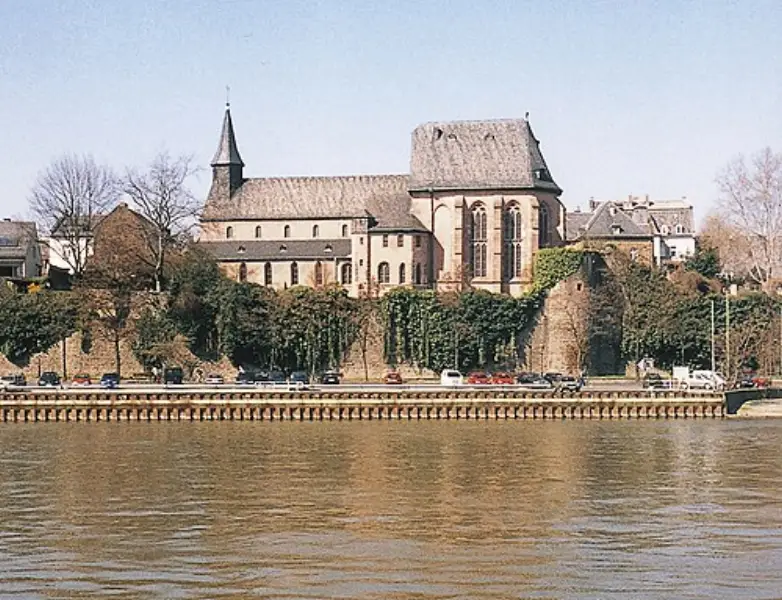
The memory of Justin endured at Rome long after his death: as late as the seventh century a separate church nearby was dedicated to him, though its site has not yet been rediscovered. His veneration traveled north with his relics. Bishop Hitto of Freising obtained them from Rome with the consent of Pope Gregory IV and brought them to his diocese — the territory of today's Archdiocese of Munich and Freising — where Freising Cathedral now houses them. In 834 Archbishop Otgar of Mainz, returning from a pilgrimage to the Seven Pilgrim Churches of Rome, brought some of Justin's relics home and built Saint Justin's Church at Höchst to enshrine them; that church still stands in Frankfurt-Höchst and bears his name. In 1298 the relics were moved again, to Saint Alban's Abbey in Mainz, and a portion came into the keeping of the monastery at the Einhard-Basilika in Seligenstadt. Through the Benedictines' care of the old parish of Wilmundsheim, Justin came to be venerated at Alzenau, whose present church has him as its patron, although his bones were never kept there. The Catholic Church celebrates his feast on 4 August and the Orthodox Church on 17 September.
§ Veneration
Timeline
- 257
Ordained a priest of the Roman Church by Pope Sixtus II, whose burial he would later oversee.
§ Life
- 269
Arrested by order of Emperor Valerian while attending a funeral and interrogated for leading the Christians of Rome.
§ Life
- 269
Beheaded at Valerian's command after refusing to forswear his Christian faith.
§ Life
- 269
Buried by his community in the coemeterium of St. Cyriaca on the Via Tiburtina.
§ Life
- 834
Archbishop Otgar of Mainz returned from a Roman pilgrimage with relics of Justin and built Saint Justin's Church in Höchst to house them.
§ Veneration
- 1298
The relics in Höchst were moved to Saint Alban's Abbey in Mainz, with portions reaching the monastery at the Einhard-Basilika in Seligenstadt.
§ Veneration
The Record
- Patron of
- Patron of the parish church of Alzenau
- Canonization
- Pre-congregation martyr, venerated since antiquity by the Roman Catholic and Eastern Orthodox Churches
Prayer
Bibliography
Show 3 sources
- Sauser, Ekkart (2003). "Justin the Confessor". In Bautz, Traugott (ed.). Biographisch-Bibliographisches Kirchenlexikon (BBKL). Vol. 21. Nordhausen: Bautz. col. 739. ISBN 3-88309-110-3.
- Schäfer, Joachim. "Justinus", Ökumenisches Heiligenlexikon, November 13, 2022.
- "Latin Saints of the Orthodox Patriarchate of Rome". www.orthodoxengland.org.uk. Retrieved 2024-07-31.
Profile text adapted from the Wikipedia article, licensed CC BY-SA 4.0.
Pray with this saint every day
Save St. Justin the Confessor to your favorites, read the full profile, and get feast-day reminders in the Saints app.
Get the Saints AppFree on the App Store for iPhone and iPad