
died c. 303·Feast October 7
St. Justina of Padua
Virgin martyr and patroness of Padua
Overview
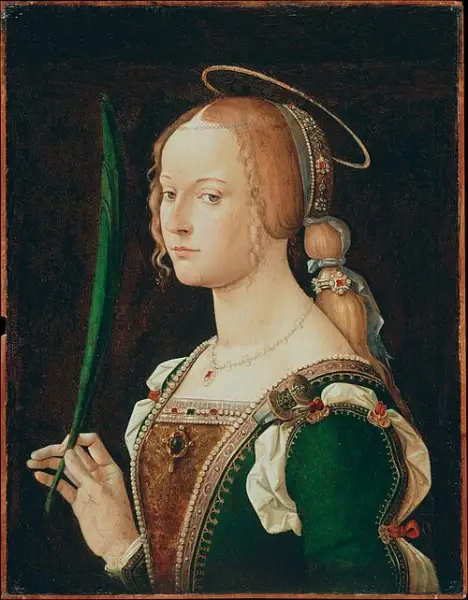
Justina of Padua is a Christian virgin martyr and one of the principal patronesses of the city of Padua, where her basilica remains among the great churches of northern Italy. According to her legend, she was born of noble parents in Patavium: her father Vitalian, a wealthy nobleman, served as prefect of the city; her mother and father, converted by the preaching of Prosdocimus, the first bishop of Padua, received her in answer to prayer after years without children. Devoted to religion from her earliest years, she took the vow of perpetual virginity. In the persecution waged by Diocletian and Maximian, her father's successor in the prefecture showed himself singularly cruel, and Justina made the prisons her mission, visiting the confined Christians to comfort and encourage them. Arrested by Maximian's order while passing the Pont Marin near Padua, she was brought before the prefect, who was struck by her beauty and tried by every means to break her constancy. Remaining firm, she was condemned and slain with the sword, traditionally in the year 303. Her tomb became the site of the Abbey of Santa Giustina, founded in the fifth century, and her cult spread through the Veneto, making her after Saint Mark the second patroness of Venice.
The Complete Life
A Child of Prayer in Patavium
The legend of Justina opens in Patavium, the Roman city on the Brenta that later generations would call Padua and whose patroness she became. Her father Vitalian, a wealthy nobleman, held the prefecture of the city — a man of standing whose household seemed to lack only one blessing: he and his wife had no children. That want was answered, the story tells, when Saint Prosdocimus, first bishop of Padua, won them for Christianity through his preaching, and they received their daughter in direct answer to their prayer. The child thus entered the world already framed as a gift from God to believing parents, and she repaid the gift in kind. From her earliest years she was devoted to religion, and as she grew to maturity she bound herself to Christ by the vow of perpetual virginity. In a noble household of the Roman empire, such a resolve set her apart from the expectations of marriage and succession, but the legend presents it as the natural flowering of the grace with which her life began. Scholars caution that the tales of her baptism by Prosdocimus rest on a document of 1117 now recognized as forged, and that she belongs to the age of the persecutions under Diocletian and Maximian rather than to the apostolic generation.
§ Hagiography
Comforter of the Prisoners
When the persecutions of Diocletian swept the empire, Padua fell under the authority of the prefect Maximian, who had succeeded Justina's father Vitalian in office and who distinguished himself by his brutality toward the Christians. Justina's response to the terror was not flight but presence. She made her way to the prisons where confessors of the faith were held, visiting them to comfort and encourage them, so that the daughter of the city's former prefect became a familiar figure among its condemned. This ministry of consolation could not long remain hidden. Maximian ordered her arrest, and the soldiers seized her as she passed the Pont Marin near Padua. Brought before the prefect, she encountered a different kind of assault: struck by her beauty, he sought by every means at his command to shake her constancy, preferring persuasion and seduction to the immediate violence he had shown her fellow believers. Against his blandishments she stood firm, and when every attack had failed the prefect abandoned pretense and ordered her slain with the sword. Art has fixed the image ever since: the young woman crowned as a princess, with the blade transfixing her bosom, her death dated by tradition to the year 303.
§ Hagiography
Martyrdom by the Pont Marin
The passio compresses the end of Justina's life into a single sustained trial of body and soul. Seized at the bridge outside Padua, she passed from the hands of the soldiers to the tribunal of Maximian, and from the tribunal to the place of execution, without ever yielding the virginity she had vowed or the faith she had professed since childhood. The prefect who condemned her had taken her father's place in the government of the city; the sword with which she was slain thus completed a succession grimmer than the one it interrupted. The Christians of Padua laid her body to rest, and her tomb became, within two centuries, the spiritual center of the city: the great abbey and basilica of Santa Giustina rose over it, founded in the fifth century, and in time the complex received the tombs of other saints as well, including Prosdocimus, Maximus, Urius, Felicitas, and Julian, together with relics of the Apostle Matthias and the Evangelist Luke. Paolo Veronese's vast canvas of her martyrdom hangs within the basilica that guards her remains. The girl who had comforted prisoners in the dark of the persecution now keeps her quiet court beneath the altars of one of the largest churches in Christendom.
§ Veneration
Ancient Cult of a Virgin Martyr
Justina's veneration is as old as the monumental Church itself. During the sixth century the people of Padua raised a church in her honor, and her figure appeared among the virgin martyrs in the presbytery arch of the Euphrasian Basilica at Poreč and in the procession of virgins mosaic in Sant'Apollinare Nuovo at Ravenna — two of the most celebrated decorative programs of early Byzantine Italy. In the seventh century the poet Venantius Fortunatus, writing from Gaul, urged travellers bound for Padua to visit her relics there, testimony that her fame had crossed the Alps within living memory of the ancient world. No formal act of canonization exists, for she belongs to the pre-congregation age in which the Church recognized martyrs by the unanimous voice of local cult, confirmed by tomb, altar, and feast. That her legend reached its medieval form through a forged document of 1117 has not disturbed this ancient standing: the forgery concerns the supposed discovery of her relics and her baptism by Prosdocimus, questions of chronology rather than of holiness. East and West alike keep her memory, the Catholic Church on 7 October, a date that in the rural Veneto fell together with the close of the grape harvest and the settling of agricultural contracts.
§ Veneration
Patroness of Cities
Few virgin martyrs of northern Italy have left so visible a mark upon their native region. Justina is the principal patroness of Padua, whose identity has been bound to her basilica for fifteen centuries; after Saint Mark she stands as second patroness of Venice, and Palmanova likewise claims her protection. Her feast on 7 October entered the civic as well as the liturgical calendar, marking the season when the grape harvest ended and the farmers of the Veneto settled their contracts for the year. The arts made her an enduring figure of the Italian imagination: Andrea Mantegna and Bartolomeo Montagna painted her, Moretto da Brescia set her beside the unicorn that symbolizes virginity in a canvas of about 1530, and Veronese gave the Abbey of Santa Giustina its monumental Martyrdom of Saint Justina. In Christian art she appears crowned as a princess, sword in breast, palm and book in hand, sometimes setting a cross upon the head of the devil. The abbey founded on her tomb, suppressed by Napoleon in 1810, was reopened in 1919 and remains a living monastery. Through basilica, painting, and feast, the virgin of Patavium continues to preside over the city that received her as an answer to prayer.
§ Iconography
Timeline
- 303
Seized by soldiers near the Pont Marin, condemned by the prefect Maximian, and slain with a sword for refusing to deny Christ.
§ Hagiography
- 500
The Paduans built a church in her honor, and she appeared among the virgin martyrs in the Euphrasian Basilica and Sant'Apollinare Nuovo.
§ Veneration
- 600
Venantius Fortunatus, composing his verses in Gaul, encouraged pilgrims bound for Padua to seek out her relics.
§ Veneration
- 1117
A spurious document asserted that her relics had come to light in Padua and that Prosdocimus had administered her baptism.
§ Hagiography
- 1810
The Abbey of Santa Giustina, built on her tomb, was suppressed under Napoleon.
§ Veneration
- 1919
The Abbey of Santa Giustina was reopened after more than a century of suppression.
§ Veneration
The Record
- Patron of
- Patroness of Padua·Second patroness of Venice·Patroness of Palmanova
- Symbols
- Crown and martyr's palm·sword transfixing her breast·lily·setting a cross on the head of the devil·unicorn symbolizing virginity·book·with Saint Prosdocimus
- Canonization
- Pre-congregation martyr, venerated since antiquity by the Roman Catholic and Eastern Orthodox Churches
Prayer
Bibliography
Show 6 sources
- Hinds, Allen Banks. "Saint Justina of Padua". A Garner of Saints, 1900. CatholicSaints.Info, 20 April 2017.
- Cheney, Liana De Girolami (September 2022). "Barbara Longhi's Saint Justina of Padua: Pagan Symbolism and Christian Martyrology". Journal of Cultural and Religious Studies. 10 (9): 464.
- Butler, Alban. "St. Justina of Padua, Virgin and Martyr", The Lives of the Saints. vol. X, 1866.
- Knapton, Michael, Law, John E., Smith, Alison. Venice and the Veneto during the Renaissance, Firenze University Press, 2014. ISBN 9788866556633.
- Stracke, Richard. "Saints Justina & Prodoscimus of Padua and Saints Justina & Cyprian of Antioch", ChristianIconography.info, University of Augusta.
- Wagner, Leopold. "Patron Saints and Their Attributes", Manners, Customs, and Observances, London, William Heineman, 1894.
Profile text adapted from the Wikipedia article, licensed CC BY-SA 4.0.
Pray with this saint every day
Save St. Justina of Padua to your favorites, read the full profile, and get feast-day reminders in the Saints app.
Get the Saints AppFree on the App Store for iPhone and iPad