
c. 482 – 565·Feast November 14
St. Justinian I
Byzantine emperor, lawgiver, and builder of Hagia Sophia
Overview
Justinian I, known as Justinian the Great, reigned as Roman emperor from 527 to 565 and stands among the most influential rulers of the late antique world. Born around 482 in the Dardanian hamlet of Tauresium, near modern Skopje, he rose through his uncle Emperor Justin I's court, married the actress-turned-empress Theodora, and mounted the throne in 527. His reign pursued the renovatio imperii, the restoration of the Empire: his generals Belisarius and Narses destroyed the Vandal kingdom in Africa, wrested Italy from the Ostrogoths, and established the province of Spania in southern Hispania, while his codification of Roman law, the Corpus Juris Civilis, remains the foundation of civil law in many modern states. He rebuilt Hagia Sophia after the Nika riots, founded the city of Justiniana Prima, fostered Byzantine art and letters, and intervened energetically in the Church, ending the Acacian schism and convoking the Fifth Ecumenical Council. His reign also knew catastrophe: fourteen years of Gothic war, the devastation of the Plague of Justinian, which he himself contracted and survived, and the death of Theodora in 548. Increasingly devout in old age, he passed away in his sleep on 14 November 565 and received burial in a golden tomb within the Church of the Holy Apostles. Eastern Christians honor him as a saint on the anniversary of his death.
The Complete Life
From Tauresium to the Palace
Justinian's birth came around 482 at Tauresium, a hamlet of the Dardanian province near the fortress of Bederiana and close to Justiniana Prima, the city he would later found. That birthplace is usually placed at the archaeological site of Gradište, beside the village of Taor, some twenty kilometers southeast of Skopje in present-day North Macedonia — an identification first proposed by Arthur Evans and later borne out by excavation. A peasant Latin-speaker from the Illyrian provinces, he owed his rise to his uncle Justin, a soldier of humble origin who mounted the imperial throne in 518. Under his uncle's patronage the young man climbed the palace hierarchy, and on Justin's accession he entered the arena of ecclesiastical politics, helping to end the Acacian schism that had divided Constantinople from Rome. In 525 he married Theodora, an actress of the Hippodrome whose intelligence and will would make her his most trusted adviser, an unconventional match for a future emperor. Contemporary sources already noted his keen interest in theological matters and his readiness to participate in debates on Christian doctrine. When Justin I died in 527, the nephew succeeded to the empire, determined from the outset to restore its ancient greatness.
§ Life
The Restoration of the Empire
Justinian conceived his reign as a renovatio imperii, a restoration of the Roman Empire, and pursued that ambition on every front. He never personally took the field, yet his generals recovered vast territories: Belisarius destroyed the Vandal kingdom of North Africa in a single campaign season beginning in 533, took Sicily in 535 and Rome in December 536, and in 540 entered Ravenna, the Gothic capital. When the war renewed under Totila, Narses finished the work, breaking the Ostrogoths at Busta Gallorum in 552 and defeating a Frankish invasion at Casilinum in 554, while a small force seized the southeastern coast of Hispania to create the province of Spania. In 555 the empire reached its greatest territorial extent since the fall of the West, its annual revenue raised to some six million solidi. The cost was immense. His throne nearly fell to the Nika riots of January 532, suppressed in the Hippodrome with terrible slaughter; the wars with Persia under Khosrow I drained the treasury; and the Goths laid Italy waste in a struggle lasting nearly two decades. Yet the ambition was sustained by an unshakable conviction of his own sacred office: he stands as the first emperor to assert in law that, by God's authority, the law had taken flesh in his own person.
§ Military activities
The Corpus of Civil Law
The most enduring monument of Justinian's reign was legislative. He appointed the quaestor Tribonian to oversee a complete revision of all Roman law, an undertaking never before attempted. The first draft of the Codex Justinianeus, gathering imperial constitutions from the second century onward, appeared on 7 April 529; the Digesta, compiling the writings of the classical jurists, and the Institutiones, a textbook of legal principles, followed in 533; a revised Codex appeared in 534, and the Novellae collected the new laws of his own reign, written in the Greek of the Eastern Empire. Together these form the Corpus Juris Civilis, which ensured the survival of Roman law, became the basis of later Byzantine law, and, passing to Western Europe in the twelfth century through Italy, furnished the foundation of Continental civil law carried across the world by the European empires. The legislation itself displayed a distinctive moral concern: divorce was restricted, prostitutes were protected from exploitation, widows recovered their dowries, children received new safeguards against neglect, and slaves obtained the right to plead in person for their freedom, a master who killed his slave being guilty of murder. Other laws, harsher in spirit, punished heretics, pagans, Jews, and Samaritans, for the emperor held that unity of faith underpinned the empire's unity.
§ Legislative activities
Emperor of the Church
Religion stood at the center of Justinian's understanding of rule, and in later life his devotion deepened into preoccupation. He sought religious unity through a Chalcedonian faith embraced by all, persecuting Miaphysite bishops and monks at one moment and offering doctrinal compromise at the next, while the empress Theodora, herself a Miaphysite, sheltered the dissidents. He promoted the cult of the Archangel Michael as imperial protector, built churches in his honor, and wove him into imperial oaths and iconography. His ecclesiastical interventions were far-reaching: he ended the Acacian schism, settled papal elections, condemned the Three Chapters, and brought Pope Vigilius to Constantinople, where the Fifth Ecumenical Council gave its assent to the emperor's demands — a victory that nevertheless bred new schism in the West and failed to win over the East. As a builder he served the faith with stone and gold: Hagia Sophia arose above the ashes of the riot-burned basilica, the Church of the Holy Apostles was rebuilt, Saints Sergius and Bacchus was raised by the imperial couple, and fortifications, cisterns, and the Sangarius Bridge secured the empire's material life. He wrote theological treatises himself, and in his final years he grew less ruthless, pardoning conspirators and displaying an old man's Christian charity.
§ Religious activities
Old Age, Plague, and Death
The last years of the reign were marked by isolation, disaster, and a certain softening of the imperial temper. Justinian relied on a small circle of advisers, many of whom he had gathered around him nearly forty years earlier, and he became increasingly fixated on religion, convinced that his actions, however severe, served a higher cause. Catastrophes pressed upon him from every side. The plague of 541 to 543 carried off a vast part of the population, and the emperor himself contracted the disease and recovered; the famine that followed the extreme weather of 535 and 536 had no recorded precedent; the Beirut earthquake of 551 and its tsunami killed tens of thousands. Theodora died in 548, and Justinian outlived her by nearly twenty years, childless. After a major earthquake in 557 he set aside his crown and gave to the poor as an act of penance. In 562 a conspiracy against his life was discovered, yet he refused to execute the plotters, pardoning even Belisarius, who stood accused of complicity. He died in his sleep on the night of 14 November 565, mourned across the capital, and found his resting place in a golden tomb within the Church of the Holy Apostles, whence soldiers of the Fourth Crusade would violate his remains in 1204.
§ Death
Saint Among the Eastern Christians
Though no formal process of canonization was ever conducted, Justinian has been widely regarded as a saint by Eastern Christians from an early period, honored for his defense of the faith and his buildings rather than for a martyr's death. In various Eastern Orthodox Churches, including the Orthodox Church in America, he and his empress Theodora are commemorated together on 14 November, the anniversary of his death; in the Eastern Churches that follow the Julian calendar the feast falls on 27 November. His memory likewise appears on 14 November in the Calendar of Saints of the Lutheran Church–Missouri Synod and of the Lutheran Church–Canada, a rare ecumenical tribute to a Byzantine basileus. His sanctity was argued from his works: the cathedral of Hagia Sophia, the codification of the law, the founding of churches from Ravenna to the borders of Ethiopia, and his lifelong attention to doctrine. Contemporaries saw another side, and Procopius in his Secret History depicted a cruel and demonic ruler; but the liturgical memory of the East fixed upon the pious lawgiver. In iconography he stands in the mosaic of Hagia Sophia offering his church to the enthroned Mother of God, an image of the emperor as forever the donor at the door of heaven.
§ Veneration
The Long Shadow of the Lawgiver
Few rulers have shaped subsequent civilization so durably. The Corpus Juris Civilis became the basis of most legal systems of continental Europe and, through empire and conquest, of legal orders across the Americas and beyond; the Basilika of Basil I and Leo VI carried it through the Byzantine world, and Slavic editions carried it further east. Hagia Sophia remained for nearly a thousand years the greatest church in Christendom and still crowns the skyline of Istanbul. Dante placed him in the sphere of Mercury in the sixth canto of the Paradiso, where the spirit of Justinian confesses that glory in life is ephemeral while service of God's glory is eternal, and uses him to rebuke the factious politics of medieval Italy. Historians have judged him variously: some see a ruler who dangerously stretched the empire's resources against the realities of the sixth century, others note that Africa and southern Italy substantially paid for themselves and that the conquests enlarged Byzantine influence over the papacy. Novelists and filmmakers from Robert Graves to Orson Welles have recast his story, and the modern states of the Balkans claim his birthplace with monuments. The empire lost much of Italy within a generation of his death, yet the law, the cathedral, and the saintly memory endured.
§ Cultural depictions
Timeline
- 482
Born at Tauresium, a hamlet of the Dardanian province — so reports his contemporary Procopius.
§ Life
- 518
Entered the arena of ecclesiastical conflicts after his uncle Justin I's accession, helping end the Acacian schism.
§ Religious relations with Rome
- 525
Married Theodora, who became his partner in government and adviser until her death.
§ Life
- 527
Succeeded Justin I as Roman emperor.
§ Reign
- 7 Apr 529
Published the first draft of the Codex Justinianeus, a collection of imperial constitutions compiled under Tribonian's direction.
§ Legislative activities
- 529
Closed the Neoplatonic Academy in Athens.
§ Authoritarian rule
- Jan 532
Faced the Nika riots, crushing the revolt in the Hippodrome with his generals Belisarius and Mundus.
§ Nika riots
- 14 Sep 533
Belisarius defeated the Vandals at Ad Decimum and took Carthage, beginning the conquest of North Africa.
§ Conquest of North Africa, 533–534
- 534
Published the final version of the Codex Justinianeus.
§ Legislative activities
- 9 Dec 536
Belisarius captured Rome from the Ostrogoths during the first phase of the Gothic War.
§ War in Italy, first phase, 535–540
- 26 Dec 537
Celebrated the completion of the new Hagia Sophia, declaring, according to Pseudo-Codinus, that he had outdone Solomon.
§ Architecture, learning, art and literature
- 541
Discontinued the regular appointment of Consuls and granted a monopoly on silk manufacture to the imperial factories.
§ Economy and administration
- 542
Contracted and survived the bubonic plague later known as the Plague of Justinian.
§ Natural disasters
- 548
Theodora, his empress, died while still comparatively young, perhaps from cancer.
§ Life
- Jun 552
Narses defeated the Ostrogoths at the battle of Busta Gallorum, where Totila was slain.
§ War in Italy, second phase, 541–554
- 554
A Frankish invasion met defeat at Casilinum, securing Italy for the empire; the Pragmatic Sanction extended his code there.
§ War in Italy, second phase, 541–554
- 24 Dec 562
Attended the second inauguration of Hagia Sophia after reworks by Isidore the Younger.
§ Architecture, learning, art and literature
- 14 Nov 565
Died childless in his sleep at Constantinople and received burial in a golden tomb within the Church of the Holy Apostles.
§ Death
- 1204
His tomb was violated and plundered when the armies of the Fourth Crusade sacked Constantinople.
§ Life
In Their Own Words
Solomon, I have outdone thee
Cesare fui e son Iustinïano
The Record
- Major works
- Corpus Juris Civilis (Codex Justinianeus, Digesta, Institutiones, Novellae)·Theological treatises preserved in Migne's Patrologia Graeca, Vol. 86·Founding of the city of Justiniana Prima·Rebuilding of Hagia Sophia
- Symbols
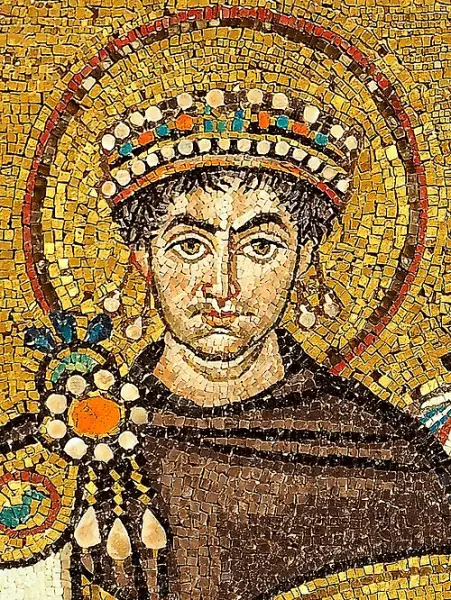
- Shown in the mosaics of San Vitale in Ravenna with his court·Offering a model of the Hagia Sophia in the 10th-century Hagia Sophia mosaic
- Canonization
- Widely regarded as a saint by Eastern Christians; commemorated without formal canonization in the Orthodox Church and by some Lutherans
Prayer
Bibliography
Show 7 sources
- Bury, J. B. (1958). History of the Later Roman Empire from Arcadius to Irene. Cosimo, Inc. ISBN 1605204056.
- Moorhead, John (1994). "Justinian I". In Dictionary of the Middle Ages, volume VII.
- Treadgold, Warren (1997). A History of the Byzantine State and Society. Stanford University Press.
- Maas, Michael (ed.) (2005). The Cambridge Companion to the Age of Justinian. Cambridge University Press. ISBN 978-1139826877.
- Procopius. Buildings. IV. i. 16–24.
- Sarris, Peter (2023). Justinian: Emperor, Soldier, Saint. London: Basic Books. ISBN 9781529365399.
- Norwich, John Julius. Byzantium: The Early Centuries.
Profile text adapted from the Wikipedia article, licensed CC BY-SA 4.0.
Pray with this saint every day
Save St. Justinian I to your favorites, read the full profile, and get feast-day reminders in the Saints app.
Get the Saints AppFree on the App Store for iPhone and iPad