
6th century·Feast December 5
St. Justinian of Ramsey Island
Breton hermit and confessor of St David
Overview
Justinian, known in Welsh as Stinan, Jestin, or Iestin, was a sixth-century hermit who lived on Ramsey Island off the Pembrokeshire coast near St David's in Wales. Tradition makes him a Breton nobleman who abandoned his native land for the solitary life, settling on the island as a hermit and practicing extraordinary ascetic discipline, standing for hours in the cold sea as a means of fixing his mind upon God. His reputation for holiness drew the attention of Saint David himself, patron of Wales, who sought out the hermit and found him so impressive that he took Justinian for his confessor and named him abbot of the monastery on the mainland. Finding the lax spirit of the monks there disheartening, Justinian withdrew the short distance to remote Ramsey Island to gather a stricter spiritual community, his more loyal brethren following after him. Legend recounts that his severity eventually cost him his life: servants or monks exasperated by his strict regime murdered him, decapitating him. His miracle legend says he carried his severed head across Ramsey Sound, walking upon the water, to the mainland chapel of St Justinian's, where his body was buried; his bones were afterwards translated to St David's Cathedral, where his shrine stood until the Reformation.
The Complete Life
A Nobleman of Brittany Becomes a Hermit
The Justinian of Welsh tradition began his life in Brittany, across the Channel in that peninsula of saints which gave so many missionaries to the British Church. He is described as a nobleman, a man of rank who possessed whatever advantages Brittany offered in the sixth century, and who relinquished them all for an island. Ramsey Island lies off the Pembrokeshire coast near St David's, remote enough for the solitary life yet within sight of the great monastic center that the Welsh saint David had made famous. There Justinian settled as a hermit, and the tradition preserves one striking detail of his asceticism: he would stand in the cold sea at prayer for hours, convinced that the extreme discipline helped him fix his mind upon God. In an age when the sea was regarded with superstitious dread, to make the freezing water a chapel of prayer was an act of both courage and devotion. The hermit's fame traveled the short distance to the mainland, and it was precisely this reputation for holiness that brought about the encounter which changed the course of his life: a visit from Saint David himself, the principal patron of the Welsh Church.
§ Traditional life
Severity in Service of Prayer
Everything recorded of Justinian's spirituality belongs to the ascetic tradition of the Celtic Church. His standing in the sea expresses a conviction that the body's comfort must be subdued if the mind is to hold fast to God, and the legend presents the practice not as eccentricity but as method: the extreme discipline was believed to help him focus on God. When he was called from solitude to govern others as abbot of the monastery at St David's, the same severity marked his rule. He grew disillusioned with the monks' poor attitude, finding among them a laxity intolerable to a man who had renounced a nobleman's ease for the discipline of a rock in the sea, and rather than lower the standard he crossed to Ramsey Island, seeking to found a holier spiritual community; his more loyal monks went with him. The hagiographic tradition is candid about the price of such rigor: it records that servants or monks aggrieved by his strict regime became his murderers. In the economy of the legend the martyrdom is not an embarrassment but a seal, the proof that the saint's demands for holiness were of the kind that the lukewarm cannot endure and the serious soul counts as life itself.
§ Traditional life
Confessor to Saint David
The central episode of Justinian's public life was his association with Saint David, apostle of Wales. Tradition tells that David came to visit the hermit on Ramsey Island and, struck by his holiness, took him for his confessor and set him over the mainland monastery as abbot. For the patron saint of Wales to choose a Breton immigrant as the father of his soul testifies both to the intimacy of the ties between Brittany and Wales and to the esteem Justinian's asceticism commanded. As confessor he heard the saint's sins — the tradition assumes that even the greatest of the Welsh saints did not exempt himself from the examen of another — and as abbot he bore responsibility for the community from which Welsh Christianity radiated. His disappointment with the monks' attitude, and his withdrawal across the sound to a stricter foundation, completed the pattern: the hermit served the Church when called upon, but never allowed office to dissolve his vocation. Ramsey Island under Justinian became a small sister-foundation to the great monastery, a place where the severest form of the spiritual life could be lived a short sail from the cathedral city that David's fame would make the religious capital of Wales.
§ Traditional life
Martyrdom and the Miracle of the Sound
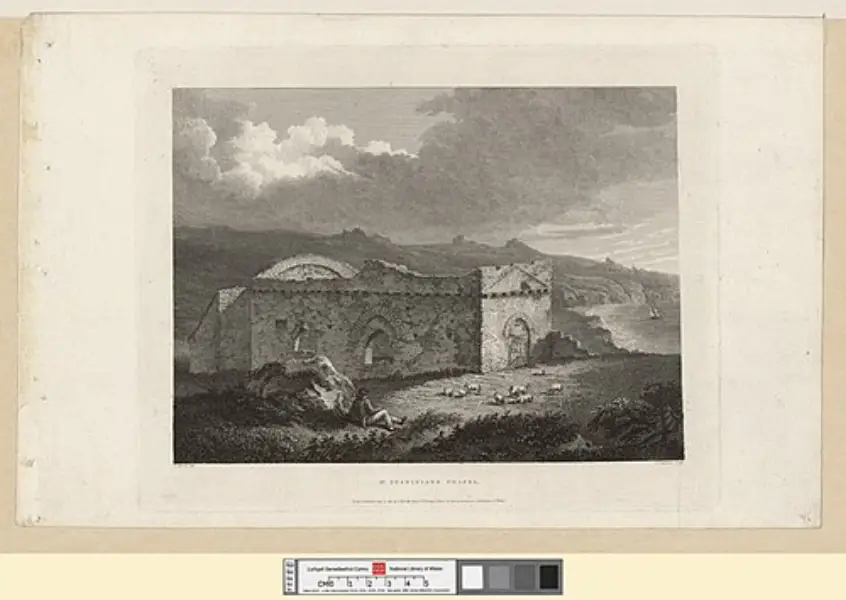
The tradition of Justinian's death belongs to the familiar type of the decapitated saint whose body performs one last marvel. Exasperated servants or monks, worn down by his strict regime, are said to have murdered him by beheading. The legend then recounts how the holy man lifted his severed head and crossed Ramsey Sound over the sea, his head borne in his arms, until he reached the mainland opposite his island home. There, at the place now called St Justinian's, his body was buried in a small ruined chapel that still stands facing the island; the miracle thus served to fix the site of his grave and, with it, the destination of pilgrims for centuries. His bones were afterwards moved to St David's Cathedral, the shrine church of his friend and penitent. There they remained, an object of devotion with the relics of David himself, until the Reformation: in 1538 Bishop William Barlow, an ardent opponent of the veneration of relics and pilgrimages, emptied the saint's shrine of its jewels and carried off the relics of both St David and St Justinian, in order to counteract what he called superstition. With that act the bodily memory of the hermit of Ramsey passed out of record.
§ Traditional life
Island, Chapel, and Holy Well
Justinian's cult is old and firmly rooted in the landscape of Pembrokeshire. His name figures on Welsh calendars of saints and martyrs of great antiquity, and his feast is kept on 5 December in the Roman Catholic, Anglican, and Orthodox traditions. Archaeological study has identified an early medieval ecclesiastical site on Ramsey Island, with a chapel dedicated to him thought to have stood at its southerly end. On the mainland the little chapel at St Justinian's, beside the bay called Porthstinian, marks where his body was said to rest; from its landing place the boats still depart for the island. The district of St Davids known as St Justinian bears his name, together with St Justinian's Well, a nineteenth-century stone enclosure raised over an ancient spring whose waters pilgrims once sought. His cult spread beyond Pembrokeshire: the church of St Just in Roseland is named for him, and the Anglican churches at Llanstinan near Fishguard and at Freystrop near Haverfordwest are dedicated to him. The Orthodox Church venerates him as Hieromartyr Justinian of Ramsey Island. Few Welsh saints have left so continuous a presence upon one small corner of the coast, where island, sound, chapel, and well all keep the memory of the Breton who prayed in the sea.
§ Veneration
The Record
- Canonization
- Pre-congregation confessor, listed on very ancient Welsh calendars of saints and martyrs
Prayer
Bibliography
Show 6 sources
- Horstman, C. (1901). Nova Legenda Angliae. Vol. II. pp. 93–95.
- Farmer, David (1978). Oxford Dictionary of Saints. Clarendon Press. pp. 228–229.
- "Who is St Justinian?", St. David's Cathedral.
- "St Tyfanog's Chapel, Chapel Site, Ramsey Island Farm (419235)". Coflein. RCAHMW. Retrieved 29 September 2021.
- Cadw. "St Justinian's Well (Grade II) (12693)". National Historic Assets of Wales.
- "St Justinian's Church, Llanstinian (231)". Coflein. RCAHMW.
Profile text adapted from the Wikipedia article, licensed CC BY-SA 4.0.
Pray with this saint every day
Save St. Justinian of Ramsey Island to your favorites, read the full profile, and get feast-day reminders in the Saints app.
Get the Saints AppFree on the App Store for iPhone and iPad