
died between 627 and 631·Feast November 10
St. Justus
Gregorian missionary and Archbishop of Canterbury
Overview
Justus, fourth holder of the archiepiscopal throne at Canterbury, died on 10 November in a year somewhere from 627 to 631. He ranked among the Italians whom whom Pope Gregory the Great sent to convert the Anglo-Saxons from their native paganism. He probably reached England with the second band of missionaries dispatched in 601, bearing with them books and all that was needed for worship. In 604 Augustine of Canterbury consecrated him the first bishop of Rochester, where King Æthelberht raised a cathedral and granted his church land by a charter that still survives. With Mellitus of London he signed Archbishop Laurence's letter urging the Irish church to accept the Roman reckoning of Easter, and in 614 he crossed to attend the Council of Paris. When Æthelberht died in 616 a pagan backlash drove him to Gaul; the next king restored him by 617. Raised to the archbishopric in 624, he received the pallium from Pope Boniface V, consecrated Romanus at Rochester and Paulinus at York, and dispatched the mission that carried Christianity into Northumbria. Venerated soon after his death, his remains were translated to a shrine in St Augustine's Abbey in the 1090s.
The Complete Life
From Italy with the Second Mission
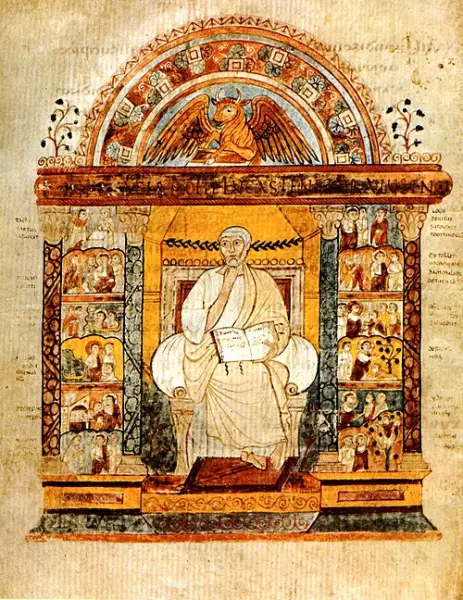
Nothing certain survives of Justus's life before England: Bede, our nearly only witness, says nothing of his origins, and everything about him begins with Pope Gregory's great plan for the conversion of the Anglo-Saxons. Almost all modern writers who make him one of the original companions of Augustine in 597 go beyond their source, for Bede believed he belonged to the second band of missionaries, dispatched in 601 at Augustine's request. That second group included Mellitus, the future bishop of London and archbishop of Canterbury, and its luggage held, as Bede notes, everything the worship and service of the Church required. Among the treasures of that shipment may have been books that medieval Canterbury treasured; a fifteenth-century chronicler, Thomas of Elmham, asserted that some volumes brought by the missionaries could still be seen in his day, and scholars have suggested that the St Augustine Gospels, now in Corpus Christi College, Cambridge, might be one of them. If that identification holds, the Gospel book that may have crossed the North Sea in Justus's company is still used to swear in new archbishops of Canterbury, a living thread to the mission he served.
§ Arrival in Britain
Bishop at Rochester
In 604 Augustine consecrated Justus a bishop over the province centered on the Kentish town of Rochester. The choice owed less to any Roman episcopal pedigree than to contemporary politics: Rochester was small, a one-street town, but it stood where Watling Street met the estuary of the Medway, fortified and strategic, and Æthelberht built the new bishop a cathedral church there. A charter dated 28 April 604, purporting to be the king's grant of land near Rochester to Justus's church, survives in the Textus Roffensis; its authenticity was doubted by Wilhelm Levison but defended by John Morris, who judged its titles and phraseology too archaic for forgery. The church Justus served was dedicated to Saint Andrew, and his cathedral clergy were probably not monks, for Bede never calls him one. From Rochester he joined the wider cause of Roman observance, signing, together with Mellitus, the letter of Archbishop Laurence to the Irish bishops that urged the Irish church to reckon Easter by the Roman tables, a letter that also complained of Irish missionaries who would not share the Roman party's table. In 614 he traveled farther still, to the Council of Paris held by Chlothar II, sent, some think, to negotiate for Kentish interests in a shifting Frankish politics.
§ Bishop of Rochester
Exile, Return, and the Pallium
The death of King Æthelberht in 616 brought the young Kentish church to the edge of collapse. His son Eadbald's relapse into paganism let loose a backlash that drove both Justus and Mellitus across the Channel to Gaul; the exiles probably took refuge with Chlothar II, hoping the Frankish king would restore them by force. The hope proved unnecessary: by 617 the new king had reinstalled Justus in his bishopric, though Mellitus could not regain London and passed instead to the see of Canterbury. From Pope Boniface V Justus received letters of encouragement, the pope judging the hard-won mission worth a personal word. The decisive turn of his career came in 624, when he succeeded Mellitus as archbishop of Canterbury and received the pallium from the same pope, the badge of metropolitan jurisdiction. The letter that accompanied it congratulated him on the conversion of a king of Kent, and scholars still argue whether the Aduluald it names was Eadbald himself, converted perhaps by Justus rather than by Laurence as Bede tells it, or the under-king Æthelwald. With his authority secured Justus consecrated Romanus to Rochester and Paulinus to York, and it was Paulinus who went north with Æthelburg of Kent to the court of Edwin, carrying the faith into Northumbria.
§ Archbishop
Death and the Shrine at St Augustine's
Bede records that Justus died on 10 November, without a year; chronologists place the death between 627 and 631, after an archiepiscopate of some three to seven years. Veneration followed quickly, as it had for his fellow missionaries: the church kept his feast on the day of his death, and the ninth-century Stowe Missal lists his name in the canon alongside Mellitus and Laurence, an early witness that all three Italian bishops of Canterbury were honored as saints together. In the 1090s, when the abbey of St Augustine at Canterbury rebuilt and reorganized the tombs of its founders, his remains were translated to a shrine beside the high altar, and his grave there is still marked. The same revival of memory produced literature: Goscelin composed a Life of Justus, and Reginald of Canterbury a poem in his honor. Later medieval chroniclers, Thomas of Elmham, Gervase of Canterbury, and William of Malmesbury among them, added little to Bede's sober account, which remains the backbone of everything known about him. Together these witnesses show a cult continuous from the seventh century to the Norman rebuilding of the abbey and beyond.
§ Archbishop
The Mission Remembered
Justus belongs to the small company of men whose obedience created the English church, and his particular contribution was durability through crisis. The Gregorian mission might have ended with Æthelberht's death; that it survived, and within a generation sent Paulinus north to convert Edwin of Northumbria, was in part the work of the exiled bishop who came back to Rochester and the archbishop who sent the faith onward from Canterbury. Medieval England never forgot him. His feast of 10 November was kept across the churches that looked to Canterbury, his shrine in St Augustine's Abbey drew the faithful until the Abbey's dissolution, and his image in art settled into a fixed type: an archbishop carrying the primatial cross, the sign of the office he held. Modern lists of the bishops of Rochester begin with him, and the archiepiscopal succession of Canterbury counts him fourth, between Mellitus and Honorius. Anglican, Roman Catholic, and Orthodox calendars alike commemorate the missionary who served one of the shortest recorded, and most consequential, archiepiscopates in English history. Few of the mission's members appear so briefly in the sources and yet stand so firmly in the succession that their work made possible.
§ Archbishop
Timeline
- 601
Probably landed in England as part of the second missionary band sent at Augustine's urging
§ Arrival in Britain
- 604
Consecrated by Augustine of Canterbury as the first bishop of Rochester
§ Bishop of Rochester
- 28 Apr 604
Received a charter of land near Rochester from King Æthelberht, recorded in the Textus Roffensis
§ Bishop of Rochester
- 614
Attended the Council of Paris convened by the Frankish king Chlothar II
§ Bishop of Rochester
- 616
Fled to Gaul after the death of King Æthelberht of Kent unleashed a pagan backlash
§ Bishop of Rochester
- 617
Reinstalled in the bishopric of Rochester by the new king of Kent
§ Bishop of Rochester
- 624
Elevated to the archbishopric of Canterbury and received the pallium from Pope Boniface V
§ Archbishop
- 1090
Body moved to a new shrine by the high altar of St Augustine's Abbey in Canterbury
§ Archbishop
The Record
- Major works
- Letter to the Irish bishops on the Roman computus, signed jointly with Mellitus under Archbishop Laurence
- Symbols
- Archbishop carrying a Primatial cross
- Canonization
- Pre-congregation, prior to the formal canonisation process
Prayer
Bibliography
Show 9 sources
- Bede (1988). A History of the English Church and People. Translated by Sherley-Price, Leo. New York: Penguin Classics. ISBN 0-14-044042-9.
- Blair, Peter Hunter (1990) [1970]. The World of Bede (Reprint ed.). Cambridge, UK: Cambridge University Press. ISBN 0-521-39819-3.
- Brooks, Nicholas (1984). The Early History of the Church of Canterbury: Christ Church from 597 to 1066. London: Leicester University Press. ISBN 0-7185-0041-5.
- Farmer, David Hugh (2004). Oxford Dictionary of Saints (Fifth ed.). Oxford, UK: Oxford University Press. ISBN 978-0-19-860949-0.
- Higham, N. J. (1997). The Convert Kings: Power and Religious Affiliation in Early Anglo-Saxon England. Manchester, UK: Manchester University Press. ISBN 0-7190-4827-3.
- Hunt, William; Brooks, N. P. (2004). "Justus (St Justus) (d. 627x31)". Oxford Dictionary of National Biography (October 2005 revised ed.). Oxford University Press.
- Stenton, F. M. (1971). Anglo-Saxon England (Third ed.). Oxford, UK: Oxford University Press. ISBN 978-0-19-280139-5.
- Wallace-Hadrill, J. M. (1988). Bede's Ecclesiastical History of the English People: A Historical Commentary. Oxford Medieval Texts. Oxford, UK: Clarendon Press. ISBN 0-19-822269-6.
- Yorke, Barbara (1997). Kings and Kingdoms of Early Anglo-Saxon England. New York: Routledge. ISBN 0-415-16639-X.
Profile text adapted from the Wikipedia article, licensed CC BY-SA 4.0.
Pray with this saint every day
Save St. Justus to your favorites, read the full profile, and get feast-day reminders in the Saints app.
Get the Saints AppFree on the App Store for iPhone and iPad