
c. 278 – c. 287·Feast October 18
St. Justus of Beauvais
Child martyr and cephalophore of Gaul
Overview
Justus of Beauvais belongs to the company of child martyrs whose cults flowered in Roman Gaul. Tradition sets his birth at Auxerre around 278 and his death around 287, when he was only nine years old. The story preserved of him tells of a journey undertaken with his father to Amiens, where the family sought to buy freedom for a kinsman held in prison, in the persecution launched by Diocletian. Along the way the boy was denounced as a Christian. Questioned, he would not disclose where his father and uncle lay hidden, and freely confessed himself a Christian, and for this he was put to death. From his execution grew one of the strangest and most beloved legends of medieval France: the tale that the beheaded child rose, lifted his own head, and continued to speak, converting the pagans who watched. The miracle was located on the road between Beauvais and Senlis, at a place that still bears his name, Saint-Just-en-Chaussée. His cult spread through France, Belgium, and Switzerland, reached England, and left his relics claimed by churches from Winchester to Zutphen.
The Complete Life
A Journey That Became a Witness
The boy who became one of Gaul's most storied martyrs was born at Auxerre around 278, in a family of Gallo-Roman Christians living under the gathering shadow of imperial persecution. The tradition that shaped his cult remembers him chiefly through a single journey. His father set out for Amiens on an errand of family loyalty, hoping to ransom or rescue a relative who was being held in prison, and he took his nine-year-old son with him. It was on this road that the family's faith became known. Whether through denunciation or discovery, word reached the authorities that the travelers were Christians and that members of the household were in hiding. The child was questioned apart from the adults. He might have saved himself by silence, and he might have cost the lives of his father and uncle by speech; he chose instead to acknowledge Christ openly while revealing nothing of where his kinsmen lay concealed. That double fidelity, to God and to family, is the whole of what the sources record of his short life, and it is enough to explain the affection with which later generations told his story.
§ History
Martyrdom and the Legend of the Head-Carrier
For his confession Justus was condemned and beheaded, in the persecutions that Diocletian's Edict let loose upon the church. The place of his execution was fixed by tradition on the road between Beauvais and Senlis, where the town of Saint-Just-en-Chaussée still keeps his name. There, however, the story refuses to end, for his legend makes him the most famous of the cephalophores, the head-carriers of medieval sanctity. When the sword had fallen, the child's body is said to have risen, gathered up the severed head, and gone on speaking. Later elaborations of the tale gave that uncanny speech a purpose: the headless boy preached as he walked, and the pagans who had come to watch an execution went away converts instead. Modern readers rightly class such stories with the legendary embroidery that gathered around many early martyrs, and scholars note that in some regions his story was mingled with the cults of other martyrs, Justin of Paris among them. But the legend itself is a form of memory: it declares that a voice which confessed Christ could not be silenced by the executioner's blade.
§ History
Relics from Winchester to Zutphen
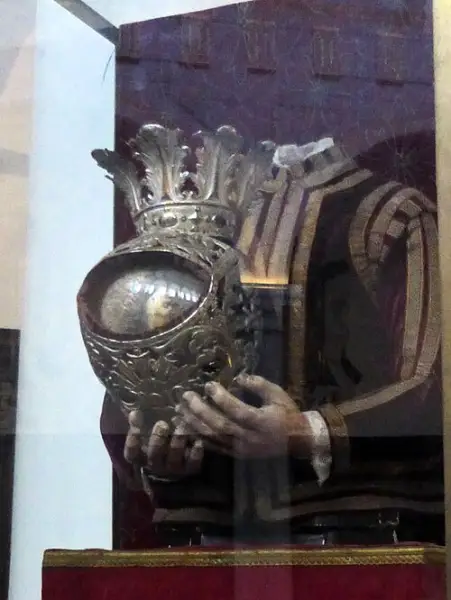
Veneration for the child martyr reached far beyond the fields where he died. Churches across France, Belgium, and Switzerland honored him, and towns named Saint-Just looked to him as their patron; his cult crossed the Channel into England as well. Winchester claimed a share of his relics from the tenth century, and the Annales monasterii de Wintonia records that in 924 Athelstan gave the martyr's head to the abbey treasury, though one scholar has suggested the gift may have been only a fragment. In the first half of the eleventh century the diocese of Chur in Switzerland received relics of its own, while the abbey of Malmedy in Belgium maintained that its monks had purchased the body outright at the start of the tenth century, a claim contested by Saint-Riquier. Farther north, Zutphen honored relics from at least the fourteenth century, probably from the eleventh. Around 1450 the Franciscans brought the skull there, and a confraternity in honor of Ewald and Justus followed in 1454. When Protestant rebels burned the friars' house in June 1572, the skull was carried out of the flames and later taken by a priest to Antwerp, where it remains in the Carolus Borromeus church.
§ Veneration
Timeline
- 278
Born at Auxerre, according to the traditional dating of his life
§ Introduction
- 287
Executed for confessing the Christian faith at the place between Beauvais and Senlis now called Saint-Just-en-Chaussée
§ History
- 924
Athelstan donated the martyr's head to the treasury of Winchester, as the Annales monasterii de Wintonia records
§ Veneration
- 1450
Franciscans establishing themselves at Zutphen brought with them a relic of the saint's skull
§ Veneration
- 1454
Brethren of Zutphen formed a confraternity honoring Ewald and Justus
§ Veneration
- Jun 1572
Friars' house set afire in the rebel assault on Zutphen; the skull was carried out to safety
§ Veneration
The Record
- Symbols
- Palm of martyrdom·Depicted as a young boy
- Canonization
- Pre-congregation; ancient cult venerated across France, Belgium, and Switzerland
Prayer
Bibliography
Show 5 sources
- "Justin of Beauvais", Saint of the Day, St. Patrick's Catholic Church. Archived from the original on 2012-11-01. Retrieved 2012-02-22.
- "Justus of Beauvais", The Oxford Dictionary of Saints. Oxford: Oxford University Press.
- "San Giusto". Santiebeati.it, 2004-03-01. Retrieved 2011-08-05.
- Groothedde, Michel. "Een vorstelijke palts te Zutphen? Macht en prestige op en rond het plein 's-Gravenhof van de Karolingische tijd tot aan de stadsrechtverlening". universiteitleiden.nl (in Dutch). pp. 298-304. Retrieved 2025-01-12.
- Debra Lacoste. "CANTUS: About the Manuscripts Indexed". Publish.uwo.ca. Archived from the original on 2011-07-20. Retrieved 2011-08-05.
Profile text adapted from the Wikipedia article, licensed CC BY-SA 4.0.
Pray with this saint every day
Save St. Justus of Beauvais to your favorites, read the full profile, and get feast-day reminders in the Saints app.
Get the Saints AppFree on the App Store for iPhone and iPad