
died 2 November 293·Feast November 2 (observed November 3)
St. Justus of Trieste
Martyr by drowning and patron of Trieste
Overview
Justus of Trieste, called in Italian San Giusto, is remembered as the martyr whose body gave the city its cathedral and whose name stands over its harbor. His passio, the narrative of his trial and passion, presents a townsman of Trieste whose good works and charity made him known. When his fellow citizens brought charges against him as a Christian, he was tried under Roman law; his refusal to worship the gods of Rome brought a verdict of sacrilege and a sentence of drowning. The executioners rowed him out over the Gulf of Trieste and tipped him from their boat near the headland now named Sant'Andrea, with weights bound to his body. That same night, tradition says, the priest Sebastian was told in a dream where the body had come ashore; the faithful found it on what is today the Riva Grumula and buried it near the water. In the Middle Ages his remains were moved to a chapel beside the church of Mary Mother of God, and when chapel and church were joined, the cathedral took his name. He is honored on 2 November, a date carried back in the ninth-century Verona codex, and he is patron of the city and diocese of Trieste and of towns in Istria and Sicily.
The Complete Life
A Citizen Known for Good Works
The passio that preserves Justus's memory introduces him not as a cleric but as a citizen: a man of Trieste, known to his neighbors for good works and for the charity he practiced among them. The detail matters, for it presents the early martyr as a lay Christian whose faith was visible first in ordinary civic life, in almsgiving and service rendered openly in a pagan city. Trieste in the later third century was a small harbor town under Roman rule, its life bound to the sea and to the empire's administration. When the mood of the community turned, it was his own fellow citizens who brought the accusation against him, a circumstance the account records without softening. Charged with being a Christian, Justus was placed on trial according to the forms of Roman law. What the sources do not record, no parentage, occupation, or date of birth, may be less important than what they do: that by the time the accusation came, his reputation for kindness was already established, so that the charge against him was not what he had done but whom he worshipped.
§ Biography
Trial, Sea, and a Dream by Night
Called upon to sacrifice to the Roman gods, Justus refused, and the refusal settled his fate: the court found him guilty of sacrilege and pronounced the sentence of death by drowning. The execution, according to local tradition, took place in the Gulf of Trieste itself, the condemned man thrown from a small boat into deep water off the promontory now known as Sant'Andrea, weights tied to his body to keep it down. The sea, however, refused the office assigned to it. On the night of the martyr's death the priest Sebastian, the presbyter of the Christian community, received a dream telling him that the body had come ashore despite the stones meant to hold it. Sebastian gathered the faithful, and their search ended on the shore of what is now the Riva Grumula, where the body of Justus lay. They buried him not far from the water's edge. Later reflection located the grave within the late antique cemetery zone near the Piazza Hortis, where the corner of Via Ciamician and Via Duca d'Aosta probably once carried the basilica of the Holy Martyrs built over the martyr's tomb.
§ Biography
From Shore Burial to Cathedral
The tomb near the shore became in time the center of Trieste's Christian memory. Centuries later, in the medieval era, his body was moved to a chapel next to the church of Mary Mother of God, a church attested since the sixth century and the forerunner of the present cathedral. When, in the tenth or eleventh century, the chapel was joined to the older church, the united building, though still dedicated to the Mother of God, came to be known as the Cathedral of Saint Justus. The martyr had given his name to the highest church of the city. His cult received the date still kept today from a precise witness: the codex in the chapter library at Verona, written in the ninth century, records his death on 2 November 293, a date so exact that scholars who did not know it placed the martyrdom instead in 303, at the outbreak of the Diocletian persecution. His feast is celebrated on 2 November, though for liturgical reasons the observance is commonly deferred to 3 November, the date many calendars print. The one firm date in his story, secured by that manuscript, anchors the whole cult of the martyr to the last decade of the third century.
§ Veneration
Patron of the City and Its Port
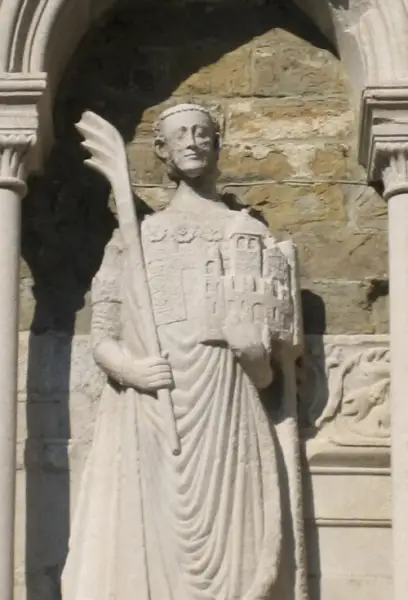
Justus is honored as patron of the city and diocese of Trieste, and his patronage extends to Albona in Istria, now Labin in Croatia, to San Giusto Canavese in Piedmont, and to Misilmeri in Sicily. The bond between saint and city showed itself again at a moment of national significance: on his feast day in 1918, at the close of the First World War, the destroyer Audace steamed in as the first Italian warship to enter the newly won port of Trieste, an arrival the city read as the martyr's own welcome. His image has remained close to the cathedral that bears his name. Among the earliest representations are the silk icon kept in the treasury, the apse mosaic of the 1100s pairing him with Servulus, the carved figure on the bell tower, the frescoes uncovered in the cathedral in 1959, and the miniature painted in the breviary of the cathedral chapter. He is shown with a spear, flowers across his chest, and the palm and cathedral of a martyr, signs of a witness that the sea could drown but not erase.
§ Veneration
Timeline
- 2 Nov 293
Drowned in the Gulf of Trieste after refusing sacrifice to the Roman gods, on the date preserved in the Verona codex
§ Biography
- 1918
Destroyer Audace led the first Italian vessel into Trieste's harbor, on the martyr's own feast day
§ Veneration
- 1959
Frescoes depicting Justus were discovered in Trieste Cathedral
§ Veneration
The Record
- Patron of
- Trieste (city and diocese)·Labin (Albona), Croatia·Misilmeri, Sicily·San Giusto Canavese, Italy
- Symbols
- Spear·Flowers across his chest·Palm·Cathedral
- Canonization
- Pre-congregation
Prayer
Bibliography
Show 6 sources
- Sauser, Ekkart (2000). "Justus of Trieste". In Bautz, Traugott (ed.). Biographisch-Bibliographisches Kirchenlexikon (BBKL) (in German). Vol. 17. Herzberg: Bautz. col. 741. ISBN 3-88309-080-8.
- "San Giusto di Trieste". Santebeati.it (in Italian).
- Acta Sanctorum November I, pp. 428-430, Passio edited by Guilielmus Van Hooff.
- di Brazzano, Stefano. Passio sancti Iusti martyris. Atti e Memorie della Societa' Istriana di Archeologia e Storia Patria 98 (1998) 58-85.
- Cuppo, Luciana (2010). "Passio sancti Iusti martyris: A Late Antique Statement of Roman Identity vis-a-vis Domination from the East". In Identity and Alterity in Hagiography and the Cult of Saints. Hagiotheca: Zagreb, pp. 37-58.
- Kirschbaum, E., et al. (eds). 1968-76. Lexikon der christlichen Ikonographie, 8 vols. Rome-Freiburg-Basle-Vienna: Herder.
Profile text adapted from the Wikipedia article, licensed CC BY-SA 4.0.
Pray with this saint every day
Save St. Justus of Trieste to your favorites, read the full profile, and get feast-day reminders in the Saints app.
Get the Saints AppFree on the App Store for iPhone and iPad