
c. 1200 – 1264·Feast May 5
St. Jutta of Kulmsee
Widow, Franciscan tertiary, and anchoress of Prussia
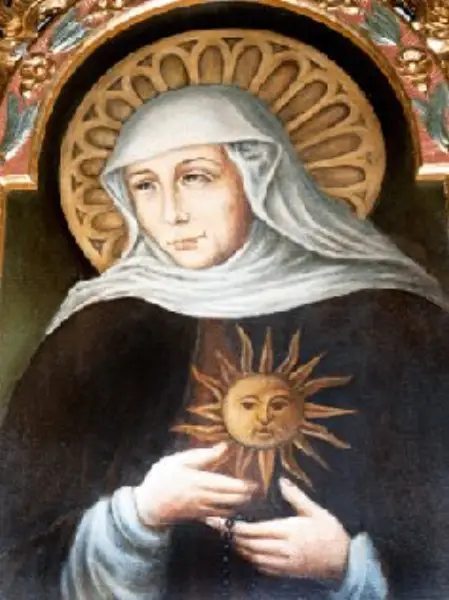
Overview
Jutta of Kulmsee, also called Judith and Otta, was born around 1200 at Sangerhausen in Thuringia to the noble family of that place, kindred to the dukes of Brunswick. Married at fifteen to a nobleman, she raised her children in the faith and won her husband, at first uneasy at her strictness, to a real esteem for her piety. His death on pilgrimage to Jerusalem left her a widow, and when the children had each entered religious life she gave everything away to the poor, joined the Third Order of Saint Francis, and set out as a barefoot pilgrim, caring for the sick, the lepers, and the homeless. Inspired by Elizabeth of Hungary, she exchanged privilege for poverty and met derision with joy. At last, in 1260, she enclosed herself in a cell by a church near Kulmsee in Prussia, sheltered by the Teutonic Order, whose Grand Master Anno von Sangerhausen was her kinsman. There she spent her remaining strength in prayer for Prussia's unbaptized peoples and its newest Christians, until fever took her in 1264, after four years of anchoritic life. She is honored as the first Prussian anchoress and patroness of Prussia.
The Complete Life
Noble Birth and a Christian Household
Jutta was born around the year 1200 at Sangerhausen in Thuringia, daughter of the noble family that bore the town's name and related to the dukes of Brunswick. At fifteen, as was the custom of her class, she was married to a nobleman, and the household they founded became the first field of her sanctity. The Franciscan chronicler Marion Habig observes that as a wife she cared more for godliness and the fear of God than for the honors of the world. Her husband did not at first share her zeal: her piety displeased him, and the young wife had to learn patience in her own house. In time, however, he came to value what he had resisted, and the two raised their children together in the Christian faith. Hagiographer Robert Ellsberg calls the marriage a happy one, and the judgment rings true to the story's course. When her husband set out on pilgrimage to Jerusalem and died there, Jutta was left to bring up the children alone, a widow in a society that offered such women few choices, and she carried that burden with the same quiet steadfastness that had marked her as a wife.
§ Marriage and children
Everything Given to the Poor
The turning came when the children, grown to a suitable age, each entered religious life, leaving their mother free to pursue her heart's desire. The model before her was Elizabeth of Hungary, the Thuringian princess who had renounced royal estate for poverty and service, and Jutta followed the same road in a humbler register. She joined the Third Order of Saint Francis, and with her confessor's permission distributed all her goods to the poor, put on simple clothes, and became a wandering pilgrim, going barefoot in summer and winter while she cared for the homeless and destitute. The Franciscan Book of Saints describes her work plainly: she devoted herself to the sick, above all to lepers, visiting the poor in their hovels and supplying their needs, leading the crippled and the blind by the hand to her home and tending them there. Such conduct drew mockery from those who thought a noblewoman was shaming her rank. Yet some who watched were moved by her piety and by the austerity she had exchanged for privilege, and the mockery and the admiration followed her side by side for the rest of her life.
§ Religious inspiration
Visions and the Inner Word
Jutta's life of charity was fed by an intense interior prayer. Alban Butler records that she received wonderful graces, favored with many visions and revelations and given an infused understanding of the Holy Scriptures, knowledge that came to her not by study but by grace. In prayer she was granted sights of Christ himself. Once he told her that all his treasures were hers and hers were his, a promise that settled her in the service of the poor; another time he bade her simply, follow me. When she lay ill and near death, he came again and offered her a choice: to enter into glory at once, or to remain and suffer still more out of love for him. She chose the longer road of suffering, and the choice proved decisive, for it opened to her the one state of life she had not yet tried, the anchorhold. Those who say that only bodily affliction, banishment from one's own land, and poverty embraced by choice can forge intimacy with God would find in Jutta a life that had gathered all three, and spent them on prayer for the salvation of others.
§ Religious inspiration
The Anchorhold at Kulmsee
In 1260 Jutta enclosed herself in a cell in the forest near Kulmsee, today's Chełmża in north-central Poland, in a church under the care of the Teutonic Order, whose Grand Master, Anno von Sangerhausen, was her kinsman. The frontier diocese of Prussia, a mission land newly and violently gathered to Christendom, received her as its first anchoress, and she took as her lifelong work the one labor suited to a walled-in woman: interceding day by day that Prussia's heathen peoples might come to faith and its newest converts stand fast. Wonders gathered around her cell. Christian neighbors testified that they had watched her carried bodily upward while rapt in prayer, seemingly borne aloft by angels, and it was told that she once walked across the pond to reach the church at Kulmsee when the water should have stopped her. Four years she lived thus, and then died of a fever in 1264. Though her confessor, Bishop Henry Heidenreich, buried her quietly as she had asked and spread no announcement, a greater crowd gathered at her funeral than ever before, thirteen priests stood at the grave, and an unaccountable fragrance filled the church. A chapel rose in her honor, for miracles multiplied at her tomb.
§ Enclosure
First Anchoress of Prussia
Fifteen years after her death, prompted by the fame of her holiness and the many wonders worked at her grave, the church opened a formal process for Jutta's canonization. Few records of her life survive, for anchoritic living was unusual outside southwest Germany, yet her story found its way into the Acta Sanctorum, and devotion kept her feast on 5 May. She is honored as patroness of Prussia and remembered as the first Prussian anchoress, the forerunner of a line that includes Dorothy of Montau, whose life in the following century bore, as the scholar Michelle Sauer observes, a surprising resemblance to her own; the two are often shown together in art. Jutta is depicted in the grey habit of the Franciscan tertiaries with long sleeves, a black strap or cord bound at waist and neck, the outward sign of the poverty she had chosen. Among her admirers was Mechthild of Magdeburg, the thirteenth-century Beguine and the first mystic to write theology in German, whose admiration for the anchoress of Kulmsee links Jutta to the great current of women's mysticism that flowed through her century.
§ Veneration
Timeline
- 1200
Born at Sangerhausen in Thuringia into the noble family of that name
§ Birth
- 1260
Enclosed herself in a cell attached to a church near Kulmsee, under the shelter of the Teutonic Order
§ Enclosure
- 5 May 1264
Died of a fever in her cell after four years of anchoritic life, and was buried at the church of Kulmsee
§ Death
In Their Own Words
All my treasures are yours, and yours are Mine
she recognized in the poor her Divine Lord, and deemed herself happy and highly honored that she could render them such services
The Record
- Patron of
- Prussia
- Symbols
- Grey habit with long sleeves·Black strap or cord tied at waist and neck·Depicted alongside Dorothy of Montau
- Canonization
- Pre-congregation; a canonization process was begun fifteen years after her death
Prayer
Bibliography
Show 5 sources
- Butler, Alban (1995). Butler's Lives of the Saints (2nd ed.). Westminster, Maryland: Liturgical Press. pp. 239-240. ISBN 0814623778. OCLC 33824974. Retrieved 17 April 2023.
- Dunbar, Agnes B.C. (1901). A Dictionary of Saintly Women. Vol. 1. London: George Bell & Sons. pp. 448-449. Retrieved 17 April 2023.
- Ellsberg, Robert (2017). "St. Jutta: Widow, Third Order Franciscan (c. 1200-1260)". The Franciscan Saints. Cincinnati, Ohio: Franciscan Media. pp. 34-35. ISBN 978-1632531940.
- Habig, Marion Alphonse, ed. (1979). The Franciscan Book of Saints. Chicago: Franciscan Herald Press. pp. 465-466. ISBN 0-8199-0751-0. Retrieved 17 April 2023.
- Sauer, Michelle M. (Summer 2015). "Violence, Isolation, and Anchoritic Preparation: Dorothy of Montau, Anchoress of Marienwerder". Magistra. 21 (1): 134.
Profile text adapted from the Wikipedia article, licensed CC BY-SA 4.0.
Pray with this saint every day
Save St. Jutta of Kulmsee to your favorites, read the full profile, and get feast-day reminders in the Saints app.
Get the Saints AppFree on the App Store for iPhone and iPad