
died 458·Feast July 2
St. Juvenal of Jerusalem
First Bishop and Patriarch of Jerusalem
Overview
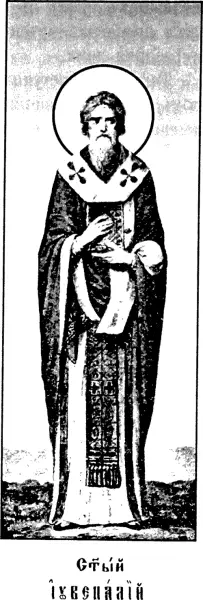
Saint Juvenal governed the church of Jerusalem for thirty-six of the most consequential years in its history. Born in the late fourth century, he was consecrated Bishop of Jerusalem in 422, at a time when his see was still a suffragan of Caesarea in the ecclesiastical geography inherited from Roman Palestine. Over the following decades he fought to raise Jerusalem to the rank its sacred history demanded: he stood with Cyril against Nestorius at Ephesus in 431, and after the storms of the Robber Council of 449 he reversed course at Chalcedon in 451, condemning the Monophysite teaching and abandoning his former ally Dioscorus of Alexandria. His constancy was rewarded when the council recognized Jerusalem as a metropolitanate with oversight of all three provinces of Roman Palestine, making him the first Metropolitan of Jerusalem and, in the recognition that followed, the first Patriarch of that Apostolic See. The price was a violent revolt among the anti-Chalcedonian monks of Palestine, who drove him from his throne and installed Theodosius in his place until imperial troops restored him in 453. He died in peace in 458, remembered for his defense of Palestinian monasticism and his promotion of Marian devotion.
The Complete Life
Origins Wrapped in Silence
Almost nothing is known of Juvenal's life before he mounted the episcopal throne of Jerusalem. The sources agree only that he was born in the late fourth century, at a moment when the church of the Holy City was emerging from centuries of obscurity. Since the destruction of Jerusalem by Rome in the year 70, and the refounding of the site as the pagan colony of Aelia Capitolina under Hadrian, the city had possessed little standing in the empire: Caesarea, where the provincial governor kept his residence, was likewise the metropolitan seat, and the bishop of Aelia, as Jerusalem's bishop was then styled, ranked as merely one of that see's suffragans. Into this modest position Juvenal was born, and it is from this reduced inheritance that his lifelong struggle for his see's honor began. A hint of his formation survives in the report that he had belonged to a monastic house in the Kedron valley, on the desert margin south and east of the Holy City where Christian monastic life was then taking root. If the report is true, the future bishop was formed in the same monastic world whose great figures he would later ordain, defend, and stand beside through the christological storms of the fifth century.
§ Life
Bishop of the Holy City
Juvenal received consecration as Bishop of Jerusalem in 422, succeeding Praulius in an office whose burdens far exceeded its rank. The city he inherited was outwardly unimpressive but inwardly transformed: pilgrims were streaming to the holy places, and the liturgical life of Jerusalem was beginning to shape the devotion of the whole Christian world. Among the new bishop's early acts was one that revealed his instinct for the monastic movement flowering in the Judean wilderness. In 428 or 429 he gave consecration to the Laura of Euthymius, the desert foundation of the great father of that name standing along the highway from Jerusalem to Jericho, and furnished it with priests and deacons for its liturgical life. The gesture bound the hierarchical church and the desert movement together at a formative moment. The old abbot and the ascetics of the Holy Land were destined to weigh decisively in the quarrels surrounding Chalcedon; when that storm broke, the lauras and monasteries that men like Juvenal had sponsored proved to be the bedrock on which the Chalcedonian cause in Palestine stood. The young bishop, it turned out, had been building alliances in the desert that would one day hold his see together.
§ Life
The Fight for Jerusalem's Rights
One object ruled Juvenal's episcopate from first to last: to guard and enlarge the standing of his church. The first great test came in 431, when he traveled to the First Council of Ephesus and sided with Cyril of Alexandria against Nestorius, casting his lot with the orthodox defense of the unity of Christ's person. The council's aftermath opened the door he had been waiting for: he started to stretch his authority over the whole of Roman Palestine, across provinces his see had never claimed since the age of Nicaea. His aim was to make Jerusalem a metropolitan see, an ambition that met resistance from the two most powerful churchmen of the East, Cyril of Alexandria and Pope Leo I, who opposed the separation of Jerusalem from Caesarea and Antioch. Juvenal pressed on regardless, at one point hoping to extend his oversight into Roman Arabia and Phoenicia as well. Whatever one judges of his methods, the object of the struggle was not mere ambition: the city of Christ's death and resurrection, the mother church of Christendom, remained canonically subordinate to cities with no share in the saving events. His persistence would be vindicated, at a price, at Chalcedon twenty years later.
§ Life
Monks, Liturgy, and the Mother of God
Juvenal's attachment to the desert was spiritual as well as political. He is judged likely to have had monastic roots himself, formed, it seems, during his years in a Kedron-valley monastery, and his support of Palestinian monasticism throughout his episcopate was strong and practical. Many of the men he raised to the clergy were local monks, so that the hierarchy of the Holy City came increasingly to share the spirit of the lauras and coenobia around it; when the moment of crisis arrived after Chalcedon, it was the great abbot Euthymius who stood by Juvenal against the rebellious multitudes. He was equally a builder of liturgy. Under his episcopate the Feast of the Theotokos on August 15 was introduced at Jerusalem, one of the earliest appearances in any church calendar of the solemnity the whole East would eventually keep, and in his years churches dedicated to the Mother of God began to rise across the province. The pairing is fitting: the city where Mary had received the news of her Son's triumph was among the first to give her a feast and a house of prayer. Juvenal's Jerusalem, disciplined by monks and enlarged by Marian devotion, became a school of worship for the entire Christian world.
§ Theological contribution
Revolt, Exile, and Restoration
The middle years of Juvenal's episcopate brought him to the edge of ruin. At the Second Council of Ephesus in 449, the gathering later repudiated as a robber synod, he stood among its leaders and was the first to sign its acts as an ally of Dioscorus of Alexandria; for this, churches that rejected the council struck his name from their diptychs. At Chalcedon in 451 he reversed himself without hesitation, condemning the council he had signed, joining the definition that Christ is acknowledged in two natures, divine and human, without separation and without mixture, and withdrawing his support when Dioscorus was tried for violating canonical law. The council consented to the Metropolitinate of Jerusalem over all of Palestine, but the anti-Chalcedonian monks rose in fury, and a large portion of the Palestinian monasteries revolted under Theodosius. When Juvenal attempted to return to his throne, the rebels ejected him from his throne and set Theodosius in the archbishop's place. The usurper filled Jerusalem with blood and sent a military company against rivals in the region, brutally executing Severianus, Bishop of Scythopolis, in 452 or 453. Juvenal fled to Constantinople in August 453, but imperial troops restored him that same year, and he governed his enlarged see in peace until his death in 458.
§ Life
Saint of the Orthodox Church
Juvenal was never the subject of a formal canonization, for he belonged to the ages in which the saints were made by the voice of the churches rather than by decree. The Orthodox East took him to itself as a bishop who had confessed the two natures of Christ at Chalcedon at the cost of his throne, and whose exile and restoration had a martyr's pattern even though he did not die a martyr's death. His feast is kept in the Eastern Orthodox Church on July 2, and the Greek Synaxaristes commemorates him on that day with the title of Patriarch of Jerusalem, honoring him among the line of shepherds that stretches back to James, the brother of the Lord. The veneration he receives is thus bound up with the doctrines he defended: the churches that keep his memory do so as part of their thanksgiving for the Council of Chalcedon and for the peace of the Church won there. In the Latin West, where his struggles were remembered chiefly through the acts of the great councils, his name survived in the learned tradition as the bishop who raised Jerusalem to patriarchal rank.
§ Canonisation
The First Patriarch of Jerusalem
Juvenal's enduring monument is the rank his see achieved through his labors. The oversight granted to Jerusalem at Chalcedon covered all three provinces of Roman Palestine, an authority that swept far past the precedent Nicaea had set and rose above ordinary metropolitan rank; command of the whole of Roman Palestine would subsequently gain him recognition as the first Patriarch of Jerusalem, an honor his successors have carried ever since. The settlement was not his full ambition, for his negotiations with Archbishop Maximus of Antioch at Chalcedon brought him Palestine but not Roman Arabia or Phoenicia, yet it transformed the standing of the Holy City in the constitutional order of the Church. The Palestinian episcopate gave its consent to the settlement, giving the new metropolitanate a local legitimacy that endured beyond the revolt against its first occupant. Within a century the logic of Chalcedon ran its course: the Emperor Justinian recognized Jerusalem as one of the five patriarchates of the Christian world, standing beside Rome, Constantinople, Alexandria, and Antioch. Every later patriarch of the Holy City occupies an office Juvenal first filled, and the honor of the see he fought for has outlasted every empire that contested it.
§ Theological contribution
Timeline
- 422
Consecrated Bishop of Jerusalem, succeeding Praulius in a see still subject to Caesarea
§ Life
- 428
Consecrates the Laura of Euthymius on the road between Jerusalem and Jericho, supplying it with presbyters and deacons
§ Life
- 431
Sides with Cyril of Alexandria against Nestorius at the First Council of Ephesus
§ Life
- 449
Acts as a leader of the Second Council of Ephesus and is the first to sign its acts as an ally of Dioscorus
§ Life
- 451
Condemns the Monophysite heresy at the Council of Chalcedon and secures the Metropolitinate of Jerusalem
§ Life
- 452
Theodosius's followers brutally execute Severianus, Bishop of Scythopolis, amid the anti-Chalcedonian rising
§ Life
- Aug 453
Driven from his throne by the followers of Theodosius, flees to Constantinople
§ Life
- 453
Restored to his see by imperial troops after the suppression of the revolt
§ Life
- 458
Dies in peace after serving as bishop and first Metropolitan of Jerusalem for thirty-six years
§ Life
The Record
- Canonization
- Pre-congregation; venerated as a saint in the Eastern Orthodox Church, with his feast on July 2
Prayer
Bibliography
Show 7 sources
- Fortescue, Adrian. 'Jerusalem (A.D. 71-1099).' The Catholic Encyclopedia. Vol. 8. New York: Robert Appleton Company, 1910
- Berardino, Angelo Di (2006). The Eastern Fathers from the Council of Chalcedon (451) to John of Damascus (750). J. Clarke. ISBN 978-0-227-67979-1
- Pringle, Denys (1993). The Churches of the Crusader Kingdom of Jerusalem: A Corpus: Volume 2, L-Z (excluding Tyre). Cambridge University Press. ISBN 978-0-521-39037-8
- 'Saint Juvenal, Patriarch of Jerusalem'. Orthodox Church in America (oca.org)
- Piercy, William C.; Wace, Henry (1911). 'Juvenalis, bishop of Jerusalem'. Dictionary of Christian Biography and Literature to the End of the Sixth Century. John Murray, Albemarle Street
- Horn, Cornelia B.; Phenix, Robert R. (eds.) (2008). John Rufus: The Lives of Peter the Iberian, Theodosius of Jerusalem, and the Monk Romanus. Society of Biblical Literature. ISBN 978-1-58983-200-8
- Honigmann, Ernest (1950). 'Juvenal of Jerusalem'. Dumbarton Oaks Papers. 5: 209-279
Profile text adapted from the Wikipedia article, licensed CC BY-SA 4.0.
Pray with this saint every day
Save St. Juvenal of Jerusalem to your favorites, read the full profile, and get feast-day reminders in the Saints app.
Get the Saints AppFree on the App Store for iPhone and iPad