
died May 3, 369 or 377·Feast May 3
St. Juvenal of Narni
First Bishop of Narni and wonder-working confessor
Overview
Saint Juvenal, remembered in Italian as San Giovenale di Narni, is venerated as the first Bishop of Narni in Umbria, though history has preserved only fragments of his life. A biography written after the seventh century, of little historical value, relates that he was born in Africa, ordained by Pope Damasus I, and set over the young church of Narni as its first bishop. The same late vita records his burial at the Porta Superiore on the Via Flaminia on August 7, while his feast has always been kept on May 3, the day of his death, traditionally given as 369 or 377. Florus of Lyon and Ado, in their martyrologies, rank him among bishops and confessors rather than among martyrs, yet Gregory the Great, in the Dialogues and in his homilies on the Gospels, remembers a Juvenal who ruled the church of Narni and grants him the martyr's title, reflecting the looser early usage by which the title honored bishops of heroic virtue. Legend tells how he delivered his city when Ligurian and Sarmatian war bands closed in, summoning a storm from heaven to break them. In 878 his relics traveled to Lucca, coming home to Narni after two years, and he remains patron of Narni and of Fossano.
The Complete Life
From Africa to the Umbrian Hills
The man whom Narni honors as the founder of its church left almost no footprint in the documentary record, and what was told of him reached the medieval world through a biography composed long after his death, after the seventh century, and of little historical value. That vita preserves the outline the city has always cherished: Juvenal was born in Africa, crossed the sea that connected the African provinces to Italy, and was ordained by Pope Damasus I, the pope who served the Roman church in the later fourth century. In the course of his ministry he became the first bishop of Narni, the steep Umbrian town on the Via Flaminia whose Christian community he is held to have organized and shepherded in its beginnings. Whatever the exact facts of his origins, the picture is coherent: a clergyman of the generation after Constantine, formed in the Roman church, sent to govern one of the new episcopal sees rising through central Italy as the countryside was Christianized. The details that survived are the details communities remember longest, the place of birth, the ordaining bishop, and the grave, and all three attached themselves to Juvenal before the tradition was written down.
§ Introduction
The Thunderstorm of Narni
The legend that made Juvenal the special guardian of his city tells that he saved Narni from invasion by calling down a divine thunderstorm. In the story's setting the town, crowned by its precipice above the Nera gorge, faced destruction by Ligurian and Sarmatian raiders, forces beyond anything the little community could resist; the bishop's answer was not the sword but prayer, and the storm that answered him broke the assault and preserved the city. Whatever historical core the tale may hold, its meaning was plain to the people who told it: the true defender of Narni was its first bishop, and his intercession remained a shield over it long after his death. The legend belongs to a type of story common around early Italian bishops, in which the man of God succeeds where arms fail, and it explains why Juvenal's cult took root so firmly in the town's civic as well as religious life. It is consistent with the dignity his memory acquired, for Gregory the Great himself knew of a sepulcher associated with Juvenal at Narni and honored his name. A city preserved by its patron's prayer would naturally guard his tomb, and through the tomb, his story.
§ Introduction
Confessor or Martyr
Juvenal died at Narni on May 3, in 369 or 377, the two dates the tradition preserved for the end of his long episcopate. His own late vita declines to call him a martyr, styling him a confessor instead, and the great martyrologies of the Carolingian age, those of Florus of Lyon and of Ado, followed that judgment, setting him down among the bishops and confessors rather than among those who bled for the faith. Gregory the Great, however, presents a different aspect. In the fourth book of his Dialogues and again in his Homiliae in Evangelium, Gregory names a Juvenal among Narni's bishops and grants him the martyr's crown of honor; he likewise knows of a tomb linked with the saint at Narni that drew the devotion of the faithful. Modern students of the tradition note that the title of martyr was sometimes given in that age to bishops who had not necessarily died for their faith, an honorific recognizing lives of extraordinary endurance and virtue. The debate is itself a tribute: whether Juvenal shed his blood or merely spent it entirely in service, the early Church judged his life worthy of the altars and gave his memory a permanent place among the saints.
§ Introduction
A Feast Kept for Fifteen Centuries
The liturgical witness to Juvenal is unusually old and unusually continuous. The Gelasian Sacramentary, one of the earliest surviving Roman service books, contains a prayer in his honor under May 3, and the Codex Bernense of the Martyrologium Hieronymianum records his name on the same day, alongside three witnesses buried on the Via Nomentana, Eventius, Alexander, and Theodulus. On this basis the Tridentine books gave him a joint remembrance with those three, folded into the Roman celebration of May 3, the Finding of the Cross; his standing there was that of bishop and confessor, not of one who had bled, his date simply coinciding with theirs. When the feast of the Finding of the Cross was abolished in the reform of 1960, the four names went on being remembered together inside the ordinary weekday mass. The Roman Martyrology still indicates May 3 as Juvenal's day, but the reform of 1969 struck him from the General Roman Calendar, leaving his observance a local rather than universal keeping. Few early Italian bishops can show so unbroken a documentary chain, from the ancient sacramentary through the medieval martyrologies to the modern books.
§ Veneration
Relics, Patrons, and a Painter's Panel
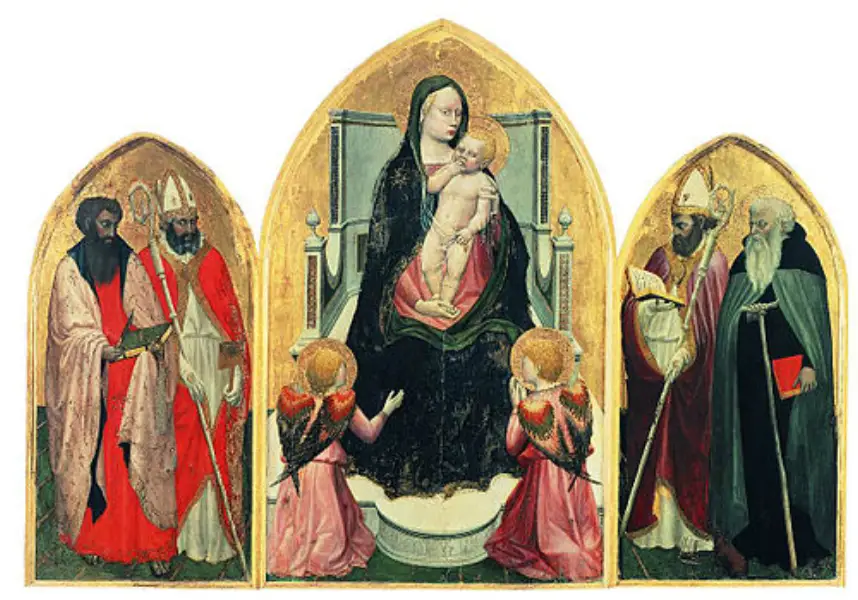
Juvenal's memory settled physically into the landscape of central Italy. His tomb at Narni is said to have been raised by Maximus, traditionally reckoned his successor in the see, who died in 416; Gregory the Great knew the shrine by reputation. In the sixth century, the writer of the Life of Pope Vigilius in the Liber Pontificalis notes that Belisarius founded a monastery near Orte and placed it under Juvenal's patronage, proof that his cult had spread beyond his own city within two hundred years of his death. In 878 his relics were carried off to the Basilica di San Frediano in Lucca together with those of St. Cassius and Cassius's wife Fausta by Adalbert, Margrave of Tuscany, yet the whole treasure made its way home after two years, and Juvenal's own remains, tradition says, were then concealed, perhaps against another seizure. Fossano in Piedmont honors him as its patron and keeps relics believed to be his, though scholars suspect they belong to a different saint bearing the same name; Chia likewise counts him a patron. His most famous portrait is indirect: the San Giovenale Triptych, the earliest dated work of Masaccio, shows the saint on the right panel beside St. Anthony, and is preserved today at the Museum of Sacred Art at Cascia di Reggello.
§ Veneration
Timeline
- 3 May 369
Dies at Narni on May 3; some traditions place his death in 377 instead
§ Introduction
- 416
St. Maximus, Juvenal's traditional successor and the credited builder of his sepulcher at Narni, dies
§ Veneration
- 878
Adalbert, Margrave of Tuscany, carries Juvenal's relics to the Basilica di San Frediano in Lucca
§ Veneration
- 880
The relics are returned to Narni after two years in Lucca
§ Veneration
- 1960
Abolition of the Finding of the Cross feast ends the shared Tridentine commemoration of Juvenal and three Via Nomentana martyrs
§ Veneration
- 1969
Juvenal is dropped from the General Roman Calendar, though the Roman Martyrology keeps his May 3 feast
§ Veneration
The Record
- Patron of
- Patron of Narni·Patron of Fossano·Patron of Chia
- Symbols
- Holding a sword in his mouth·Holding a chalice
- Canonization
- Pre-congregation; venerated as a bishop and confessor since the early centuries
Prayer
Bibliography
Show 6 sources
- Ὁ Ἅγιος Ἰουβενάλιος Ἐπίσκοπος Ναρνί. 3 Μαΐου. ΜΕΓΑΣ ΣΥΝΑΞΑΡΙΣΤΗΣ (in Greek)
- 'Saint of the Day, May 3: Juvenal of Narni'. SaintPatrickDC.org. Retrieved March 6, 2012
- Caraffa, Filippo (22 June 2002). 'San Giovanale di Narni'. Santi e Beati. Retrieved August 10, 2008
- Martyrologium Romanum. Libreria Editrice Vaticana, 2001. ISBN 88-209-7210-7
- 'St. Juvenal of Narni'. Catholic Online. Retrieved August 10, 2008
- 'Key to Umbria'. Archived from the original on January 7, 2009. Retrieved August 10, 2008
Profile text adapted from the Wikipedia article, licensed CC BY-SA 4.0.
Pray with this saint every day
Save St. Juvenal of Narni to your favorites, read the full profile, and get feast-day reminders in the Saints app.
Get the Saints AppFree on the App Store for iPhone and iPad