
c. 1761 – 1796·Feast July 2
St. Juvenaly of Alaska
Protomartyr of America and missionary hieromonk
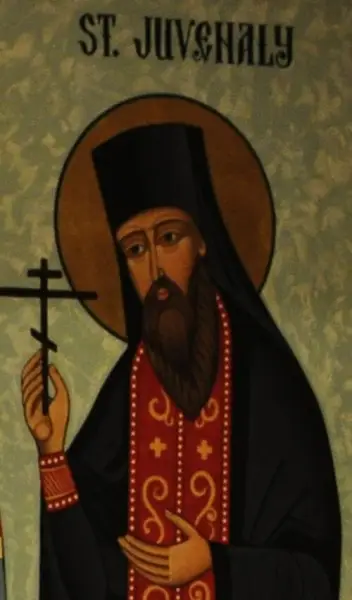
Overview
Saint Juvenaly of Alaska, born Yakov Feodorov Govorukhin around 1761 at Yekaterinburg in the Urals, is honored as the Protomartyr of America. A worker in the imperial mining industry by trade and the son of a smelting master of the Nerchinsk mines, he abandoned his career in 1791 to become a novice at the Valaam Monastery on Lake Ladoga. Two years afterward he made his monastic profession and received ordination to the priesthood, taking the name Juvenaly for the fifth-century Patriarch of Jerusalem, and was chosen for the first Orthodox missionary band sent from Valaam and Konevets to Russian America. After a journey of some eight thousand miles across Siberia and the Bering Sea, the ten missionaries reached Kodiak Island in September 1794, where Juvenaly and his fellow priest Makary baptized some six thousand Sugpiaq within two months. He carried the Gospel to the mainland in 1795, baptizing Chugach Eskimos at Nuchek and Dena'ina Indians at Kenai, and pressed west the following year toward the peoples beyond Lake Iliamna. There, near Kuinerrak at the mouth of the Kuskokwim River, he and his companions were killed in 1796, making him the first to seal the American mission with blood.
The Complete Life
A Miner's Son from the Urals
The man the Church now honors as the Protomartyr of America began life far from any ocean, in the mining town of Yekaterinburg in the Ural Mountains, where he was born in 1761 and received the name Yakov Feodorov Govorukhin. His father, Feodor Govorukhin, was a smelting master of the Nerchinsk mines, and the son followed the same industrial trade, and served at the Voskresenskiĭ works in Kolyvan, holding an ensign's rank there. It was a respectable and settled career in the service of the Russian state's metal industry, the life for which his upbringing had prepared him. Nothing in the record suggests that Yakov was marked out by education or office for any extraordinary destiny; he was a skilled workman in his twenties and thirties in one of the empire's frontier industries. Yet the mining settlements of the Urals stood within the vast diocese over which the Orthodox faith had spread across Siberia, and the spiritual currents that were then moving Russian monasticism, particularly the renewal centered at the monastery of Valaam on Lake Ladoga, reached even there. In his thirtieth year the mine official made the decision that reordered his whole existence.
§ Life
From Ensign to the Tonsure
In 1791 Yakov Govorukhin left his position at the Kolyvan mines of his own will and went to the Valaam Monastery to live as a novice, exchanging the ordered hierarchy of the mining service for the strictest school of Russian prayer. The island monastery in Lake Ladoga, together with its neighbor Konevets, was then a source of missionary zeal as well as contemplative life. Two years later, in 1793, Yakov was selected for the American mission then being assembled, and in preparation he received the monastic tonsure and ordination to the priesthood. For his new life he took the religious name Juvenaly, chosen to recall the fifth-century Patriarch of Jerusalem who bore it, whose own struggles for the honor of a distant see the young monk could hardly have foreseen he would echo in a wilderness at the world's other end. The choice of a mining man for the mission was no accident of chance: a laborer who had managed men and hardship in the empire's eastern works possessed precisely the endurance the American enterprise would demand. Within months of his ordination, Father Juvenaly was on the road eastward toward the Pacific.
§ Life
Ten Missionaries to Kodiak
In 1793 the Ladoga monasteries of Valaam and Konevets together provided a company of ten ascetics for the mission to Russian America. Archimandrite Joasaph Bolotov led the group, four priest-monks, Juvenaly and Makary among them, a hierodeacon, a monk named German, and four novices in training. They were bound for the Russian outpost on Kodiak in the Gulf of Alaska, eight thousand miles away by the long road across Siberia and over the northern Pacific. What the missionaries found on their arrival on September 24, 1794 was nothing like what they had been promised: the settlement was primitive beyond description, violence was commonplace, the church they had been assured of did not exist, and the supplies promised for three years were absent. Undeterred, Fathers Juvenaly and Makary set out around the island and within two months baptized the local Sugpiaq Eskimos, altogether about six thousand people, one of the most extraordinary mass ingatherings in the history of Christian missions. The two priests did the work by going around the island of Kodiak itself, village by village along its coasts. The desert island had become, in the space of a season, a baptized land with the makings of a church.
§ Life
Death at the Kuskokwim
In 1795 Juvenaly left Kodiak for the mainland, baptizing Chugach Eskimos at Nuchek and Dena'ina Indians at Kenai, and in 1796 he pressed west of Lake Iliamna toward the continent's far northern reaches, beyond even the lands the Russians called Alyaska. There, among peoples not yet at peace with the newcomers, he was killed together with three promyshlenniki and a few baptized Kenai natives. His death came in 1796 at Kuinerrak, where the Kuskokwim empties into the sea. The oldest account, recorded by Ioann Veniaminov, relates that the local chiefs, having given him their children to educate at Kodiak, regretted their decision, overtook him, and killed him as a deceiver; the same tradition holds that he neither fled nor resisted, asking only for his companions' safety, and that when struck down he rose and followed his attackers, so that at last they hacked his body to pieces, and that a pillar of smoke rose where his remains lay. Later accounts were worse than worthless: the so-called diary of Father Juvenaly, printed as a primary source for a century, was demonstrated by the historian Lydia T. Black to be a fabrication by one of Bancroft's assistants.
§ Death
Protomartyr of America
Juvenaly was canonized in 1980, when the Russian Orthodox Church enrolled him among the saints, adding his name to the constellation of holy figures who sanctified the American continent. His canonization crowned nearly two centuries of local memory: the peoples of southwestern Alaska had preserved their own oral tradition of the missionary's death, and the Church's official act gave that tradition doctrinal weight. He is honored under three liturgical dates. His principal feast falls on July 2; he is commemorated again on September 24 with all the Saints of Alaska, the anniversary of the Valaam mission's landing on Kodiak; and on December 12 the Church pairs him with those who first shed their blood for the Gospel on American soil, the company whose sacrifice consecrated the new world. In the iconography of the Orthodox Church in America he appears in the monastic habit with his epitrachelion and the cross, the insignia of a hieromonk who died in the midst of his ministry. As Protomartyr of America he stands first in the long line of those who have died for the faith on the continent.
§ Veneration
The Feast of Two Worlds
The hymnography of Juvenaly's feast binds him to the land where he died and to the monastery that sent him. The troparion sung on September 24 celebrates Alaska rejoicing and America made festive because the new world has been hallowed by martyrdom, calls to mind Kodiak echoing with songs of thanksgiving and Iliamna and Kenai keeping the festival of faith, and glorifies the apostle and martyr Juvenaly alongside Peter the Aleut, who endured persecution and death for the truth. The kontakion joins the two shores of his life still more closely, singing that Valaam celebrates together with Alaska because her spiritual son has embraced the new martyr Peter with love, and that the two, by their voluntary sacrifice, united the old world with the new. The Church's poets thus read his death not as a failure of the mission but as its consecration, the act by which a distant colony became holy ground. Scholars have continued to labor over his memory as well: studies of the oral tradition about his death among the native peoples of southwestern Alaska, and of the forged diary that long distorted his story, have restored the older and more credible account on which the Church's veneration rests.
§ Hymns
Timeline
- 1761
Born at Yekaterinburg and named Yakov Feodorov Govorukhin, son of a smelting master of the Nerchinsk mines
§ Life
- 1791
Leaves his post at the Voskresenskiĭ mines of his own will and enters Valaam Monastery as a novice
§ Life
- 1793
Tonsured a monk and ordained a priest for the American mission, taking the name Juvenaly
§ Life
- 24 Sep 1794
Reaches Kodiak Island with the ten-member Valaam mission after the overland and sea journey from Russia
§ Life
- 1794
Baptizes about 6,000 Sugpiaq Eskimos around Kodiak together with Father Makary in two months
§ Life
- 1795
Baptizes Chugach Eskimos at Nuchek and Dena'ina Indians at Kenai on his mainland journey
§ Life
- 1796
Killed with three promyshlenniki and several baptized Kenai natives near Kuinerrak, beyond Lake Iliamna
§ Death
- 1980
Canonized by the Russian Orthodox Church as the Protomartyr of America
§ Veneration
In Their Own Words
It is said that Iuvenaliĭ, when attacked by the savages, did not attempt either to flee or to defend himself, which he might have done with success, but surrendered himself without any kind of resistance into their hands asking only for the safety of his companions, which was granted him.
The Record
- Patron of
- Patron of Alaska
- Symbols
- Monastic habit·Epitrachelion·Cross
- Canonization
- Canonized in 1980 in Alaska by the Russian Orthodox Church
Prayer
Bibliography
Show 5 sources
- Black, Lydia T. 'The Daily Journal of Reverend Father Juvenal: A Cautionary Tale'. Ethnohistory 28(1):33, 1981
- L'vov, Apollinariĭ Nikolayevič (1894). 'Краткiя историческiя свѣдѣнiя объ учрежденiи въ Сѣверной Америкѣ православной миссiй'. Прибавленiя къ Церковнымъ вѣдомостям, № 38-39
- Oleksa, Michael (1986). 'The Death of Hieromonk Juvenaly'. St. Vladimir's Theological Quarterly 30:3, pp. 231-268
- Veniaminov, Ioann (1984). Notes on the Islands of the Unalashka District. Alaska History no. 27. The Limestone Press, Kingston, Ontario
- 'Martyr Juvenaly of Alaska'. Orthodox Church in America (oca.org). Retrieved 2025-12-06
Profile text adapted from the Wikipedia article, licensed CC BY-SA 4.0.
Pray with this saint every day
Save St. Juvenaly of Alaska to your favorites, read the full profile, and get feast-day reminders in the Saints app.
Get the Saints AppFree on the App Store for iPhone and iPad