
died 8 February 397·Feast February 8
St. Juventius of Pavia
Fourth-century bishop and evangelizer of Pavia
Overview
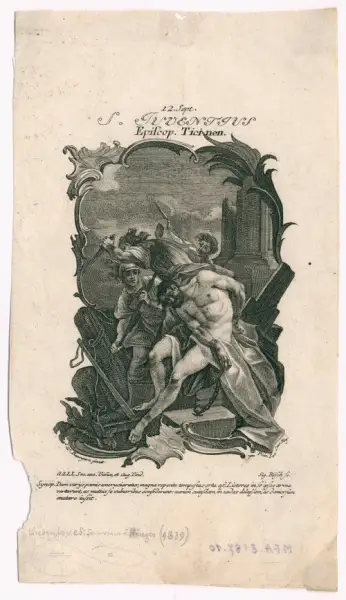
Saint Juventius, whose name appears in old documents under the spellings Eventius, Iventius, and Inventius, stands among the founding figures of Christianity in the Po valley. Sent to Pavia by Saint Hermagoras together with his companion Saint Syrus, he undertook the evangelization of a city that would become one of the important episcopal sees of northern Italy. The mission of the two missionaries bore fruit in the establishment of a bishopric at Pavia, and when the episcopal succession was organized, Syrus took the chair as the city's first bishop. Juventius himself governed the see for thirty-nine years, a tenure of remarkable length in a turbulent century, and he died on February 8, 397, near the close of the fourth century. His memory has been kept liturgically ever since under two observances: February 8, his own feast day, and September 12, when Pavia celebrates him jointly with Saint Syrus. Though the ancient sources record little of his speech or deeds, the endurance of his cult and the double feast kept in his honor testify to the depth of the roots he planted in the Lombard city.
The Complete Life
Sent by Hermagoras to the Po Valley
The mission of Juventius belongs to the first chapter of Christianity in northern Italy. According to the account preserved of the Pavian church, he and Syrus were dispatched to Pavia by Saint Hermagoras, the figure remembered as an apostle of the Aquileian church and a link in the chain by which the Gospel traveled westward from the eastern Mediterranean. The two missionaries thus arrived not as wandering preachers but as envoys of an organized evangelizing effort, charged with bringing a city to the faith and leaving behind the structures that would keep it there. Their work succeeded in founding a bishopric at Pavia, and the ordering of its leadership assigned the first episcopacy to Syrus, while Juventius carried the office in his turn. In an age when a mission station could vanish with the death of its founder, the establishment of a resident episcopacy was the decisive act that turned preaching into a church. Juventius's share in that work made him a father of the Pavian diocese, and the city that received the Gospel through his labors never forgot the debt, enrolling both missionaries among its principal saints.
§ Introduction
Thirty-Nine Years and Two Feasts
Juventius governed Pavia for thirty-nine years, and the length of that episcopate is itself part of his legacy. A bishop who leads a young church for nearly four decades gives it continuity through the critical years of its formation, teaching, ordaining clergy, and binding a new Christian community into the wider fellowship of the Italian churches. He died on February 8, 397, at the close of the fourth century, having lived long enough to see the faith move from tolerated sect to the religion of the empire. The liturgical memory of Pavia honored him with an unusual double observance: a feast on February 8, marking the day of his death, and a second celebration on September 12, when the city keeps him together with Saint Syrus, the companion of his mission and the first occupant of its episcopal throne. The paired feast expresses the old truth that the founding of a church is the work of workers in common, while the solitary feast preserves the particular gratitude owed to the long-serving bishop himself. Both observances carried his name across fifteen centuries of Pavia's Christian history.
§ Introduction
The Record
- Canonization
- Pre-congregation; venerated as a saint from the earliest centuries of the Church
Prayer
Bibliography
Show 2 sources
- Lanzoni, Francesco (1927). Le diocesi d'Italia dalle origini al principio del secolo VII (an. 604). Faenza: F. Lega, p. 986
- Watkins, Basil (2015). 'Juventius of Pavia'. The Book of Saints: A Comprehensive Biographical Dictionary (8th ed.). Bloomsbury Publishing, p. 411. ISBN 978-0-567-66415-0
Profile text adapted from the Wikipedia article, licensed CC BY-SA 4.0.
Pray with this saint every day
Save St. Juventius of Pavia to your favorites, read the full profile, and get feast-day reminders in the Saints app.
Get the Saints AppFree on the App Store for iPhone and iPad