
c. 810 – 865·Feast 7 September
St. Kassia
Byzantine hymnographer, composer, and abbess
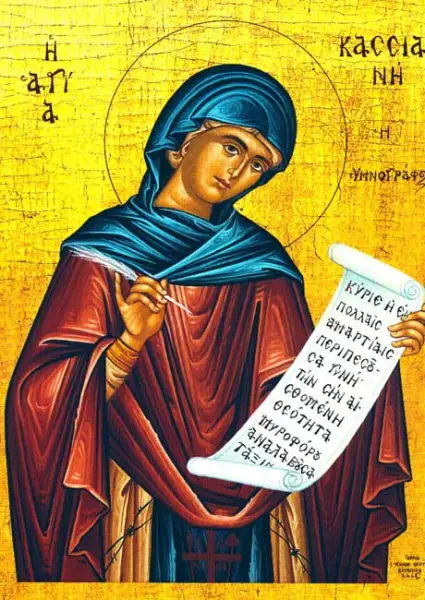
Overview
Kassia, known also as Kassiani or Cassia, was a Byzantine-Greek woman of letters — hymn writer, composer of melody, and poet — whose life ran from about 810 to about 865. Born in Constantinople to a wealthy family, she received a classical Greek education that shaped all her writing. Within Byzantine sacred song she stands alone: no other woman's compositions are known to have entered that rite's liturgical books. About fifty of her hymns remain, chiefly stichera, and her name is attached to at least 261 epigrams and gnomic verses. With Anna Comnena she shares the distinction of belonging to the tiny company of middle Byzantine women who wrote under their own names. Byzantine chroniclers recount that as a young woman she took part in a bride show for the future emperor Theophilos and answered his taunt about Eve with a witty retort about the salvation wrought through Mary, but he chose Theodora instead. In 843 at the latest she had established a religious house for women in the western part of the capital, ruling it as founding abbess. A defender of icon veneration during the second iconoclastic period, she was scourged for her outspokenness. Late in life she traveled briefly to Italy and settled on the Greek island of Kasos, where she died around 865.
The Complete Life
A Gifted Daughter of Constantinople
Kassia was born in Constantinople between 805 and 810, into a wealthy family of the Byzantine capital. She grew into a woman famed alike for her exceptional beauty and her exceptional intelligence, and while still a young girl she became known to Theodore the Studite, the great abbot and reformer, who admired her erudition and the polish of her pen. Her early study of classical Greek literature left a permanent mark on her writing, both sacred and secular. The chronicles of three Byzantine writers, Pseudo-Symeon the Logothete, George the Monk, and Leo the Grammarian, preserve her most famous youthful encounter: a bride show organized by the empress dowager Euphrosyne so that the young Theophilos could choose a wife by presenting a golden apple to his chosen bride. Smitten by her beauty, Theophilos approached Kassia and tested her with the words that through a woman had come the baser things, an allusion to Eve's transgression. She answered at once that through a woman had come the better things, pointing to the salvation that entered the world through the Virgin Mary at the Incarnation of Christ. Unsatisfied with being outmatched, Theophilos rejected her and gave the apple to Theodora.
§ Life
Founding a Convent by the Walls
By 843 at the latest Kassia had brought a religious house for women into being near the Constantinian Walls, and she governed it as founding abbess. Later writers liked to imagine that the move was motivated by bitterness over her failure to marry Theophilos and become empress, but a letter from Theodore the Studite shows that religious conviction moved her toward the monastic life. In her era monasticism was a common vocation, and her biographers judge that piety may have weighed as heavily as disillusion or artistic ambition in her choice. Her house became intertwined with the life of the Byzantine Church through its close relationship with the nearby Stoudios monastery, whose ninth- and tenth-century revision of the empire's liturgical books set the standard for Byzantine worship. That connection proved providential for her own work, for the Stoudite liturgical reforms helped preserve her hymns for posterity. As abbess she governed a community of women while continuing to write poetry and compose music for it, an unusual combination of authority, scholarship, and artistry for a woman of her century, and the convent remained the base from which she would defy the religious policy of the imperial court.
§ Life
Defender of the Icons
The emperor who had once rejected Kassia became one of the fiercest iconoclasts to sit on the Byzantine throne, and any residual feelings he may have carried for her won her no protection from his policy of persecuting those who defended the veneration of icons. Her penalties included a flogging at the lash. She refused to be silenced, and one saying from those years survives as the motto of her character: she declared that she hated silence when it was time to speak. The conflict outlasted Theophilos. After his death in 842 his young son Michael III became emperor, with the empress Theodora acting as regent, and together they brought the second iconoclastic period, which had begun in 814, to an end in 843, restoring peace to the empire and the icons to their places of honor. Because of her strong and costly defense of the veneration of icons, Kassia regularly appears on the icon of the Sunday of Orthodoxy, the Lenten festival that opens the fast, commemorating the restoration her generation suffered and prayed to see. Her witness belongs to the history of that triumph.
§ Life
The Hymns of a Contemplative Composer
Kassia's spirituality lives above all in her music. She wrote spiritual poetry and composed the melodies to accompany it, becoming an exceptional and rare phenomenon among the composers of her day, and the earliest surviving manuscripts of her works, like those of her predecessors Romanos the Melodist and Andrew of Crete, came centuries after her lifetime. Her masterpiece is the eponymous Hymn of Kassia, also called the Troparion of Kassiani, sung year after year on Great and Holy Wednesday as the doxastichon closing the aposticha of orthros. Its subject is the sinful woman who anointed Christ, and tradition wrapped its composition in a poignant legend: the aged Theophilos, still loving her, rode to her monastery, and she hid in a closet rather than let her old passion overcome her vow; the emperor found her unfinished hymn, wept, added one line of his own, on the footsteps Eve once heard in Paradise at evening, and departed. The music that survives is slow, sorrowful, and plaintive, demanding a wide vocal range and ranking among the most challenging works of solo Byzantine chant. Her Canon for the Departed, with its thirty-two strophes sung at memorial services, shows the same fusion of grief, doctrine, and hope.
§ Sacred music
Italy, Kasos, and the Quiet End
After the restoration of the icons, Kassia's life moved beyond Constantinople. She traveled briefly to Italy, a journey whose purpose and duration the surviving record leaves unclear, and eventually settled on the Greek island of Kasos, where she died sometime around 865. Her tomb or reliquary may be found in the city of Panaghia on that island, where a church preserves her memory to this day. Even in her last retreat her pen did not rest: much of her secular writing belongs to the reigns of Theophilos and Michael III, the span of years that framed her public life. Her epigrams and gnomic verses, some 261 works in all, were never set to music, yet they carry the same ethical seriousness as her hymns, promoting teachings for the lives of Christians in forms drawn from the classical tradition. Later centuries embroidered her story freely, and fictitious tales grew up around her relationship with Theophilos, with some chroniclers describing an exile in Italy during the iconoclast wars and a death on Kasos placed between 867 and 890. She died, by the best reckoning, as she had lived, a woman of letters under a monastic veil.
§ Life
Feast Days East and West
Kassia's sanctity was acknowledged from the beginning of her afterlife in the Church's memory; she was canonized in the pre-congregation manner, by the devotion of the faithful rather than by formal process. The Orthodox Church keeps the feast of Saint Kassiani on 7 September, and she is likewise venerated in the Catholic Church and the Anglican Communion. Her presence in Orthodox worship, however, is not confined to a single day: her hymns are sung throughout the liturgical year, above all on Great and Holy Wednesday, when her troparion is chanted in every church of the Byzantine rite, and her verses appear in the Menaion, the Triodion, and the Christmas vigil. Because of her courageous defense of the veneration of icons, the icon of the Sunday of Orthodoxy, which begins the Lenten fast, customarily shows her standing among the confessors of the faith. Her recognition has continued to widen in modern times, and in 2022 the Episcopal Church entered her on its own calendar of saints, once more with 7 September, extending her commemoration into the English-speaking Christian world more than eleven centuries after her death.
§ Religious commemoration
The Only Woman in the Byzantine Liturgy
Kassia occupies a position no other woman holds in the history of Byzantine sacred music: no other woman's chant is known within the Byzantine liturgical books. Roughly fifty of her hymns remain, mostly stichera, though at least twenty-six carry uncertain attribution because so many medieval hymns circulated anonymously or under varying names; at least twenty-three are judged genuine. Alongside them stand her 261 attributed epigrams and gnomic verses, works credited with joining worldly and sacred concerns for the first time in the genre, clothing ethical instruction for Christian life in the language of classical Greek learning. One Byzantinist described her method as pagan learning seeping into monastic truth, and thought it likely that the epigrams served as a kind of catechism for her nuns and the friends of her monastery. She abandoned the stock themes of Greek prosody to write about friendship and foolishness, social structures, beauty, and the defense of women's rights, and scholars suggest that writing outside the male-dominated genres gave her an advantage that accounts for her originality. Modern recordings by ensembles from the Kronos Quartet to Cappella Romana have carried her chant far beyond the churches for which she wrote it.
§ Secular writings
Timeline
- 810
Born in Constantinople, between 805 and 810, into a wealthy family.
§ Life
- 842
Theophilos died; his son Michael III became emperor with Empress Theodora as regent, and the second iconoclastic period soon ended.
§ Life
- 843
Established a religious house for women near the Constantinian Walls, on the western side of the capital, as founding abbess.
§ Life
- 865
Died on the Greek island of Kasos, where her tomb or reliquary may be found in the city of Panaghia.
§ Life
- 2022
Entered on the Episcopal Church's calendar of saints, her commemoration set for 7 September.
§ Religious commemoration
In Their Own Words
And through a woman [came forth] the better [things]
I hate silence when it is time to speak.
The Record
- Major works
- Hymn of Kassia (Troparion of Kassiani), chanted on Great and Holy Wednesday·Doxastichon chanted at the Vesperal Divine Liturgy on Christmas Eve·Irmoi for the Matins Canons of Great and Holy Thursday and Great and Holy Saturday·Canon for the Departed, her longest composition, of 32 strophes for memorial services·Approximately fifty hymns, most in the stichera form, used in the Byzantine liturgy·261 secular epigrams and gnomic verses
- Symbols
- Depicted on the icon of the Sunday of Orthodoxy
- Canonization
- Pre-congregation saint; her feast of 7 September is kept by the Orthodox Church, and she was added to the Episcopal Church liturgical calendar in 2022.
Prayer
Bibliography
Show 6 sources
- Mellas, Andrew (2020). Liturgy and the Emotions in Byzantium: Compunction and Hymnody. Cambridge: Cambridge University Press.
- Touliatos, Diane (2001). "Kassia". Grove Music Online. Oxford: Oxford University Press.
- Kazhdan, Alexander (2005) [1991]. "Kassia". In Kazhdan, Alexander (ed.). The Oxford Dictionary of Byzantium. Oxford: Oxford University Press.
- Tripolitis, Antonia (1992). Kassia: The Legend, the Woman and her Work. New York: Garland.
- Touliatos-Banker, Diane (Spring 1984). "Women Composers of Medieval Byzantine Chant". College Music Symposium. 24 (1): 62–80.
- The Lives of the Spiritual Mothers. Buena Vista, CO: Holy Apostles Convent, 1991, pp. 374–381.
Profile text adapted from the Wikipedia article, licensed CC BY-SA 4.0.
Pray with this saint every day
Save St. Kassia to your favorites, read the full profile, and get feast-day reminders in the Saints app.
Get the Saints AppFree on the App Store for iPhone and iPad