
1656 – 1680·Feast April 17
St. Kateri Tekakwitha
Mohawk virgin and the first Native American saint
Overview
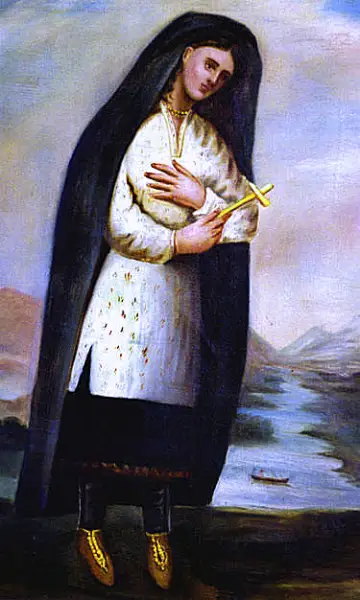
Kateri Tekakwitha was a Mohawk woman of the mid-seventeenth century whose quiet constancy made her the first Native American to be raised to the altars of the Catholic Church. Born near Ossernenon in present-day New York, she lost her parents and brother to a smallpox epidemic as a small child and carried its scars and weakened sight for the rest of her life. Raised afterward in her uncle's household, she encountered Jesuit missionaries in her youth and, after long resistance from her relatives, was baptized on Easter Sunday of 1676, taking the name Catherine. When ridicule and threats followed her conversion, she left the Mohawk country and walked two hundred miles to the mission village of Kahnawake, south of Montreal, where converted Native Christians lived near the Jesuits. There she made a public vow of perpetual virginity on the Feast of the Annunciation in 1679, prayed and worked for her people, and accepted severe bodily penance. She died at Kahnawake on April 17, 1680, still in her early twenties. Witnesses reported that her scarred face became radiant at death and that she appeared afterward to several friends, and pilgrims soon gathered at her grave. Beatified in 1980 by Pope John Paul II, she was canonized by Pope Benedict XVI in 2012, honored as the Lily of the Mohawks.
The Complete Life
A Childhood Marked by Sickness and War
Tekakwitha was born around 1656 in Ossernenon, a Mohawk village in what is now northeastern New York. Her father, Kenneronkwa, was a Mohawk chief; her mother, Kahenta, was an Algonquin woman captured in a raid, adopted into the tribe, and married to Kennerkwa after she had already been baptized and taught by French missionaries at Trois-Rivières. The village itself was a mingled world, for the Mohawks received hundreds of captives taken in war to replace their own dead. When the girl was about four, smallpox swept through the family: her parents and her little brother died, and she alone survived, her face scarred and her sight impaired, covering her marks with a cloth and a shawl. An uncle received her first, and afterward her paternal aunt and that aunt's husband, a Turtle Clan chief, gave her a home; she grew into a skilled and modest young woman who wove mats, prepared food, and made clothing with care. At eleven she first met three Jesuits, probably the first white Christians she had ever seen, and their manner left a deep impression, though her uncle opposed anything that might lead her toward their faith.
§ Early life and education
Refusing Every Husband but Christ
The world of her girlhood was unstable. In 1666 French troops marched into Mohawk country, burned three villages, and drove the people into flight; the peace that followed obliged the Mohawks to tolerate Jesuit missionaries, and a mission rose near present-day Auriesville. When Tekakwitha was about thirteen she helped the priest Jean Pierron nurse the wounded after a Mohican assault on Caughnawaga, and later that year she saw the Iroquois leadership promise to abandon the Feast of the Dead after a confrontation with Father Pierron. By seventeen her adoptive mother and aunt were arranging a marriage for her; she fled the cabin and hid in a field until they gave up. To her confessor she declared that she could have no spouse but Jesus. In the spring of 1674 the visiting priest Jacques de Lamberville heard her story, and she began to study the catechism under his direction. On Easter Sunday, April 18, 1676, he baptized her, and she received the name Catherine, in honor of Catherine of Siena — Kateri in the Mohawk tongue. Not every villager welcomed the change: some accused her of sorcery, and others stoned and threatened her until her life in the longhouse became unbearable.
§ Conversion and Kahnawake
Two Hundred Miles to Kahnawake
To live her faith in peace, Kateri left everything she knew and traveled some two hundred miles to the mission of St. Francis Xavier at Sault Saint-Louis, the village the French called Kahnawake, just south of Montreal. The Jesuits had founded it for the conversion of Native peoples, and it sheltered Christians from several nations of the Iroquois Confederacy who had moved north; recognized by New France and granted a measure of self-government, it kept the longhouses, the chapel, and the movement from site to site that marked ordinary Iroquois settlement. She reached the mission in 1677 — the year Chauchetière himself came — and lodged in the longhouse of her elder sister and that sister's husband. Anastasia Tegonhatsiongo, who had been her mother's intimate friend, was the clan mother of the house, and the other Christian women instructed her in the regular practices of prayer, for the missionaries were few and much of the daily work of conversion belonged to the villagers themselves. Father Cholenec observed that the Iroquois who became Christian at Kahnawake owed their conversion chiefly to the zeal of their own relatives. In that setting the young convert found not only safety but a community in which her vocation could take shape among her own people.
§ Mission du Sault St-Louis: Kahnawake
The First Iroquois Virgin
At Kahnawake Kateri's interior life hardened into resolve. She placed thorns on her sleeping mat and lay upon them while praying for the conversion and forgiveness of her relatives, a bodily penance that drew on traditional Iroquois ritual yet alarmed the priests, who feared for her delicate health; she answered that she would gladly surrender her body to hunger and suffering if her soul could keep its nourishment. With her friend Marie-Thérèse Tegaianguenta she even attempted to found a religious order for Native women, a proposal the Jesuits declined. In 1679, on the Feast of the Annunciation, she made the vow of perpetual virginity that the Church has ever since regarded as the completion of her conversion, telling Father Cholonec that she had consecrated herself wholly to Jesus, the son of Mary, and had chosen him alone for her husband. The early Jesuit biographers called her the first Iroquois virgin. Though circumstances never allowed her to receive the formal consecration of virgins from a bishop, the United States Association of Consecrated Virgins would one day take her as its patroness. Chauchetière, who came to believe she was a saint, fixed on her charity, industry, purity, and fortitude, while Cholenec emphasized her virginity.
§ Conversion and Kahnawake
Holy Wednesday, 1680
Kateri spent only the last two years of her life at Kahnawake, but they fixed her memory forever. During Holy Week of 1680 her friends saw that her strength was failing, and when her hours grew few the villagers gathered with Fathers Chauchetière and Cholenec, who gave her the last rites. She died at about three in the afternoon on Holy Wednesday, April 17, 1680, in the arms of Marie-Thérèse, her last words an act of love: Jesus, Mary, I love you. What followed became the seed of her cause. Cholenec recorded that the scarred, swarthy face he had known changed within a quarter of an hour after death and turned beautiful and white, her smallpox marks vanishing. In the weeks that followed she was believed to visit three of her circle: Anastasia Tegonhatsiongo beheld her kneeling with a wooden cross that gleamed like the sun; Marie-Thérèse was woken in the night by a voice bidding her farewell on the road to heaven; and Chauchetière gazed on her at her grave for two hours in what he described as baroque splendor. He built a chapel near her grave, pilgrims came from 1684 onward, and her remains, placed in the rebuilt mission chapel, were used as relics of healing.
§ Death and appearances
From Petition to Canonization
The road to the altars was long. A first printed account appeared only in 1715, and not until the 1880s did Catholic missions and bishops petition Rome for permission to venerate her, alongside the martyred Jesuits Isaac Jogues and René Goupil, arguing that her honor would encourage the faith among Native Americans. Catholics of the United States set the process in motion at Baltimore's Third Plenary Council in 1885, joined afterward by Canadian Catholics; in both countries, nine hundred and six Native Americans signed twenty-seven letters pressing the cause. Theologians approved her spiritual writings on July 8, 1936; the cause itself opened on May 19, 1939; and on January 3, 1943, Pope Pius XII declared her venerable. Pope John Paul II beatified her on June 22, 1980. The miracle that opened the way to sainthood reached back to 2006, when a Lummi boy in Washington state, dying of a flesh-eating infection, recovered after his family and an expanding network of friends prayed for her intercession and a relic was placed against his body; the next day the disease stopped advancing. A second miracle was certified on December 19, 2011, and on October 21, 2012, Pope Benedict XVI canonized her at St. Peter's Basilica.
§ Veneration
Lily of the Mohawks in the Modern World
Few American saints have entered the imagination so widely. More than three hundred books on her life have appeared in over twenty languages, and she has stepped into opera, theater, fiction by Leonard Cohen and Louise Erdrich, song, and animation. Her image — a lily and a cross, with a turtle or feathers recalling her Mohawk birth — stands at the National Shrine in Fonda, New York, at Auriesville, in the Basilica of the National Shrine of the Immaculate Conception, at the Cross in the Woods in Michigan, on the bronze portal of St. Patrick's Cathedral in New York, and in churches and schools across the continent. Since 1939 the Tekakwitha Conference has gathered yearly to support Catholic missions among Native Americans, its members praying in Kateri Circles. Commentators have seen in her virtues a bridge joining the Mohawk and European worlds, and her memory is honored far beyond Catholicism: in 2022 the Episcopal Church approved a feast for her on April 17. Yet her canonization also stirs debate among Mohawks, some of whom see in her story the sorrows of colonization, while others — and many elderly Native women interviewed in the 1990s — claim her simply as part of their own heritage. Under her patronage of ecology, the environment, exiles, orphans, and the ridiculed, she remains the Protectress of Canada and the Genevieve of New France.
§ Cultural references
Timeline
- 1656
Born at Ossernenon, a Mohawk town in today's upstate New York
§ Early life and education
- 1666
French forces burn the Mohawk villages of central New York, and she flees with her adoptive family
§ Upheaval and invasions
- 1667
Meets the Jesuit missionaries Jacques Frémin, Jacques Bruyas, and Jean Pierron when they visit her village
§ Upheaval and invasions
- 1669
Helps tend the wounded and carry food and water after Mohican warriors attack Caughnawaga
§ Upheaval and invasions
- Apr 1674
Tells the visiting Jesuit Jacques de Lamberville of her desire to become a Christian and begins studying the catechism with him
§ Family pressures
- 18 Apr 1676
Baptized by Jacques de Lamberville on Easter Sunday and given the name Catherine
§ Conversion and Kahnawake
- 1677
Leaves her village and joins the Christian Native community at the mission of St. Francis Xavier at Kahnawake
§ Conversion and Kahnawake
- 1679
Makes a vow of perpetual virginity on the Feast of the Annunciation, a decision the Church regards as completing her conversion
§ Conversion and Kahnawake
- 17 Apr 1680
Dies at Kahnawake on Holy Wednesday, in the arms of her friend Marie-Thérèse
§ Death and appearances
- 1684
Pilgrimages to her graveside chapel at Kahnawake are already under way
§ Death and appearances
- 1695
Claude Chauchetière writes the first biography of Tekakwitha
§ Jesuit Missionaries Chauchetière and Cholenec
- 1885
United States Catholics initiate her canonization cause at the Third Plenary Council of Baltimore
§ Veneration
- 3 Jan 1943
Pope Pius XII declares her venerable
§ Veneration
- 22 Jun 1980
Beatified by Pope John Paul II at Vatican City
§ Veneration
- 21 Oct 2012
Canonized by Pope Benedict XVI, becoming the first Native American saint
§ Veneration
In Their Own Words
I can have no spouse but Jesus.
I will willingly abandon this miserable body to hunger and suffering, provided that my soul may have its ordinary nourishment.
I have deliberated enough. For a long time, my decision on what I will do has been made. I have consecrated myself entirely to Jesus, son of Mary, I have chosen Him for husband, and He alone will take me for wife.
Jesus, Mary, I love you.
The Record
- Patron of
- environment and ecology·people in exile·Native Americans·orphans·people ridiculed for their piety·patroness of the United States Association of Consecrated Virgins
- Symbols
- lily·turtle·rosary·cross or crucifix
- Canonization
- Canonized by Pope Benedict XVI at St. Peter's Basilica on 21 October 2012; beatified by Pope John Paul II in 1980
Prayer
Bibliography
Show 6 sources
- Greer, Allan (2005). Mohawk Saint: Catherine Tekakwitha and the Jesuits. Oxford University Press.
- Koppedrayer, K. I. (1993). "The Making of the First Iroquois Virgin: Early Jesuit Biographies of the Blessed Kateri Tekakwitha". Ethnohistory. 40 (2). Duke University Press: 277–306.
- Sargent, Daniel. Catherine Tekakwitha. New York: Longmans, Green & Co., 1936.
- Walworth, Ellen Hardin (1891). The Life and Times of Kateri Tekakwitha: The Lily of the Mohawks, 1656–1680. Buffalo: Peter Paul.
- Lecompte, Edward. Glory of the Mohawks: The Life of the Venerable Catherine Tekakwitha. Translated by Florence Ralston Werum. Milwaukee: Bruce Publishing Co., 1944.
- "Liturgical Calendar. Proper to The Dioceses of Canada" (PDF). cccb.ca. January 27, 2016.
Profile text adapted from the Wikipedia article, licensed CC BY-SA 4.0.
Pray with this saint every day
Save St. Kateri Tekakwitha to your favorites, read the full profile, and get feast-day reminders in the Saints app.
Get the Saints AppFree on the App Store for iPhone and iPad