
1271 – after 1326·Feast 7 October
St. Katherine of Ledbury
Noble widow who became an anchoress of Ledbury
Overview
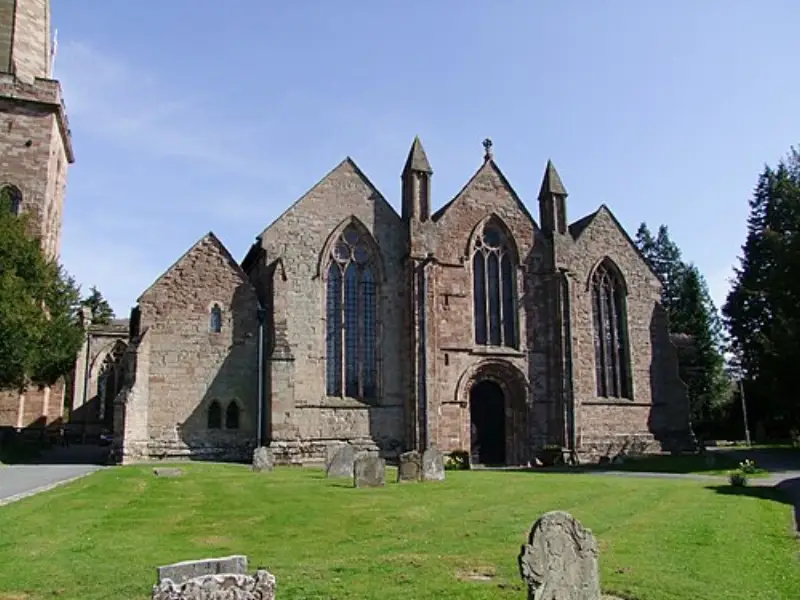
Katherine of Ledbury, also known as Katherine de Audley, was a Gloucestershire-born noblewoman of the thirteenth and fourteenth centuries who abandoned her rank to live as an anchoress at Ledbury in Herefordshire. Born in 1271 at Brimpsfield, the daughter of Baron John Giffard and Maud de Longspée, a great-granddaughter of King John, she married Baron Nicholas de Audley as a teenager and bore three children. When her husband and father both died in 1299 she inherited lands across four counties, making her one of the most eligible widows of the Welsh border country. Yet in February 1308, the day of King Edward II's coronation, she disappeared from the world she had known, and by degrees she surrendered her properties, transferring her dower-lands to her son for an annuity and granting her Carmarthenshire estates to her daughter. By 1323 a deed styled her a recluse, enclosed at the Church of St Michael and All Angels in Ledbury. Legend tells that she had followed the miraculous ringing of church bells to the town, vowing to rest nowhere else, and that she lived there on herbs and milk. Though never officially canonized, she was honored as a saint by the town, celebrated in a sonnet by William Wordsworth and in a book by Poet Laureate John Masefield.
The Complete Life
A Baron's Daughter of the Welsh Marches
Katherine was born in 1271 at Brimpsfield in Gloucestershire, into the highest rank of the Anglo-Norman nobility. Her father was John Giffard, 1st Baron Giffard, lord of Brimpsfield Castle; her mother was Maud de Longspée, a great-granddaughter of King John, binding the girl to the blood royal of England. In 1287 or 1288, when she was fifteen or sixteen, she was married to Baron Nicholas de Audley, and she bore him two sons and a daughter, the first arriving when she was seventeen. Her life to that point followed the expected course of a noblewoman of her class: marriage, childbearing, and the management of great households. The turning point came in 1299: husband and father died within months of each other, and Katherine found herself owner of lands across Carmarthenshire, Shropshire, Staffordshire, and Cheshire. McAvoy reckons her the most sought-after widow on the Welsh frontier, a woman whose remaining single so long must have astonished her contemporaries, furnishing material for the future mythologizing of her life. Where she lived in the years between her widowhood and her appearance in Ledbury is not known.
§ Life
Disappearance and the Road to Enclosure
Katherine dropped out of sight on 25 February 1308, coronation day of Edward II, and several accounts next place her in Ledbury, living as a recluse. McAvoy has speculated that the disappearance and reappearance may have been a strategy to escape remarriage to another lord, a fate commonly imposed on wealthy widows of the period. Her path toward withdrawal from the world unfolded through a series of deliberate legal acts. In November 1308, according to John Masefield, she secured license to settle her dower-lands on her son Nicholas, taking from him £100 yearly to live on — Masefield's first sign of her withdrawal from the world. The antiquarian Rotha Mary Clay dated the gift of part of her maternal inheritance to 1312 and, from where the deed was drawn, judged that Ledbury was already her home, with the bishop enclosing her there as anchoress of St Michael and All Angels. On 7 October 1313 she granted her Carmarthenshire lands to her daughter and son-in-law, though Masefield held that she was not yet a recluse at that date. Sometime between then and 1323 her enclosure began: a deed of that year, the earliest to call her recluse, records an annuity of £30 conveyed by the Hereford sheriff out of lands her husband's executor controlled.
§ Life
The Anchoress Under the Bell-Tower
As an anchoress Katherine belonged to one of the most demanding vocations of medieval England: a woman walled into a cell attached to a parish church, committed to remain there until death. Local folklore identifies the Farm or Mill of the Hazels as the place she lived before building her hermitage at the parish church, and preserves the memory of her walks: Mabel's Furlong preserves the name of the lane down which mistress and maid walked to the church, a label still printed on maps, and Katherine's Acre is the field to its south. Other traditions denied her any home at the farm, making her maid the errand-runner who brought back the milk she sometimes drank. Within St Michael and All Angels she kept to the shadow of the bell-tower, and her way of life left its mark on the town's geography and imagination alike. Katherine's Stone, the rock on which she was reputedly seated when the miraculous bells sounded, long remained visible beside Katherine's Acre until someone removed it. One Victorian account even remembered her as a former pious superintendent of St Katherine's Almshouses in Ledbury, an image of active charity that preceded her enclosed withdrawal, and one of several threads in the weaving of her story.
§ Legends
The Bells That Rang Alone
The legends of Katherine cluster around a single sign: church bells rung by no human hand. One Ledbury legend tells that a vision warned her she must not rest until she reached a place where the bells rang unaided. In Clay's version of the story, mistress and maid roamed from one place to another, across Worcestershire and into Herefordshire, tracking the hoof-prints of the stolen mare. The antiquarian Jabez Allies recorded another version in which Katherine prayed over the theft and the footprints of both thief and horse sank deep, not into soil alone but into the very stones they crossed; Allies drew the marks he said he had found in the sandstone of Whelpley Brook, known to neighbors as St. Catherine's Mare and Colt and long carried as charms against robbery. At Bosbury the bells rang for a wedding, and Katherine knew it was not the place, having said she would end her days in a town whose name ended in bury. Only at Ledbury did the bells ring of themselves, and she resolved to remain. Her asceticism was remembered in the fare attributed to her, herbs and milk, and her enclosure found its liturgical echo in the words Masefield followed back to the Exeter rite: let this be my rest for ever and ever.
§ Legends
Poverty at the End
The documents that trace Katherine's careful disposal of her properties also record how poorly those arrangements served her in the end. During the final years of her life, the funding meant to sustain her anchoritic existence was mismanaged, paid haphazardly, and at times fraudulently stolen. Liz Herbert McAvoy has wondered whether the woman who had commanded estates in four counties lived her last years as an anchoress in genuine poverty, depending largely on alms from the community of Ledbury she had chosen as her home. The irony is sharp but fitting to the anchoritic ideal, which required the recluse to die to property and status as completely as to family. Katherine died sometime after 1326 or 1327, having spent roughly two decades or more enclosed at St Michael and All Angels. No record tells how the townspeople marked her passing, but the veneration that followed suggests they remembered her as one of their own. The chapel that may have risen over her hermitage and tomb, the place-names scattered through the town, and the bells she chose as her sign all kept her memory alive in Ledbury long after the last annuity payment had been spent and the details of her life had passed into legend.
§ Life
A Saint Without a Canonization
Katherine was never formally canonized, yet Ledbury knew her as a saint. John Masefield recorded that she was known simply as a very good woman, and speculation holds that the Chapter House of St Michael and All Angels Church, also called St Katherine's Chapel, was built as a shrine to her, perhaps in anticipation of a canonization that never came; Masefield noted that the chapel has no altar, a possible sign that it was left unconsecrated pending an appeal for her canonization. The Diocese of Hereford keeps her memorial on 7 October, the date on which she stripped herself of her estates ahead of enclosure. An older feast on 25 November appears in the Encyclopædia Britannica Eleventh Edition's notice of a St Catherine Audley, a recluse of Ledbury reputed for piety and clairvoyance, but Masefield attributed that date to confusion with Catherine of Alexandria, whose long-attested feast falls on the same day. Clay went further, proposing that Katherine's very sainthood may have grown out of that tangle, for the town's chapel, hospital, and almshouse were all dedicated to her namesake long before Katherine was born. McAvoy points instead to the closeness of Katherine's cell to St Katherine's Hospital, less than a hundred meters away, welding the two women together in the popular imagination.
§ Cult
Poets, Bells, and the Memory of Ledbury
Katherine's afterlife belongs largely to English literature. In 1827 William Wordsworth, staying at Brinsop Court in Herefordshire, traveled to Ledbury and composed the sonnet St. Catherine of Ledbury, published in 1835, which fixed the legend of the self-ringing bells in the national imagination; McAvoy speculates that the poet's wife and sister, staying near Ledbury before him, may have carried the local story to him. Alexandra Walsham of Cambridge University read the poem as a healthy reminder that poets and scholars invent and reinvent the traditions that time lets lapse. In 1951 the Poet Laureate John Masefield, himself a native of Ledbury, learned that the parish bells would soon fall silent for lack of funds, wrote St. Katherine of Ledbury and Other Ledbury Papers, and gave the proceeds to the Ledbury Bell Fund. Masefield offered a natural explanation for the legend, noting that Ledbury lies in one of England's few earthquake zones and suggesting that a tremor had rung a consecration bell while Katherine watched, and he found historical depth in her legendary words, which echo the Ritual of Enclosure. He also took a harmless pleasure in seeing portraits of Katherine and Mabel in the carved heads on the chapel corbels, one a visionary, the other still of the world.
§ References in literature
Timeline
- 1271
Born at Brimpsfield, Gloucestershire, to John Giffard, 1st Baron Giffard, and Maud de Longspée.
§ Life
- 1287
Married Baron Nicholas de Audley at fifteen or sixteen; her first child was born when she was seventeen.
§ Life
- 1299
Her husband and her father both died, leaving her a large inheritance of lands in Carmarthenshire, Shropshire, Staffordshire, and Cheshire.
§ Life
- 25 Feb 1308
Went missing on the day of King Edward II's coronation, later appearing in Ledbury as a recluse.
§ Life
- Nov 1308
Secured license to settle her dower-lands on her son Nicholas, taking from him £100 each year to keep herself.
§ Life
- 1312
Gave away part of her maternal inheritance, likely while already living in Ledbury.
§ Life
- 7 Oct 1313
Conveyed her Carmarthenshire estates to her daughter and that daughter's husband; Hereford diocese now keeps this date as her memorial.
§ Cult
- 1323
A deed styling her a recluse — her £30 annuity payable by the Hereford sheriff — is the earliest record to use that title of her.
§ Life
- 1827
William Wordsworth, visiting Ledbury from Brinsop Court, composed the sonnet "St. Catherine of Ledbury."
§ Wordsworth's sonnet
- 1835
Wordsworth's sonnet was published, immortalizing the legend of Katherine and the bells.
§ Wordsworth's sonnet
- 1951
Poet Laureate John Masefield, a native of Ledbury, wrote St. Katherine of Ledbury and gave the proceeds to the Ledbury Bell Fund.
§ John Masefield's book
In Their Own Words
Here I set up my rest
Be this my rest for ever and ever
When struck, I am the Rose of the World, called Katherine
The Record
- Major works
- Hermitage built at the Church of St Michael and All Angels, Ledbury, where she lived as an anchoress·Transfer of her estates to her children, securing annuities that funded her enclosed life
- Patron of
- Ledbury, Herefordshire
- Symbols
- ringing bells·the footprints of her stolen horse·clairvoyance·herbs and milk
- Canonization
- Never formally canonized; venerated locally as a saint, with a memorial on 7 October in the Diocese of Hereford and an older feast on 25 November.
Prayer
Bibliography
Show 6 sources
- Clay, Rotha Mary (1914). The Hermits and Anchorites of England. London: Methuen. p. 74–75.
- McAvoy, Liz Herbert (2013). "Uncovering the 'saintly Anchoress': myths of Medieval anchoritism and the reclusion of Katharine de Audley". Women's History Review. 22 (5): 801–819.
- Masefield, John (1951). St. Katherine of Ledbury. London: Heinemann.
- Allies, Jabez (1835). Observations on Certain Curious Indentations in the Old Red Sand-Stone of Worcestershire and Herefordshire Considered as the Tracks of Antedeluvian Animals. London: William Edwards.
- "A woman Ledbury will never forget". Worcester News. Newsquest. Retrieved 1 December 2018.
- Reade, Compton (1904). Memorials of Old Herefordshire. Herefordshire, England: Bemrose and Sons. p. 274.
Profile text adapted from the Wikipedia article, licensed CC BY-SA 4.0.
Pray with this saint every day
Save St. Katherine of Ledbury to your favorites, read the full profile, and get feast-day reminders in the Saints app.
Get the Saints AppFree on the App Store for iPhone and iPad