
died early 6th century·Feast November 5
St. Kea
Hermit bishop of the Old North and Cornwall
Overview
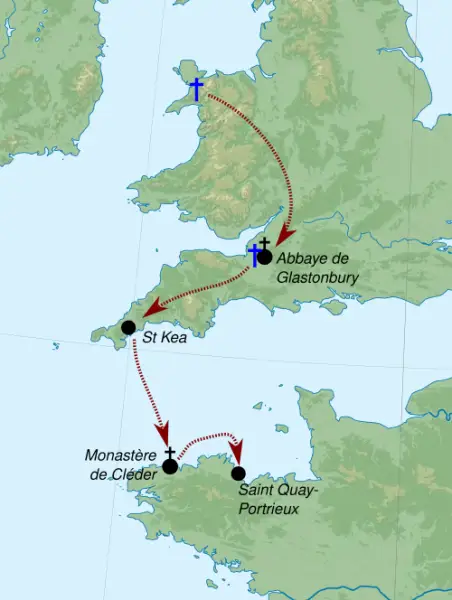
Kea was a British saint of the late fifth and early sixth centuries who came from the Hen Ogledd, the Old North — the Brythonic-speaking country of the far island north, in lands today lying between Scotland and England. Tradition makes him the son of King Lleuddun Luyddog of Lothian, and gives him service as a bishop in North Britain before he abandoned episcopal rank for the life of a hermit. His wandering took him first into Wales and then southward through the West Country, where he founded churches at Street in Somerset and Landkey in Devon before settling at Old Kea in Cornwall, a place that took his name. There, the legend relates, he clashed with the Cornish king Teudar, who harassed him for sheltering a hunted deer; when his oxen were confiscated, Kea yoked the deer to his plow in their place. In old age he crossed to Cleder in Brittany, where he died and where he is honored as Saint Quay. His memory was kept in Cornwall by mystery plays performed at Playing Place and by the Cornish-language drama Beunans Ke, rediscovered in 2000, which preserves episodes of his legend, including his dealings with King Arthur.
The Complete Life
A Prince of the Old North
Kea came from the Hen Ogledd, the Old North of British legend and history, the Brythonic-speaking country spread over the island's north — today's border country of Scotland and England — in the generations after Rome withdrew from Britain. Tradition names his father as King Lleuddun Luyddog of Lothian, placing the saint in the royal house of one of the old northern kingdoms at precisely the time when such realms were fighting to hold their own against Pict, Saxon, and Angle. His cult was popular not only in the lands of his birth but throughout Wales and the West Country, a spread that reflects the movement of British Christians in that age from the embattled north toward the western kingdoms that remained theirs. Kea is remembered in Breton as Ke and in Cornish and Breton alike under that short form, while the French call him Ké. A companion called Fili — Filius in some forms — gave his name to the parish church of Philleigh in Cornwall, and is said to have journeyed from Wales at the saint's side, one of the many secondary figures that gathered around a founder of Kea's reputation.
§ Introduction
Bishop Who Became a Hermit
The shape of Kea's vocation is given by the medieval lives: he served as a bishop in North Britain before giving up the episcopate to become a hermit. To resign a see in search of solitude was a striking act in the sixth-century church, and the tradition of Kea's renunciation places him among those British saints for whom the hierarchy of the declining northern kingdoms could not contain the desire for God. The chief sources for his life are, in any case, late: Maurice of Cleder's lost Latin hagiography of the seventeenth century, which survives only in a French digest, and Beunans Ke, the incomplete Cornish-language play of the sixteenth century brought to light again in 2000 and now held by the National Library of Wales. Through these channels comes the account of the royal son who held office in the church of the Old North and then walked away from it, first into Wales and then into the southwest. Whatever the historical nucleus, the memory preserved is of a man who measured every station by the single standard of detachment, and who found in the hermit's cell the freedom the episcopal throne could not give.
§ Legend
Street, Landkey, Old Kea, and the King's Deer
Kea's missionary path ran south by stages. From Wales he moved into the West Country, founding churches at Street in Somerset and at Landkey in Devon, communities that carried his name into two counties before he made his final settlement. That settlement was at Old Kea in Cornwall, on the river among the fields of mid-Cornwall, which was subsequently named for him and remained the center of his cult. Here the legend attaches its most memorable story: Kea sheltered a deer that the Cornish king Teudar was hunting, and the enraged king harassed the saint and confiscated his oxen. Kea answered the injury with the famous image of his iconography, yoking the deer to the plow so that the hunted beast did the work of the stolen teams, a parable of gentleness victorious over power. An alternate tradition makes him an Irish monk who, watching missionaries depart for Cornwall without him, prayed not to be left behind until the granite slab beneath his feet floated and carried him across the sea, the same marvel told of Piran landing at Perranzabuloe. Either way, the saint who arrived belonged to Cornwall forever.
§ Legend
Across the Sea to Cleder
The last chapter of Kea's life belongs to Brittany. In age he crossed the Channel to Cleder in Brittany, on the northern coast of the Breton peninsula, and there he eventually died. The Breton church keeps him as Saint Quay, and the parish of Cleder became the home of his principal shrine, honored by Catholics, Anglicans, and Orthodox alike on his feast of November 5. The crossing from Cornwall to Brittany joined Kea to the great company of British and Welsh saints whose bones sanctified the Armorican peninsula in the age of migration, when the peoples of the western sea moved continually between the two coasts. It is fitting that the life which began with a throne in the Old North should end in a Breton village by the water: prince, bishop, hermit, fugitive from a king's anger, and finally pilgrim, he exhausted every worldly station before death found him. His attributes in art gather the story into a single figure, the hermit with his stag, the hunted beast made gentle beside the man who gave up everything to follow Christ.
§ Legend
Plays at Playing Place and a Rediscovered Saint
Kea's cult remained alive in Cornwall long after the middle ages through the drama of the Cornish people. Plays featuring the saint were performed at Playing Place, near Truro, in the plain-an-gwarry, the open-air round where biblical and saintly plays were staged, and a plaque today marks the field that held them. The most substantial monument is Beunans Ke, the Life of St Ke in Cornish verse, an incomplete play of the sixteenth century that vanished for centuries and was rediscovered in 2000. The drama preserves Kea's dealings with King Arthur, recounting Arthur's war against the Roman emperor Lucius Hiberius and the treason Mordred afterward committed, so that the saint's legend intersects with the Matter of Britain itself. A French summary of the lost Latin life by Maurice of Cleder, the seventeenth-century priest of the saint's Breton shrine, carries the narrative tradition on the other side of the Channel. Few Cornish saints can show so continuous a memory: a parish named Old Kea, a round where his story was acted, a plaque for pilgrims, and a rediscovered play that returned his voice to the language in which Cornwall first prayed to him.
§ Plaque at Playing Place
The Record
- Major works
- Churches at Street, Somerset and Landkey, Devon·Settlement at Old Kea, Cornwall
- Patron of
- Old Kea, Cornwall
- Symbols
- hermit with a stag
- Canonization
- Pre-congregation; ancient cult in Cornwall, Devon, Wales, and Brittany
Prayer
Bibliography
Show 7 sources
- Doble, G. H. (1964). The Saints of Cornwall, part 3. Truro: Dean and Chapter, pp. 89-103.
- Ellis, P. B. (1992). The Cornish Saints. Penryn: Tor Mark Press, p. 12.
- "Beunans Ke (The Life Of St Ke)". Llyfrgell Genedlaethol Cymru - National Library of Wales. Archived from the original on 22 September 2012. Retrieved 20 November 2009.
- Orme, Nicholas (2000). "Sidwell (Sativola)", The Saints of Cornwall. OUP Oxford, p. 157. ISBN 9780191542893.
- Monks of Ramsgate (1921). "Kea". Book of Saints. CatholicSaints.Info, 15 December 2013.
- Hunt, Robert (1903). "St. Kea's Boart", Popular Romances of the West of England, 3rd ed. London: Chatto and Windus.
- Henderson, James Charles (1929). Four Saints of the Fal: St Gluvias, St. Kea, St. Fili, St Rumon.
Profile text adapted from the Wikipedia article, licensed CC BY-SA 4.0.
Pray with this saint every day
Save St. Kea to your favorites, read the full profile, and get feast-day reminders in the Saints app.
Get the Saints AppFree on the App Store for iPhone and iPad