
c. 786 – 821·Feast July 17
St. Kenelm
Boy king and martyr of Mercia
Overview
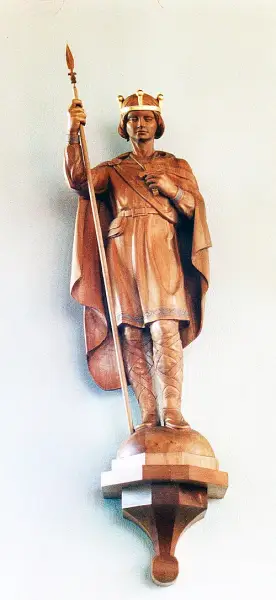
Kenelm, or Cynehelm, was a prince of the Mercian royal house who became one of the most popular saints of medieval England. History knows him as the son of King Coenwulf of Mercia: a letter attributed to Pope Leo III in 798 addresses him as king at the age of twelve, his name appears on charters from 803 onward, and he subscribed his father's final charter in 821. The legend that grew around him tells a darker and stranger story: a boy of seven crowned on his father's death, warned by a prophetic dream, murdered in the Clent Hills by his tutor Askobert at the instigation of his envious sister Quendryda, and secretly buried beneath a thorn. A dove was said to have carried the news of his resting place to the Pope, and a party from Winchcombe recovered the body, guided by a pillar of light, while a healing spring burst from the ground where he had lain. His relics were translated to the royal abbey of Winchcombe, where pilgrims flocked for centuries on his feast of July 17. Chaucer invokes him in The Nun's Priest's Tale, and William of Malmesbury recorded that no shrine in England drew more pilgrims.
The Complete Life
A Prince of the Mercian Royal House
Kenelm was born into the ruling family of Mercia, the great midland kingdom of Anglo-Saxon England, in the generation after the age of Offa. The historical record places him precisely in that world: when Offa died, his son Ecgfrith was crowned but reigned only twenty weeks and was probably killed in battle, and the succession passed to a distant cousin, Coenwulf, whose son was Kenelm, or Cynehelm. The boy grew up a king's son in a court that straddled the old hero culture and the newer Christian order, and the very meaning of his name suggests royalty — the prefix cyne carrying the sense of the royal. Two figures of his childhood stand in the sources: his sister Cwenthryth, called Quendryda in the legend, who entered the cloister and became abbess of Minster-in-Thanet at the time of their father's death; and the tutor and guardian Askobert, who in the story of the legend would become his murderer. Between history and hagiography, the child of the charters and the child of the legend are one and the same prince, remembered by a whole nation.
§ Factual records of Kenelm's life
Heir Hallowed to the Throne
The documented traces of Kenelm's life sketch a royal career cut to the pattern of an heir. In 798 a letter allegedly from Pope Leo III addressed him as king and gave his age as twelve, and it is likely that his father had by then 'hallowed' him to the throne in the Mercian manner, anointing the heir during the king's own lifetime. In 799 his name stands among the witnesses to a grant of land to Christ Church, Canterbury, and the charters carry it regularly from 803 onward — the ordinary currency of a prince acting in his father's government. Then the record falls silent: his name disappears from the charters for a time after 811, so long a silence that historians have suspected he died in those years. But he was alive, for in 821 the record finds him again, signing his father's final charter under the style "Kenelmus, son of the king." By that document he must have been about thirty-five years old. The charters thus correct the legend at one point and confirm it at another: he did live and die a royal son of Coenwulf, though not as a seven-year-old.
§ Factual records of Kenelm's life
The Legend of the Boy King
The earliest full telling of the legend survives in a twelfth-century manuscript from Winchcombe Abbey, claiming descent from an account by a Worcester monk named Wilfin, and it makes Kenelm a child of seven when his father Coenwulf died. The boy was chosen to succeed; his sister Quendryda, envying him and foreseeing a crown of her own if he were removed, bribed his tutor Askobert with money and the command to slay her brother. On the night before a royal hunt in the forests of Worcestershire, Kenelm dreamed that he climbed a great tree decked with flowers and lanterns and saw the four quarters of his kingdom from on high: three bowed to him, but the fourth chopped at the trunk until the tree fell, and he became a white bird and flew to safety. His nurse, a wise old woman skilled in dreams, wept when she heard it, for she knew the child was fated to die. The dream, the treason of his own family, and the hunt that would end in martyrdom form the tragic opening of one of the most loved stories of medieval England.
§ The Legend of St Kenelm
The Blossoming Rod and the Te Deum
The legend gives the child martyr two signs of heaven's favor before his death. On the first day of the hunt, tired and hot, Kenelm lay down beneath a tree to rest, and Askobert began digging his grave; the boy woke and warned his murderer that he would be slain in another spot, thrusting his stick into the ground, where it instantly took root and flowered — the tree known after as St Kenelm's Ash. Unshaken, Askobert led the little king up into the hills of Clent, and while the boy's voice rose in the Te Deum, the old hymn of praise to God, the assassin struck off his head and buried him where he fell. The image of the boy singing praise at the moment of murder fixed itself in the English imagination as the very type of martyrdom: innocent, unwarned in vain, and worshipful to the last breath. His soul, the story continues, took wing as a dove with a scroll in its beak, crossed the sea, and let fall before the Pope a riddle that told, in veiled words, where the headless king-born Kenelm lay beneath a thorn in the meadow of the kine.
§ Winchcombe Abbey
Discovery, Spring, and Translation
The Pope wrote to the Archbishop of Canterbury, who sent a party from the Mercian capital at Winchcombe to find the body. On the way a column of light appeared above a Worcestershire thicket and showed them where to look; beneath it lay the murdered king's remains, and as they raised them a rushing fountain burst from the ground and flowed into a stream that brought health to all who drank of it. Carrying the body home, the party was met at the ford of Pyriford over the River Avon by an armed band from Worcester Abbey claiming the relics, and the dispute was settled by agreement that whichever group woke first in the morning should win the prize — the Winchcombe monks rose first, though the Worcester party pursued them to the last mile. Exhausted within sight of the abbey, they struck their staffs into the ground and a second spring burst forth to refresh them, and when at last they brought the body through its gates, the bells of Winchcombe rang without any hand upon them. There the relics were buried with all honor, and the murderer's patroness Quendryda, who cursed her brother's name, lost both her eyes upon the psalter she held.
§ Winchcombe Abbey
Martyr of Winchcombe
Kenelm has been revered as a martyr since the earliest telling of his story, and his cult was confirmed by no formal act: he belongs to the age before congregations, venerated in the Catholic Church, the Anglican Communion, and the Eastern Orthodox Church alike. His feast falls on July 17, the date of the translation of his relics to Winchcombe, and his major shrine was the Royal Mercian Abbey there, where a stone coffin said to be his, once in the abbey church, may still be seen at St Peter's Church in the town. William of Malmesbury, writing in the twelfth century, testified that no place in England drew more pilgrims on a saint's day than Winchcombe on Kenelm's. The South English Legendary added its own tender legend of the cult's survival: Quendryda had forbidden her brother's name to be spoken, so God caused a cow to sit at the secret grave, eating nothing by day yet returning each evening full of milk, until all the district knew and the valley was called Cowbach. The spring at his grave on the Clent Hills was still faithfully visited, and the memory of the murdered boy outlasted every attempt to silence it.
§ South English Legendary
From Chaucer to the Pilgrimage Trails
Few English saints can show so long a literary afterlife. Chaucer's Nun's Priest's Tale appeals to the Life of Saint Kenelm, with its dream foretelling murder, as proof that dreams may be believed, and William Shenstone devoted one of his elegies to the tale. In the twentieth century Francis Brett Young wrote the long poem The Ballad of St Kenelm, AD 821, later set to music by Andrew Downes, and Geoffrey Hill named the saint and his village of Romsley in The Triumph of Love. On the ground, his memory is carried by eight Anglican churches dedicated to him, from the Clent Hills to Dorset, and two Roman Catholic churches of Our Lady and St Kenelm at Halesowen and Stow-on-the-Wold, near the two poles of his story; in 2023 the Catholics of the Clifton diocese set Kenelm's name over a newly formed pastoral area. At Romsley in the Clent Hills, the twelfth-century church of St Kenelm at Kenelstowe still stands, and for generations the villagers kept his feast with a fair and the custom of 'crabbing the parson', bombarding the cleric with crab apples. Two long-distance paths, St Kenelm's Trail and St Kenelm's Way, now link Clent and Winchcombe on foot, restoring in walking what the pilgrims of the middle ages knew by heart.
§ Literature
Timeline
- 798
A letter allegedly from Pope Leo III addresses him as "King Kenelm" and gives his age as twelve
§ Factual records of Kenelm's life
- 799
Adds his name as witness when a gift of land is made to Christ Church, Canterbury
§ Factual records of Kenelm's life
- 803
His name begins to appear on a variety of charters, continuing through the following years
§ Factual records of Kenelm's life
- 811
His name disappears from the charters after this year, leading some to believe he died then
§ Factual records of Kenelm's life
- 819
Coenwulf of Mercia dies, leaving the seven-year-old Kenelm chosen king; his sister Quendryda conspires with his tutor Askobert against him
§ Winchcombe Abbey
- 821
Signs his father's final charter as "Kenelmus, son of the king", proof that he still lived
§ Factual records of Kenelm's life
- 17 Jul 821
Said to be murdered in the Clent Hills while singing the Te Deum; the historical record suggests he was about thirty-five, not a child
§ Winchcombe Abbey
In Their Own Words
There was no place in England to which more pilgrims travelled than to Winchcombe on Kenelm's feast day.
Low in a mead of kine under a thorn, of head bereft, lieth poor Kenelm king-born
Why in the 'Life' of Saint Kenelm I read / Who was Kenelphus' son, the noble king / Of Mercia, how Kenelm dreamed a thing / A while before he was murdered, so they say
The Record
- Canonization
- Pre-Congregation; venerated as a martyr from the early medieval period
Prayer
Bibliography
Show 7 sources
- Baring-Gould, S. (Sabine) (1897). The Lives of the Saints. Vol. 8, part 2. London: John C. Nimmo, pp. 427-428.
- Wasyliw, Patricia Healy (2008). Martyrdom, Murder, and Magic: Child Saints and Their Cults in Medieval Europe. Peter Lang, p. 75 et seq. ISBN 9780820427645.
- Butler, Alban (1962). Thurston, Herbert; Attwater, Donald (eds.). Butler's Lives of the Saints. Vol. 3. New York: P. J. Kenedy & Sons, pp. 127-128.
- D'Evelyn, Charlotte; Mill, Anna J., eds. (1967) [1956]. "Saint Kenelm, from Corpus Christi College Cambridge MS 145". The South English Legendary. Vol. 1. Oxford University Press, pp. 279-291.
- Hill, Geoffrey (1998). The Triumph of Love. New York: Houghton Mifflin, pp. 1, 2. ISBN 9780395912355.
- Hogg, Richard M.; Denison, David (2006). A history of the English language (illustrated ed.). Cambridge University Press, p. 228. ISBN 978-0-521-66227-7.
- "Anglo-Saxons.net: S 184". Sean Miller. Retrieved 1 April 2021.
Profile text adapted from the Wikipedia article, licensed CC BY-SA 4.0.
Pray with this saint every day
Save St. Kenelm to your favorites, read the full profile, and get feast-day reminders in the Saints app.
Get the Saints AppFree on the App Store for iPhone and iPad