
died 13 September 1624·Feast September 13
St. Ketevan the Martyr
Queen of Kakheti and great martyr of Georgia
Overview
Ketevan was a Georgian princess of the Mukhrani branch of the Bagrationi dynasty, daughter of Prince Ashotan, who became queen consort of Kakheti through her marriage to Prince David, the future King David I. Widowed after his brief reign of 1601 to 1602, she turned to religious building and charity, and when a murderous usurper seized the Kakhetian crown with Iranian backing in 1605, she rallied the nobles, defeated the usurper in battle, and became regent for her young son Teimuraz I, governing Kakheti until 1614. Contemporary chroniclers recorded the mercy she showed the defeated enemy, treating their wounded, compensating harmed merchants, and honoring the fallen. In 1614 she went to the Safavid court as a negotiator, placing herself in the Shah's hands as a kind of honorable captive — a gambit that could not hold back the invasion. Held for years in Shiraz, she was ordered by Shah Abbas I to renounce Christianity and convert to Islam; on her refusal she was tortured to death with red-hot pincers on 13 September 1624. Canonized soon after by Patriarch Zachary, she became one of Georgia's most beloved saints. Portuguese Augustinian eyewitnesses carried portions of her relics to Georgia, and the search for her remains in Goa, confirmed by genetic analysis in 2013, kept her memory alive across continents into the twenty-first century.
The Complete Life
A Princess of Mukhrani Becomes Queen of Kakheti
Ketevan was born into the highest ranks of the Georgian aristocracy, a daughter of Prince Ashotan Bagration of Mukhrani, founder's heir of the Bagrationi-Mukhrani line within Georgia's ancient royal house. Her marriage joined her to another branch of the same dynasty: Prince David Bagration of Kakheti, who in 1601 ascended the throne of that eastern Georgian kingdom as King David I. Her tenure as queen consort was brief, lasting only through 1602, for David died young, leaving her a widow with a small son, Teimuraz, whose claim to the troubled Kakhetian crown would define the rest of her public life. Widowed royalty in the Caucasus of that era enjoyed neither security nor leisure. Kakheti lay within the shadow of the Safavid empire, its politics entangled with Persian power and with the rivalries of a royal family whose members could and did kill for the throne. Into that dangerous world the young widow brought the resources of her station. Rather than withdraw into private grief, she devoted herself to religious building and works of charity, laying the foundation of the reputation for piety that would carry her through regency, captivity, and martyrdom.
§ Life
Mercy in Victory and Piety in Power
The crisis of 1605 revealed both the steel and the charity of Ketevan's character. David's brother Constantine murdered his own father, King Alexander II, and seized the Kakhetian crown with the support of Safavid Iran. Ketevan drew the Kakhetian nobility to her side against the patricide, crushed the loyalist army in the field, and lived to see the usurper perish. Victory might have licensed vengeance, but she chose the opposite course. The Safavid official and chronicler Fażli Ḵuzāni recorded her characteristic mercy toward the survivors of the defeated side: she ordered that wounded enemy soldiers receive proper treatment and be accepted into service if they wished it. Muslim traders harmed by the fighting received restitution and their liberty. The body of Constantine himself — her husband's murderer — was given honorable burial at her command and dispatched to Ardebil. Once the rising was over she exchanged the sword for statecraft, treating with Shah Abbas I, Georgia's overlord, until he recognized the boy Teimuraz I as king. With that secured, she took up the office of regent and governed Kakheti from 1605 to 1614, a decade in which her faith expressed itself in governance, generosity, and the patient defense of her son's inheritance.
§ Life
Hostage and Martyr in Shiraz
In 1614 Ketevan undertook the mission that would cost her everything. Sent by Teimuraz as a negotiator to Shah Abbas I, she made herself the Shah's guest in all but name, hoping her presence at his court would stay the Iranian armies from crossing into Kakheti. The attempt failed; her kingdom suffered attack all the same, and she remained held in Shiraz for several years while the Shah nursed his grievances against her recalcitrant son. Eventually Abbas turned his revenge upon the mother. He ordered the queen to renounce Christianity and embrace Islam, expecting a captive widow far from home to yield. She refused. What followed was among the most notorious martyrdoms of the seventeenth century: she was tortured to death with red-hot pincers, dying on 13 September 1624. Her death was witnessed by Portuguese Augustinian missionaries, whose account of her passion carried her story to Europe. Part of her remains were smuggled to Georgia by those very missioners and laid to rest at the Alaverdi Monastery; the rest, tradition says, found burial at the Church of St. Augustine in Goa, across the Indian Ocean, where they would lie undiscovered for nearly four centuries.
§ Life
Canonization and the Literature of Her Passion
The Georgian Orthodox Church raised Ketevan to the altar soon after her death. Patriarch Zachary of Georgia, who led the church from 1613 to 1630, canonized the martyred queen, and the church fixed her commemoration on 13 September — 26 September by the Gregorian reckoning — the anniversary of her passion. Her passion entered literature almost at once. Her son Teimuraz exploited the Augustinian account of his mother's death in his poem The Book and Passion of Queen Ketevan, composed in 1625, a work of both filial grief and national memory. The German author Andreas Gryphius drew on the same tradition for his classical tragedy Catharina von Georgien of 1657, carrying her story into European drama. Nearer to her own world, the Georgian monk Grigol Dodorkeli-Vakhvakhishvili of the David Gareja Monastery wrote a hagiographic work and several hymns centered on her life and martyrdom. The fascination crossed borders and centuries: in 1861 the Scottish poet William Forsyth published The Martyrdom of Kelavane, based on the traveler Jean Chardin's account of her death. Few saints of the Eastern churches have been remembered in so many languages.
§ Sainthood
The Recovery of the Queen's Relics
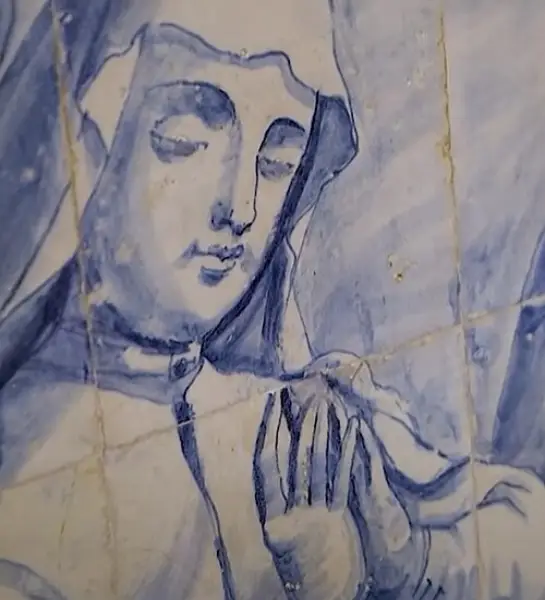
The importance of Ketevan to the Georgian people has driven a modern relic hunt spanning three decades. Since 1989, delegations from Georgia worked with the Archaeological Survey of India to locate her grave among the ruins of the Augustinian convent of Our Lady of Grace at Old Goa, hindered for years by the difficulty of interpreting the Portuguese documents that described her burial. Those sources held that her palm and arm bone fragments rested in a stone urn beneath a specific window of the convent's Chapter Chapel. In May 2004 a collaboration between the architect Sidh Losa Mendiratta and the Archaeological Survey of India located the chapel and the window; the urn itself was gone, but its coping stone and bone fragments lay nearby. Ancient DNA analysis at the CSIR-Centre for Cellular and Molecular Biology in Hyderabad and the Estonian Biocentre revealed the rare mtDNA haplogroup U1b — unknown in India, familiar in Georgia — and by 2013 further testing had shown the bone to belong to a woman of Georgian origin. In 2008 a large panoramic azulejo of her martyrdom was discovered at the Graça Convent in Lisbon, restored with Georgian funding and replicated at the Palace of Mukhrani in 2017. On July 9, 2021, India handed her relics to Catholicos-Patriarch Ilia II, closing a chapter four centuries long.
§ Relics and archaeological findings
Timeline
- 1601
Became queen consort of Kakheti upon the accession of her husband, David I.
§ Life
- 1605
Rallied the Kakhetian nobles against the usurper Constantine I, whose loyal force was routed and who died in battle.
§ Life
- 1605
Negotiated with Shah Abbas I to confirm her son Teimuraz I as king and assumed the regency of Kakheti.
§ Life
- 1614
Traveled to Shah Abbas as a negotiator and effectively surrendered herself as an honorary hostage, failing to prevent the Iranian invasion of Kakheti.
§ Life
- 13 Sep 1624
Put to death under torture with heated pincers at Shiraz, having refused to deny Christ and embrace Islam.
§ Life
- 1625
Her son Teimuraz published The Book and Passion of Queen Ketevan, drawing on the Augustinian eyewitness account of her death.
§ Sainthood
- 1657
Andreas Gryphius's classical tragedy Catharina von Georgien, based on her story, was published in Germany.
§ Sainthood
- 1861
Scottish poet William Forsyth published The Martyrdom of Kelavane, based on Jean Chardin's account of her death.
§ Sainthood
- 1989
Georgian delegations began working with the Archaeological Survey of India to locate her grave in Old Goa.
§ Relics and archaeological findings
- May 2004
The Chapter Chapel and window described in Portuguese sources were found at the Augustinian convent in Goa, with bone fragments near the window.
§ Relics and archaeological findings
- 2013
Genetic testing identified bone fragments recovered in Goa as those of a Georgian woman — very likely the queen herself.
§ Relics and archaeological findings
- 2017
Georgia unveiled its own copy of the Portuguese martyrdom scenes at the Palace of Mukhrani, and her relics came home for a six-month visit.
§ Relics and archaeological findings
- 9 Jul 2021
India formally handed over her relics to the Georgian government and to Catholicos-Patriarch Ilia II.
§ Relics and archaeological findings
The Record
- Major works
- Religious building and charitable works in Kakheti·Negotiations with Safavid Iran on behalf of her kingdom
- Canonization
- Canonized by Patriarch Zachary of Georgia (1613–1630); the Georgian Orthodox Church keeps her feast on September 13 (September 26 on the Gregorian calendar).
Prayer
Bibliography
Show 8 sources
- Lang, David Marshall (1976). Lives and Legends of the Georgian Saints. New York: Crestwood.
- Suny, Ronald Grigor (1994), The Making of the Georgian Nation: 2nd edition, pp. 50-51. Indiana University Press, ISBN 0-253-20915-3.
- Georgians seek buried bones of martyred queen. The Guardian. June 25, 2000.
- Rayfield, Donald (2000), The Literature of Georgia: A History, pp. 105-106. Routledge, ISBN 0-7007-1163-5.
- Forsyth, William (1861), The Martydom of Kelavane, p. iii. London: Arthur Hall, Virtue & Co.
- Niraj Rai et al., Relic excavated in western India is probably of Georgian Queen Ketevan, Mitochondrion, Available online 16 December 2013.
- Monteiro, Lisa (October 18, 2018). "St Ketevan's relics return after Georgia visit". The Times of India. Retrieved 2020-11-06.
- "Bonds Of Friendship": India Gifts Relic Of 17th Century Queen To Georgia. The Economics Times. Retrieved 9 July 2021.
Profile text adapted from the Wikipedia article, licensed CC BY-SA 4.0.
Pray with this saint every day
Save St. Ketevan the Martyr to your favorites, read the full profile, and get feast-day reminders in the Saints app.
Get the Saints AppFree on the App Store for iPhone and iPad