
c. 498 – 618·Feast June 3
St. Kevin of Glendalough
Founder and first abbot of Glendalough
Overview
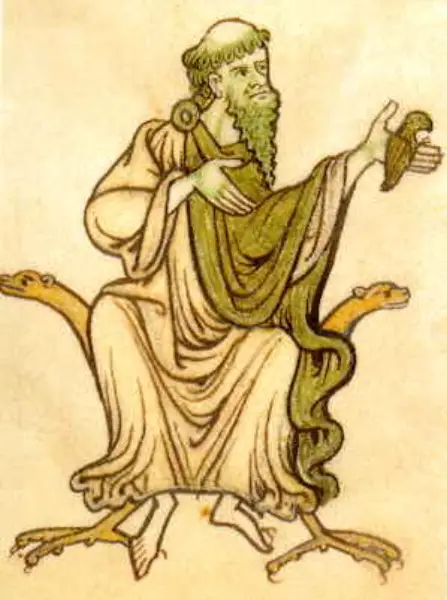
Kevin of Glendalough, known in Irish as Caoimhín and in Latin as Coemgenus, lived from about 498 until 3 June 618 and stands among the most beloved figures of early Irish monasticism. Born of noble Leinster parents, Coemlog and Coemell, he was baptized by Cronan of Roscrea and ordained a bishop by Lugidus before withdrawing from human company altogether. He settled in the remote glen of the two lakes in County Wicklow, living seven years as a hermit in a cave cut into the rock face above the upper lake, the shelter now called St. Kevin's Bed, clothed in animal skins and sleeping on stones. Disciples soon gathered to him, and a walled settlement near the lakeshore grew into the monastery of Glendalough, which became a renowned school of saints and scholars and the parent of several other monasteries. word of Kevin as a teacher and holy man had carried across Ireland by 540, and in 544 he journeyed to the Hill of Uisneach to meet the abbots Columba, Comgall, and Cannich before pressing on to Clonmacnoise. Having firmly established his community, he withdrew for four years of solitude and returned only at the earnest request of his monks, presiding over Glendalough until his death. His cultus was confirmed by Pope Leo XIII in 1902, and the legend of the blackbird that nested in his outstretched hand keeps his memory alive in poetry and song.
The Complete Life
A Noble Child of Leinster
The life of Kevin is documented only from later sources, since no contemporaneous material survives, but the late-medieval Latin Vita preserved among the records of the Franciscan Convent in Dublin and edited by John Colgan in the Acta Sanctorum Hiberniae preserves the outline of his origins. That account makes Kevin, like Columba, wellborn — a son of Coemlog and Coemell of Leinster. His birth in 498 is placed at the Fort of the White Fountain, and his baptism at the hands of Cronan of Roscrea. The name Coemgen itself means fair-begotten or noble in birth, fitting for his lineage. A seventeenth-century tradition made him the pupil of Petroc of Cornwall, who had come to Leinster about 492, no surviving late-medieval or early-modern hagiography knows the claim, which rests instead on a shorter vita, obtained by the Bollandist editors from Henry Fitzsimon, that no longer survives. The Vita also carries legends of doubtful veracity that the seventeenth-century editors kept for the antiquity of the underlying document. Among them is an infancy tale of a white cow that came each morning and evening to the child's home and supplied the milk that fed him.
§ Early life
The Hermit in the Rock
Kevin received ordination at the hands of Bishop Lugidus, but the diaconate of the world held little appeal for him. After his ordination he moved to Glendalough precisely to avoid the company of his followers, seeking the loneliest refuge the glen could offer. The glen of the two lakes, before his arrival, was a remote and deserted place, ideal for a secluded retreat, and there, in the account of the Vita, an angel led him to a cave set in the rock face. That shelter, now known as St. Kevin's Bed, is a man-made cave cut close to the mountain's edge, high above the upper lake, some ten metres up the rock. Reaching it means squeezing through a rectangular space and a short passage only a metre high and eighty centimetres wide, and the inner chamber measures barely four feet across and less than three feet high — a space in which an adult could not stand upright. It could have served only as a sleeping place or a spot for prayer and meditation, and it may be that Kevin used it chiefly as his bed. There he lived the hermit's life for seven years, clothed in animal skins, sleeping on stones, eating very sparingly, going barefoot, and giving his days to prayer in the company of the animals and birds around him.
§ Hermitage
From Hermitage to Holy City
Solitude such as Kevin sought could not long contain a holiness that shone so visibly. Disciples soon gathered around him, and a walled outpost known as Kevin's Cell took shape nearer the shore to house those who wished to live under his direction. By 540 his reputation as teacher and holy man had traveled across Ireland, and crowds sought his counsel. The retreat of a hermit thus became, almost against its founder's inclination, one of the great centers of Irish monastic life. Glendalough blossomed into a famous school of saints and scholars, mother of other monasteries, and its seven churches in time drew pilgrims from every corner of Ireland. The church of Saint Kevin itself contained a well-equipped writing room, a scriptorium that produced the Book of Glendalough in the twelfth century, a manuscript now kept at Oxford's Bodleian Library. To the second order of Irish saints — the generation after the first apostles — Kevin belonged, the first great apostles of the island, and his foundation carried their work forward for centuries as a place of learning, prayer, and pilgrimage.
§ Monastery
Ascetic of the Two Lakes
The spirituality Kevin practiced was that of the desert fathers transplanted to an Irish glen. He lived as a hermit close to nature, taking the animals and birds for his companions, clad in animal skins, resting on bare stone, and eating little. Barefoot and given to constant prayer, he made of discomfort a road to God rather than fleeing it where he could avoid it. Even as abbot he did not abandon the ascetic habit of his years in the cave: until his death he lived by fasting, praying, and teaching, binding the disciplines of the solitary to the duties of a superior. The story that captured the imagination of later generations shows the depth of this recollection. Kevin was said to have stretched out his hand, rapt and motionless, while a blackbird made her nest in his palm, laid her eggs, and remained until the chicks fledged, the saint refusing to disturb her. However the legend is read, it expresses the ideal his life embodied: a union with creation so complete that the wild things of the glen trusted him, and a recollection so deep that the saint could forget his own body in the presence of God. He is honored as an ascetic to this day, and the blackbird remains his emblem.
§ Monastery
Solitude Refused and Death at Last
In 544, with his community firmly established, Kevin set out on a journey through the heart of Ireland. His first stop was the Hill of Uisneach in Westmeath, where Columba, Comgall, and Cannich — giants of the Irish church — had gathered of the Irish church. He then proceeded to Clonmacnoise, where he arrived to find that Cieran, the founder of that monastery, had died only three days before. Even in these travels the pull of solitude asserted itself: having firmly established his community, Kevin retired into solitude for four years and returned to Glendalough only at the earnest request of his monks, who would not permit their founder to abandon them permanently. The remainder of his life he gave to the monastery he had never quite intended to build, presiding over Glendalough and living by fasting, prayer, and teaching. He died on 3 June 618, the date his feast keeps to this day, closing a life that had spanned more than a century by tradition and had transformed a lonely glen in Wicklow into one of the sacred places of Ireland.
§ Monastery
Cultus Confirmed
Like the great saints of the early Irish church, Kevin was venerated from the generation after his death without any formal process, his cult growing naturally at the shrine of Glendalough and in the dedications that carried his name across Ireland. His memory remained constant through the centuries of upheaval that the Wicklow glen witnessed, and the medieval pilgrimage to his seven churches never wholly lapsed. In the modern era the Roman Catholic Church ratified what the Irish people had never forgotten: on 19 June 1902 Pope Leo XIII confirmed the cultus of Saint Kevin, placing the ancient veneration on the formal footing of the Church's approval. He is honored in both the Catholic Church and the Eastern Orthodox Church, and his feast is kept on 3 June, the anniversary of his death. The Diocese of Dublin counts Kevin among its patron saints, and he is invoked likewise for the Archdiocese of Dublin, for Glendalough, and for Kilnamanagh. His principal shrines remain in the glen he chose: St. Kevin's Cell, St. Kevin's Bed, and St. Kevin's Church, visited by pilgrims and travelers who follow the path he first walked in the sixth century.
§ Legacy and veneration
The Saint and the Blackbird in Art and Song
Few Irish saints have entered modern culture as thoroughly as Kevin. Among the best-loved poems of Nobel laureate Seamus Heaney is St Kevin and the Blackbird, which tells how the saint kept his hand stretched out, rapt and unmoving, while the bird raised her brood in his palm, lays her eggs, and rears her young there, the monk unmoving until the brood has fledged. Around 2009 the Welsh artist Clive Hicks-Jenkins made a series of paintings depicting the story through Heaney's poem, giving the sixth-century hermit a place in contemporary visual art. Kevin is remembered in popular culture above all as an ascetic, a reputation sealed by the folk song The Glendalough Saint, recorded and made popular by The Dubliners, which sings of a saint renowned for learning and piety who looked upon girls with disparity. His name surfaces in unexpected places: James Joyce referenced him several times in Finnegans Wake, the longest episode appearing in Part IV, and the filmmaker Kevin Smith has referred irreverently to his saintly namesake in his live shows. Beneath the folklore stands the enduring reality of Glendalough, whose monastic ruins remain among Ireland's most significant, still drawing pilgrims to the valley where a hermit's cave became the cradle of a holy city.
§ Legacy and veneration
Timeline
- 498
Born at the Fort of the White Fountain in Leinster, son of Coemlog and Coemell, and baptized by Cronan of Roscrea.
§ Early life
- 540
Word of the holy teacher had traveled the length of Ireland, and crowds came looking for his counsel.
§ Monastery
- 544
Journeyed to the Hill of Uisneach in Westmeath for a meeting with the abbots Columba, Comgall, and Cannich.
§ Monastery
- 544
Proceeded to Clonmacnoise, arriving where Cieran had died three days before.
§ Monastery
- 3 Jun 618
Died at Glendalough after decades presiding over the monastery he founded.
§ Monastery
- 19 Jun 1902
Pope Leo XIII confirmed his cultus for the Roman Catholic Church.
§ Legacy and veneration
The Record
- Major works
- Founding of the monastery of Glendalough, County Wicklow·Settlement known as Kevin's Cell near the lakeshore
- Patron of
- Patron of blackbirds·Patron of the Archdiocese of Dublin·Patron of Glendalough·Patron of Kilnamanagh
- Symbols
- Blackbird
- Canonization
- Cultus confirmed by Pope Leo XIII on 19 June 1902 for the Roman Catholic Church.
Prayer
Bibliography
Show 10 sources
- "Saint Kevin". Encyclopædia Britannica.
- O'Riain, Padraig. A Book of Irish Saints. Dublin: Four Courts Press. p. 148. ISBN 978-1-84682-318-3.
- O'Hanlon, John (1873). Lives of the Irish saints. p. 51.
- "CATHOLIC ENCYCLOPEDIA: St. Kevin (Coemgen)". www.newadvent.org.
- Jankulak, Karen (2000). The Medieval Cult of St Petroc. Boydell & Brewer. p. 16. ISBN 978-0-85115-777-1.
- "Glendalough Monastic History, Co. Wicklow". glendalough.connect.ie. Retrieved 5 October 2023.
- "Holy Hermit Kevin of Glendalough", Holy Hermits Online, St John's Cathedral, Brisbane.
- Heaney, Seamus, The Spirit Level (London: Faber and Faber, 1996), pp20-1.
- Barrow, Lennox. Glendalough and Saint Kevin. Dundalk: Dundalgan Press, 1972.
- Plummer, Charles, ed. "Vita Sancti Coemgeni (Life of St. Kevin)." In Vitae Sanctorum Hiberniae. Vol. 1. Oxford: Clarendon Press, 1910. 234–57.
Profile text adapted from the Wikipedia article, licensed CC BY-SA 4.0.
Pray with this saint every day
Save St. Kevin of Glendalough to your favorites, read the full profile, and get feast-day reminders in the Saints app.
Get the Saints AppFree on the App Store for iPhone and iPad