
5th century – died 490 or 505·Feast October 8
St. Keyne
Fifth-century Welsh holy woman and hermitess
Overview
Keyne, whose name appears in many forms including Keyna, Cenau, and Ceinwen, was a holy woman and hermitess of the fifth century who, by tradition, journeyed far across the lands we now call South Wales and Cornwall. She was one of the many daughters — twelve by one reckoning, twenty-four by another — of the Welsh king Brychan of Brycheiniog, and though celebrated as a great beauty who received many offers of marriage, she took a vow of virginity and gave herself to the religious life, earning the Welsh name Cain Wyry, Keyne the Maiden. Her medieval vita reports that she founded several oratories, among them Llangeinor in mid-Glamorgan, Llangunnor and Llangain in Dyfed, and Rockfield in Runston, Gwent, before crossing the Severn into Cornwall, where she lived for many years as a hermitess. The village of St Keyne in Cornwall keeps her name, together with its church and holy well. Around 490 she is said to have visited her nephew Saint Cadoc at St Michael's Mount; he persuaded her to return to Wales, where a healing spring marked the place of her settlement. Her death came on 5 October — the year given variously as 490 or 505 — and she died, as she had lived, a virgin. Her most enduring memorial is the holy well at St Keyne, famed for the legend that the marriage partner who drinks from it first will rule the household — a story memorialized in Robert Southey's poem.
The Complete Life
A Princess Who Chose the Better Part
Keyne was born into the royal house of Brycheiniog, one of the many daughters of the Welsh king Brychan. One source, the De Situ Brecheniauc, credits Brychan with twenty-four daughters, all of whom were saints; another tradition numbers them at twelve. The fifth and early sixth centuries in Wales were an age of remarkable sanctity among the ruling families, and Brychan's household in what is now South Wales produced an extraordinary number of men and women whom the church honored as saints. Among them Keyne stood out. Medieval accounts describe her as a great beauty who attracted many offers of marriage, as befitted a king's daughter, yet she declined them all. She took a vow of perpetual virginity and gave her life over to God, a decision so identified with her that the Welsh remembered her as Cain Wyry, Keyne the Maiden. The only literary source for her life, the Vita Sanctae Keynae edited by John of Tynemouth in his fourteenth-century Sanctilogium Angliae Walliae Scotiae et Hiberniae, was written nearly eight centuries after her death and is probably not trustworthy in its details, and no contemporary record of her survives; yet the depth of devotion to her across Wales and Cornwall argues for a real woman behind the legend, remembered wherever her name was given to church and spring.
§ Life
Oratories Across Wales and a Hermitage in Cornwall
The vita reports that Keyne traveled widely through the Welsh kingdoms and beyond, an unusual pattern for a woman of her era and one that has prompted debate among scholars. She is said to have founded several oratories: Llangeinor in mid-Glamorgan, Llangunnor and Llangain in Dyfed, and Rockfield, known in Welsh as Llangennon, at Runston in Gwent. Each dedication planted her memory in a different corner of the south, and the number of foundations suggests a reputation that grew wherever she passed. Eventually, the account continues, she made her way over the Severn to Cornwall and passed long years there in the solitary life. Her chosen dwelling in the place that still bears her name. The village of St Keyne keeps both a church and a holy well dedicated to her, and numerous other dedications scattered through South Wales, Anglesey, Somerset, Hertfordshire, and Cornwall testify to the breadth of her cult. G. H. Doble doubted that any woman of the age could have covered such distances or planted so many communities, suggesting she may have been a man, a view shared by Alban Butler; but Jane Cartwright and others have challenged such reasoning as reflecting an assumption that male saints are more likely to be historical than female ones.
§ Life
Return to Wales and a Peaceful Death
Around the year 490, Keyne is said to have visited her nephew Saint Cadoc at St Michael's Mount, one of the holy men of her family's vast spiritual network. Cadoc persuaded the aging hermitess to return to Wales, and her final home was marked, in the manner of so many Celtic saints, by a healing spring that rose where she settled. She died a virgin on 5 October, though the year is uncertain — the traditions give either 490 or 505. Llangeinor in Glamorgan has been proposed as the likely spot of her death, for an ancient well still stands there, credited to this day with healing properties. The date of her passing was fixed in the calendar of the Welsh and Cornish churches: her feast is celebrated on 8 October, although some records give 30 September. She had lived as princess, pilgrim, foundress, and hermitess, and she died as she had chosen to live, unmarried and devoted to God, leaving behind a chain of churches and wells from Glamorgan to Cornwall that kept her name in the mouths of the faithful for a millennium and a half.
§ Life
The Well That Rules the Household
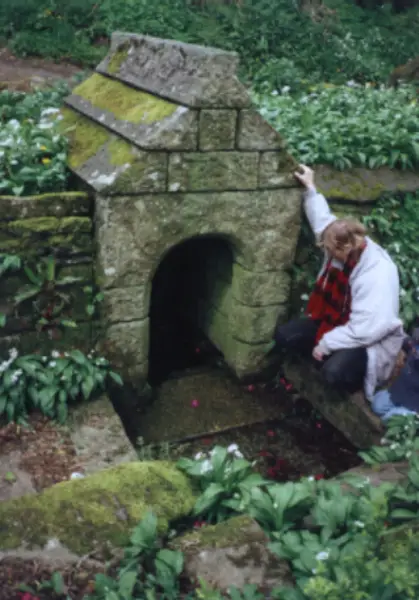
Keyne's most enduring and romanticized legacy attaches to the holy well that bears her name at St Keyne in Cornwall. The well stands about half a mile southeast of her church, sheltered in a small housing of dressed granite first raised in the sixteenth century, then rebuilt in 1936 when the neighboring lane was widened. The tale, already old in the Middle Ages, holds the first spouse to taste its water will govern the household and hold sway over the other. Carew set the spell down in 1602: the one who first drinks of the sacred stream thereby gains the mastery. Robert Southey memorialized the story in his ballad The Well of St Keyne, set to an adaptation of the Helston Furry Dance air, and Victorian visitors continued to attribute supremacy in marriage to the partner who first tasted the water. Her cult also embraced Keynsham in Somerset, where some sources place her near the banks of the Avon, formerly swarming with serpents until her prayer transformed them to stone — the ammonite fossils still found there — though a similar wonder is told of St Hilda, and the town's name may instead derive from Caega's hamm. One of the pair of altars in the Berkeley Chapel of Bristol Cathedral is traditionally dedicated to St Keyna.
§ St Keyne's well
Timeline
- 490
Visited her nephew Saint Cadoc at St Michael's Mount and was persuaded to return to Wales.
§ Life
- 505
Died a virgin on 5 October, traditionally at Llangeinor in Glamorgan; some sources place her death in 490.
§ Life
- 1602
Richard Carew recorded in verse the spell she was said to have laid upon the waters of her holy well.
§ St Keyne's well
- 1936
The sixteenth-century granite housing of St Keyne's well was rebuilt after the adjoining lane was widened.
§ St Keyne's well
In Their Own Words
The quality that man or wife / Whom chance or choice attaines / First of this sacred stream to drinke / Thereby the mastery gains.
The Record
- Major works
- Oratories at Llangeinor, Llangunnor, Llangain, and Rockfield (Llangennon)·Settlement and holy well at St Keyne, Cornwall
- Patron of
- Original patron of St Martin-by-Looe (Penndrumm)·Patron of Keynsham, Somerset, in some sources·Linked with the River Kenwyn in Truro
- Symbols
- Holy well
- Canonization
- Pre-congregation canonization by ancient popular devotion; venerated since the medieval period in Wales and Cornwall.
Prayer
Bibliography
Show 9 sources
- Cartwright, Jane (2008). Feminine Sanctity and Spirituality in Medieval Wales. Cardiff: University of Wales Press. p. 68. ISBN 9780708319994.
- Farmer, general consultant ed.: David Hugh (1996). Butler's lives of the Saints (1. publ. ed.). Tunbridge Wells: Burns & Oates. ISBN 086012259X.
- Ray Spencer A Guide to the Saints of Wales and the Westcountry, pp. 51–52.
- David Hugh Farmer Oxford English Dictionary of Saints.
- J. Meyrick A Pilgrim's Guide to the Holy Wells of Cornwall, pp. 68–69.
- Ford, David Nash. "St. Keyne Wyry". David Nash Ford's Early British Kingdoms. Retrieved 10 June 2015.
- Farmer, David Hugh (2011). The Oxford dictionary of saints (5th ed. Rev. ed.). Oxford: Oxford University Press. p. 255. ISBN 9780199596607.
- Rogan, John (2000) Bristol Cathedral, History and Architecture Tempus Publishing Ltd; pp 102.
- "Local News". The Cornishman. No. 86. 4 March 1880. p. 5.
Profile text adapted from the Wikipedia article, licensed CC BY-SA 4.0.
Pray with this saint every day
Save St. Keyne to your favorites, read the full profile, and get feast-day reminders in the Saints app.
Get the Saints AppFree on the App Store for iPhone and iPad