
fl. late 3rd century – died c. 330·Feast Saturday after the fifth Sunday after Pentecost
St. Khosrovidukht
Arsacid princess of Armenia's conversion to Christianity
Overview
Khosrovidukht, an Arsacid princess of the Armenian royal house, lived through the most consequential generation in her nation's religious history. Her name, Parthian for daughter of Khosrov, marked her as the child of King Khosrov II of Armenia and the namesake of her paternal great-grandfather Khosrov I. In 252 her father and family were assassinated by the Parthian agent Anak on the orders of Ardashir I, and while her infant brother Tiridates was taken to be raised in Rome, Khosrovidukht was brought up in Caesarea Mazaca in Cappadocia by the noble foster parents Awtay of the Amatuni family and his wife of the Slkunik family. She returned to Armenia after the Romans restored her brother to the throne in 287. When Tiridates, having persecuted the Christians and imprisoned Gregory the Illuminator in the Khor Virap dungeon, was struck with madness, Khosrovidukht received a dream instructing her to free Gregory; at her urging the king released the saint, whose prayers restored him in 301. Tiridates then proclaimed Christianity the state religion, making Armenia the first Christian nation, and Gregory baptized the royal family in the Euphrates. Khosrovidukht joined her brother and Queen Ashkhen in building Armenia's first great churches, donating her jewels to the work, and ended her days in retirement at the castle of Garni, dying perhaps around 330.
The Complete Life
A Daughter of the Arsacids in Exile
Khosrovidukht was born into the Arsacid dynasty of Armenia, ruled as a client-kingdom under Rome and cousin to the Arsacids of Parthia. She was the daughter of King Khosrov II of Armenia by a mother whose name is unknown, and her only known sibling was her brother Tiridates, who would rule Armenia from 287 to 330. Her name was a dynastic one in the Arsacid royal house: the Parthian Xosrovi-dowxt means daughter of Khosrov, and she bore it in honor of her father and of her paternal great-grandfather, King Khosrov I, who had ruled Armenia before him. Her childhood was shattered in 252, when Anak, a Parthian emissary carrying out Ardashir I's orders, murdered her father and the whole of her family. After Anak was captured and executed, the Roman authorities separated the surviving children. The baby brother was carried off to Rome for his upbringing; Khosrovidukht grew up at Caesarea Mazaca in Cappadocia, under the care of foster parents — Awtay, a lord of the Amatuni house, and his Slkunik wife. The orphaned princess thus grew to womanhood in a Roman provincial city, far from the kingdom her family had ruled.
§ Biography
The Dream That Freed the Illuminator
Khosrovidukht returned to Armenia after her brother's restoration to the throne by Diocletian in 287, and she lived at a court where the state religion was still Zoroastrianism. Yet Christian influences had reached the royal circle: Christian teaching had already reached the royal circle, and Khosrovidukht with her sister-in-law Queen Ashkhen may have embraced the faith through the Hripsimeyan nuns and the hidden Armenian Christian network. The crisis came when Tiridates put a company of Christians to death — the Hripsimeyan nuns among them — and threw another, Gregory the Illuminator, into the pit of Khor Virap, where he languished for years. The king then became mentally ill, and in the traditional account his affliction was heaven's response to the persecution. In a dream Khosrovidukht was told to free Gregory. She carried the message to her brother, who ordered the prisoner released. Gregory's prayers and teaching cured Tiridates of his illness in 301, and the repentant king declared Christianity the state faith of Armenia, the first realm anywhere to make such a proclamation. Gregory then became Catholicos of the Armenian Apostolic Church and baptized the king's family, court, and army in the waters of the Euphrates river, with the princess standing among the first-fruits of the nation's conversion.
§ Biography
Jewels for the Houses of God
The conversion of Armenia in 301 was not left to words alone. Tiridates, Khosrovidukht, and Queen Ashkhen took part in the construction of the great churches of the new faith: the Etchmiadzin Cathedral, the mother church of Armenian Christianity, together with the Saint Gayane Church, the Saint Hripsime Church, and the Shoghakat Church, all rising at or near the ancient capital in honor of the martyrs whose deaths had broken the king's heart and opened his kingdom to the Gospel. The two royal women matched their labor with sacrifice. During the construction of the Saint Gayane and Saint Hripsime churches, Ashkhen and Khosrovidukht donated their jewels to defray the expenses of the work, surrendering the ornaments of their Arsacid rank so that the martyrs' memorials could rise in beauty. The gesture belongs to a pattern that runs through her whole life: a woman who lost her family to political violence gave what she had to build peace between heaven and her people. The churches she helped to found still stand among the holiest sites of the Armenian Apostolic Church, monuments to the generation in which a persecuted faith became the soul of a nation.
§ Biography
Retirement at Garni and Death
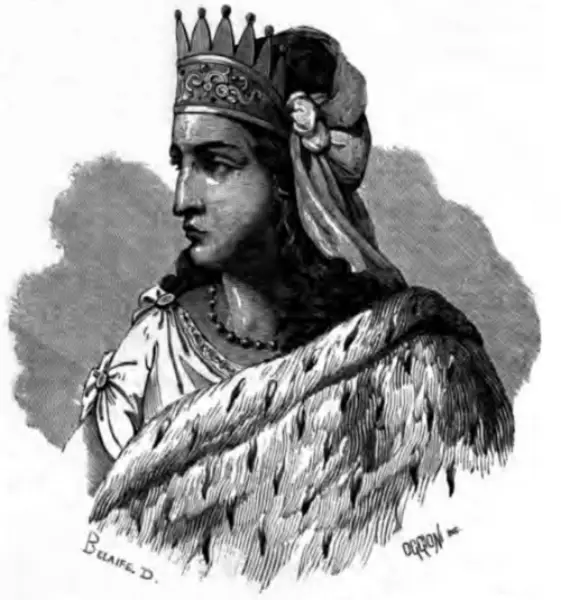
Toward the end of her life, Khosrovidukht withdrew from public affairs together with Queen Ashkhen, and the two women retired to the castle of Garni, the fortress complex that had long served the Arsacid kings as a summer residence. She may have died around the year 330, within a few years of her brother, whose reign ended with his death in the same period. The exact circumstances of her passing are unknown, as is the place of her burial, for the sources that preserve her story were written long after the events they record. What the tradition remembers is the outline of a life given quietly to the service of the faith: an orphan raised in exile, a sister whose dream released the apostle of Armenia from his pit, a princess whose jewels became churches. The painting of 1701 that shows Tiridates, Ashkhen, and Khosrovidukht together preserves the memory of the royal trio whose combined witness carried Armenia into the Christian world, and an idealized early twentieth-century image of the princess continues to hang in the gallery of Armenia's saints.
§ Biography
Saint of the First Christian Nation
The Armenian Apostolic Church honors Khosrovidukht as a saint alongside her brother Tiridates and her sister-in-law Ashkhen, the royal family through whom Armenia became the first Christian nation in the world. Their joint feast is kept on the Saturday after the fifth Sunday after Pentecost, a placement in the liturgical cycle that gathers the saints of the Armenian conversion into the summer season of Pentecost. No formal canonization process stands behind her cult; she belongs to the ranks of the pre-congregation saints, whose veneration arose from the gratitude of the church they helped to found. The primary testimony to her life comes through the History of the Armenians of Agathangelos, the classical account of Armenia's conversion, and through the liturgical calendars of the Armenian church, which assign her commemoration within the annual cycle of the saints. Her feast is recorded in the Domar, the Armenian church's great calendar and liturgical cycle issued by the Armenian Orthodox Theological Research Institute in 2002, which secures her place in the living worship of the church rather than merely in its history books.
§ Khosrovidukht (sister of Tiridates III of Armenia)
Timeline
- 252
Her father King Khosrov II and family were assassinated by the Parthian agent Anak, and she was taken to be raised in Caesarea Mazaca in Cappadocia.
§ Biography
- 287
Returned to Armenia after Diocletian restored her brother Tiridates III to the Armenian throne.
§ Biography
- 301
After her dream prompted Gregory the Illuminator's release, Tiridates was cured and proclaimed Christianity Armenia's state religion.
§ Biography
- 330
Died around this year, having retired toward the end of her life to the castle of Garni with Queen Ashkhen.
§ Biography
- 1701
A painting depicted Tiridates, Ashkhen, and Khosrovidukht together, preserving her image for later generations.
§ Khosrovidukht (sister of Tiridates III of Armenia)
The Record
- Major works
- Participation in the construction of Etchmiadzin Cathedral, Saint Gayane Church, Saint Hripsime Church, and Shoghakat Church·Donation of her jewels toward the building of the Saint Gayane and Saint Hripsime churches
- Patron of
- Venerated in the Armenian Apostolic Church
- Canonization
- Pre-congregation canonization; venerated as a saint in the Armenian Apostolic Church together with her brother Tiridates III and sister-in-law Ashkhen.
Prayer
Bibliography
Show 6 sources
- Domar: the calendrical and liturgical cycle of the Armenian Apostolic Orthodox Church, Armenian Orthodox Theological Research Institute, 2002, p. 443.
- The Circle of Ancient Iranian Studies, Iranian History: Armeno-Iranian Relations in Pre-Islamic Period By: Nina Garsoian, October 20, 2004.
- R.W. Thomson, Agathangelos's History of the Armenians, SUNY Press, 1976.
- B. Eghiayean, Heroes of Hayastan: a dramatic novel history of Armenia, Armenian National Fund, 1993.
- M.H. Dodgeon & S.N.C Lieu, The Roman Eastern Frontier and the Persian Wars AD 226–363, A documentary History Compiled and edited, Routledge, 1994.
- Schmitt, Rüdiger (2005). "Personal Names, Iranian iv. Parthian Period". Encyclopædia Iranica, online edition. New York.
Profile text adapted from the Wikipedia article, licensed CC BY-SA 4.0.
Pray with this saint every day
Save St. Khosrovidukht to your favorites, read the full profile, and get feast-day reminders in the Saints app.
Get the Saints AppFree on the App Store for iPhone and iPad