
c. 640 – 689·Feast July 8
St. Kilian
Apostle of Franconia and Martyr Bishop
Overview
Kilian, whose Irish name was Cillín and whose original Gaelic form was Ceallach, was a missionary bishop from Ireland who brought Christianity to Franconia, in what is now the northern part of Bavaria, during the second half of the seventh century. Born to a noble family near Mullagh in County Cavan around the year 640, he received his formation in Irish monastic schools before setting out for the continent. In 686 he traveled to Rome with eleven companions and obtained missionary faculties from Pope Conon, then continued to Würzburg, a stronghold of the still-pagan East Frankish ruler Gozbert. With the priest Colmán and the deacon Totnan he preached throughout East Franconia and Thuringia, winning the duke and many of his people to the faith. When he rebuked Gozbert for marrying his brother's widow, the duke's wife Geilana had Kilian and his two companions beheaded on 8 July 689. His relics rest in Würzburg Cathedral, and he is honored as the Apostle to the Franconians.
The Complete Life
An Irish Noble Born to Mission
Irish tradition places Kilian's birth around the year 640 among the nobility of Cloughballybeg, near Mullagh in the south-east of present-day County Cavan. His name has traveled through many spellings — Chillian, Killian, Cilian, Kilian — and survives in Ireland most often as Cillian, the form used in the Irish liturgical calendar, while the original Gaelic Ceallach is preserved in the old parish church of Teampall Cheallaigh at Mullagh. The Ireland of his boyhood was a land of monastic schools whose reputation reached far across Europe, and Kilian was formed in exactly that world. As a young man, tradition reports, he belonged for a time to the renowned community of Hy — Iona under its earlier designation — the great Columban foundation off Scotland's western coast. Whether or not every detail of this account can be verified, it places him firmly within the network of Irish monasteries that trained and sent the missionaries of the seventh century. The oldest written witnesses to his life, an eighth-century necrology kept at Würzburg and a notice in the martyrology of Hrabanus Maurus, confirm that his memory was cherished in Germany scarcely a generation after his death.
§ Accounts of his life
Formation in the Schools of Ross and Kerry
Kilian's education followed the classic path of an Irish ecclesiastical student of his age. He began his studies at Rosscarbery in County Cork, the school of Ross, one of the great learning centers of the south of Ireland, and completed them at Tuosist in County Kerry, where he is believed to have lived before ever he saw the continent. That formation joined scripture, liturgy and ascetic discipline in the monastic manner, and it prepared him not for a quiet local ministry but for the peregrinatio, the voluntary exile for Christ that so many Irish monks and bishops embraced. Tuosist, near Kenmare, has never forgotten the connection: the parish keeps him as its patron, a church and a holy well there bear his name, and his feast is still kept each July with a pattern day, when crowds gather at the well to pray before evening festivities. The scholar who studied at Ross and Kerry thus carried a whole tradition of Irish learning and holiness with him when he turned his face toward the Rhine and the missionary lands beyond it.
§ Patronage
To Rome and On to Würzburg
In the summer of 686 Kilian set out with eleven companions, crossed Gaul and made his way to Rome, arriving in the late autumn. There he met Pope Conon and received the missionary faculties that gave his undertaking official standing. From the Eternal City the band traveled north to the castle of Würzburg, the seat of Herzog Gozbert, ruler of the East Franks, a people still entirely pagan. The company did not stay together: part of the group moved on to seek other fields of labor, while Kilian stayed behind in Würzburg with two steadfast fellow workers: Colmán, a priest whom some sources name Colonan or Kolonat, and Totnan, a deacon. Kilian made the town his headquarters, and from it his preaching spread across an ever-widening circle of territory in East Franconia and Thüringen. The mission bore remarkable fruit: he brought Duke Gozbert himself to baptism and with the duke a large portion of his subjects abandoned paganism for Christianity. Within a few years a ducal capital on the Main had become the center of a living church, and the ground on which the three missionaries preached would one day hold the cathedral of the diocese that grew from their work.
§ Accounts of his life
A Rebuke and a Martyr's Death
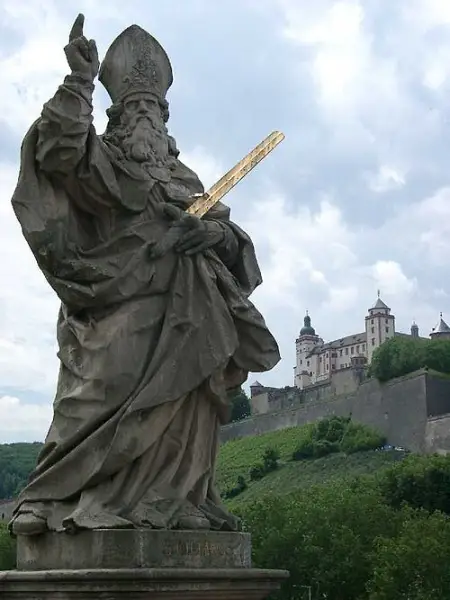
The turning point of the mission came from within the duke's own household. Kilian confronted Gozbert with the teaching of sacred scripture: the duke was living in violation of it, for he had married Geilana, the widow of his brother. Whether she had ever truly accepted the faith is doubtful, for the sources note that Kilian had failed to convert her. When Geilana learned of the bishop's words against her marriage, her anger turned deadly. Seizing her opportunity while the duke was absent, her soldiers were sent to the great square of Würzburg, where the three missionaries stood preaching, and there all of them were beheaded. The date of the martyrdom, 8 July 689, has been kept ever since as Kilian's feast. The deaths of the three missionaries did not undo their work; the church they had planted in East Franconia endured, and the blood they shed in its main square proved the seed of a Christian tradition that Würzburg has never ceased to honor. Kilian's statues show him with the sword, the very instrument of his execution, held beside his bishop's mitre.
§ Death
Veneration at Würzburg
Kilian was never formally canonized in the modern manner; his cult is pre-congregational, rising from the devotion of the church he founded. The earliest testimonies are the eighth-century necrology of Würzburg and the martyrology notice of Hrabanus Maurus. Burchard, appointed first bishop of Würzburg by Boniface, raised a cathedral on the very spot where the three martyrs were believed to have died, and had their relics recovered from the earth and laid to rest within a vault of that church. Their skulls, set with precious stones, have survived to the present day. Each year on Kilian's feast a glass case enclosing the three skulls is carried up from the crypt, borne in procession through the streets before great crowds, and placed on display in Würzburg Cathedral, which is dedicated to the saint. On the famous Saints' Bridge over the Main, statues of Kilian, Colmán and Totnan stand among the figures that watch over passers-by. He is venerated in both the Catholic Church and the Eastern Orthodox Church.
§ Veneration
Legacy in Germany, Ireland and Beyond
Few missionary bishops of the seventh century left so dense a trail of memorials. In Würzburg the Kiliani-Volksfest, held for two weeks every July, remains the principal civil and religious festival of the whole region, and the city preserves his abbey among its monuments; nearby Heilbronn and Hassfurt keep churches under his name, as does Paderborn, of which he is also patron. In his Irish homeland devotion has flourished for twelve centuries: the parish church and holy well at Tuosist, the church at Mullagh and the heritage centre opened there in 1995 by President Mary Robinson, built by the local community together with the Diocese of Würzburg, all keep his memory alive on both sides of the Channel. Emigration carried his name still farther: churches honor him in Blenker and Hartford in Wisconsin, in Mission Viejo, California, and in Farmingdale, New York, while in Australia the town of Bendigo raised St. Kilian's Church, by report the largest wooden church in all Australia, perhaps anywhere, and the Minnesota town that bears his name grew around a parish of the same dedication. Schools in Ireland, Northern Ireland, Ghana and the German school in Dublin complete a legacy of education that spans four continents.
§ Legacy
Timeline
- 640
Born to noble parents at Cloughballybeg near Mullagh, in what is now County Cavan, Ireland
§ Accounts of his life
- Jun 686
Set out with eleven companions through Gaul toward Rome to seek missionary faculties from the Pope
§ Accounts of his life
- Nov 686
Received faculties from Pope Conon and traveled on to the ducal castle of Würzburg, base of his East Frankish mission
§ Accounts of his life
- 8 Jul 689
Beheaded in the main square of Würzburg on Geilana's orders, together with Colmán and Totnan
§ Death
- 1995
A heritage center holding relics and replicas of the saint was opened in his home village of Mullagh by President Mary Robinson
§ Other
The Record
- Patron of
- Sufferers of rheumatism·The parish of Tuosist, County Kerry·Paderborn, Germany
- Symbols
- Bishop's mitre·Sword
- Canonization
- Pre-congregation; honored as a martyr from the earliest Würzburg records of the eighth century
Prayer
Bibliography
Show 6 sources
- Lauchert, Friedrich (1910). "St. Kilian". In Herbermann, Charles (ed.). Catholic Encyclopedia. Vol. 8. New York: Robert Appleton Company.
- "St. Kilian", Diocese of Sandhurst, Australia. Archived from the original on 20 April 2016. Retrieved 13 August 2014.
- "Teampaill Ceallaigh". mullagh.ie.
- Moore, Norman (1887). "Cilian". In Stephen, Leslie (ed.). Dictionary of National Biography. Vol. 10. London: Smith, Elder & Co.
- O Riain-Raedel, Dagmar. "Kilian [St Kilian, Cilian] (d. 689?)". Oxford Dictionary of National Biography (online ed.). Oxford University Press. doi: 10.1093/ref:odnb/5419.
- Delehaye, Hippolyte (1911). "Kilian, St". Encyclopædia Britannica. Vol. 15 (11th ed.). p. 792.
Profile text adapted from the Wikipedia article, licensed CC BY-SA 4.0.
Pray with this saint every day
Save St. Kilian to your favorites, read the full profile, and get feast-day reminders in the Saints app.
Get the Saints AppFree on the App Store for iPhone and iPad