
1224 – 1292·Feast July 24
St. Kinga of Poland
Hungarian princess, duchess of Poland, and Poor Clare
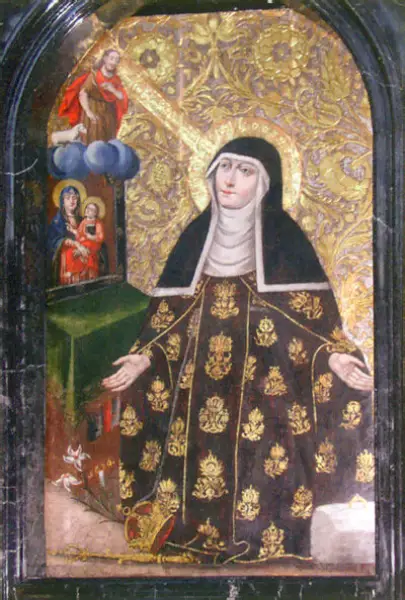
Overview
Kinga of Poland, also known as Cunegunda, was born on 5 March 1224 at Esztergom in the Kingdom of Hungary, a daughter of King Béla IV of Hungary and Maria Laskarina, niece of St. Elizabeth of Hungary and sister of St. Margaret of Hungary. Her marriage to Bolesław V the Chaste made her Grand Duchess of Poland, an alliance between Krakow and Hungary formed in anticipation of the Mongol threat to both lands. Though united in marriage, the devout couple took a vow of chastity, a sacrifice the Polish people came to regard as a pledge of divine favor in a time of crisis. When the Mongols devastated Poland in 1241, Kinga fled with her husband to Hungary, yet many later writers held her responsible for keeping Polish belief and selfhood alive once the raids had passed. As duchess she visited the poor and helped the lepers, and after Bolesław's death in 1279 she sold all her possessions, gave the proceeds to the poor, and became a Poor Clare nun at the monastery of Stary Sącz, refusing ever after to be addressed by her former titles. She died there on 24 July 1292. Beatified in 1690 and canonized by Pope John Paul II in 1999, she is patroness of Poland and Lithuania and patron saint of salt miners, honored in a chapel carved entirely of salt deep in the Wieliczka mine.
The Complete Life
A Daughter of the Árpáds
Kinga was born on 5 March 1224 at Esztergom, the seat of the Hungarian kings, into the most saintly dynasty of Central Europe. Her father was King Béla IV of Hungary and her mother Maria Laskarina, of the imperial house of Nicaea. Holiness ran deep in her family: she was a niece of St. Elizabeth of Hungary and a great-niece of St. Hedwig of Andechs, and her sisters included St. Margaret of Hungary and Jolenta of Poland, who would herself be honored among the blessed. She grew up in a kingdom already bracing for catastrophe, for the Mongol Empire was moving westward and Hungary lay in its path. In that climate her marriage was arranged as an act of statecraft: she was wed to Bolesław V, called the Chaste, who would become High Duke of Poland, and the union bound Krakow and the Kingdom of Hungary together in preparation for the Mongol threat that hung over both regions. The fifteenth-century chronicler Jan Długosz described her at that time as a girl of fifteen considered unusually beautiful and virtuous, a judgment that the rest of her life would vindicate in full measure.
§ Biography
A Marriage Vowed to Chastity
The marriage of Kinga and Bolesław, though concluded for reasons of dynasty and defense, became something extraordinary in the history of Christian marriage. Though man and wife, the devout pair bound themselves by a vow of chastity and lived as brother and sister for the length of their marriage. For the Polish people their vow became a point of pride, viewed as a holy offering made to win God's favor for a Poland and an eastern Europe in the grip of crisis — and their marriage was read that history seemed to confirm, for Poland survived the Mongol storms that destroyed so much around it. As duchess, Kinga did not withdraw into ceremonial seclusion. She took up charitable works, visiting the poor and helping the lepers whose sufferings most courtiers avoided. When the Mongol raids came — beginning in 1240, with the sack and burning of Krakow in March 1241 and the defeat of the Polish armies on April 9, 1241 — Kinga and Bolesław were forced to flee to safety in Hungary. Yet even in flight and ruin she earned a lasting title to gratitude: more than one source names her as the force that kept Polish belief and nationhood breathing after the Mongol storms.
§ Biography
From the Palace to the Poor Clares
Kinga's inner life matured steadily from the works of charity of her married years toward the contemplative enclosure she had long desired. The pattern of her spirituality was self-emptying: a princess who practiced chastity within marriage, a duchess who served lepers with her own hands, a widow who stripped herself of everything. Bolesław's death came in 1279, and without delay she disposed of everything she owned, handing the proceeds to the poor in literal obedience to the Gospel. Jan Długosz noted in his Annals that hardly had her husband been laid in the ground than she put on the habit of the Order of St. Clare, declaring that this was what she had desired for years — words revealing that the cloister had been the secret desire of her heart through all the decades of public life. She entered the Poor Clare monastery at Sandec, now Stary Sącz, and would pass the remainder of her days in contemplative prayer. So complete was her renunciation that she refused to let anyone refer to her past role as Grand Duchess of Poland, insisting that the woman who prayed in the choir of Stary Sącz was simply Sister Kinga, a penitent among penitents.
§ Biography
Thirteen Years in the Cloister
Kinga lived as a Poor Clare at Stary Sącz for the final thirteen years of her life, a period of quiet prayer that contrasted with the turbulence of her earlier decades. She had known the duties of a royal consort, the terror of the Mongol invasion, and the responsibilities of governance; now her world contracted to the monastery church, the choir, and the cell. She died there on 24 July 1292, aged sixty-eight, the date the Church would fix as her feast. Devotion to her began at once among the Polish people and spread through the lands she had served. The monastery of Stary Sącz, where she had lived her final years, became the center of her cult, and the memory of the duchess-nun grew steadily through the following centuries. The widow who had buried her husband and then buried her past proved even more fertile in death than in life: the cause that would lead to her being raised to the altars was set in motion long before the formal machinery of canonization existed in its modern form, sustained by the affection of a nation that regarded her chastity and charity as gifts given on its behalf.
§ Biography
From Beatification to the Altars of Peter
Kinga's cause advanced along the formal paths of the Roman Church across three centuries. Pope Alexander VIII beatified her on 11 June 1690 at Saint Peter's Basilica in the Papal States, confirming the devotion the Polish and Hungarian churches had long nurtured. In 1695, five years on, Poland and Lithuania named her their chief patroness — a title binding her intercession to two nations. The cause for her canonization was formally opened on 13 July 1741, though centuries would pass before it reached its conclusion. The fulfillment came in our own era: on 16 June 1999, during his historic pilgrimage to Poland, Pope John Paul II canonized Kinga in Saint Peter's Square, raising the medieval duchess to the honors of the altar as a saint of the universal Church. The canonization belonged to the long series in which John Paul II honored the saints of Central Europe, and it placed Kinga among the virgins officially recognized as saints of the Catholic Church — a fitting company for a woman whose marriage had been a lifelong witness to consecrated chastity. Her feast is kept on 24 July, the anniversary of her death at Stary Sącz.
§ Kinga of Poland
The Salt Chapel a Hundred Meters Underground
The most famous legend of Kinga connects her with the treasure of the Carpathian foothills. Tradition holds that she cast her betrothal ring down the Aknaszlatina salt mine, then in Hungarian territory, and that the ring journeyed by miracle along with the salt deposits to Wieliczka in Poland, where it was rediscovered — a story that made her the discoverer and patron of the great Polish salt mines. Where the ring came to light, the miners raised a statue of Saint Kinga carved wholly of salt, set 101 meters under the earth's surface. More remarkable still is the chapel dedicated to her in the Wieliczka salt mine, some 331 feet below the surface, carved completely out of salt and adorned with figures of Pope John Paul, Saint Joseph, Saint Clement, and Our Lady of Lourdes, all hewn from the same translucent rock. The chapel has become one of Poland's most extraordinary sacred spaces, and Kinga is recognized throughout the mining world as the patron saint of salt miners. As chief patroness of Poland and Lithuania, commemorated in art as an abbess wearing a crown, she remains a guardian figure for two nations that honor the Hungarian princess who gave them her life and her faith.
§ Legend
Timeline
- 5 Mar 1224
Born at Esztergom in the Kingdom of Hungary, daughter of King Béla IV and Maria Laskarina.
§ Biography
- 1240
The Mongol war machine opened its raids against Poland and Hungary, the campaigns that would shadow her early years as duchess.
§ Biography
- Mar 1241
The Mongols sacked and burned Krakow, Poland's chief seat of power.
§ Biography
- 9 Apr 1241
Mongol forces defeated the Polish armies, and Kinga and Bolesław fled to safety in Hungary.
§ Biography
- 1243
Became High Duchess consort of Poland upon her husband's accession as High Duke.
§ Kinga of Poland
- 1279
After Bolesław's death she sold her possessions, gave the money to the poor, and entered the Poor Clare monastery at Stary Sącz.
§ Biography
- 24 Jul 1292
Died aged 68 at Stary Sącz after thirteen years of contemplative prayer as a Poor Clare.
§ Biography
- 11 Jun 1690
Beatified by Pope Alexander VIII at Saint Peter's Basilica in the Papal States.
§ Kinga of Poland
- 1695
Named chief patroness of Poland and Lithuania.
§ Kinga of Poland
- 13 Jul 1741
The cause for her canonization was formally opened.
§ Kinga of Poland
- 16 Jun 1999
Canonized by Pope John Paul II in Saint Peter's Square, Vatican City.
§ Kinga of Poland
In Their Own Words
a girl of fifteen who was considered unusually beautiful and virtuous
his widow, Kinga, had scarcely buried her husband, before she donned the habit of the Order of St. Clare, announcing that she had long yearned for this
The Record
- Major works
- Charitable works among the poor and lepers of Poland·Poor Clare monastery life at Stary Sącz·Alliance between Krakow and the Kingdom of Hungary against the Mongol threat
- Patron of
- Patroness of Poland·Patroness of Lithuania·Patron saint of salt miners
- Symbols
- Depicted as an abbess·Crown
- Canonization
- Beatified by Pope Alexander VIII on 11 June 1690; canonized by Pope John Paul II on 16 June 1999 in Saint Peter's Square.
Prayer
Bibliography
Show 7 sources
- Kristó, Gyula (2003). Háborúk és hadviselés az Árpádok korában [Wars and Tactics under the Árpáds] (in Hungarian). Szukits Könyvkiadó. ISBN 963-9441-87-2.
- Klaniczay, Gábor (2002). Holy Rulers and Blessed Princes: Dynastic Cults in Medieval Central Europe. Cambridge University Press. ISBN 0-521-42018-0.
- Sokol, Stanley S. (1992). "Cunegunda (Helen)". The Polish Biographical Dictionary: Profiles of Nearly 900 Poles who Have Made Lasting Contributions to World Civilization. Bolchazy-Carducci. p. 74. ISBN 9780865162457.
- Index ac status causarum beatificationis servorum dei et canonizationis beatorum (in Latin). Typis polyglottis vaticanis. January 1953. p. 54.
- Berglund, Bruce R.; Porter, Brian A. (2010). Christianity and Modernity in Eastern Europe. Central European UP. pp. 368 n.61. ISBN 9789639776654.
- Jan Dlugosz, The Annals of Jan Dlugosz: A History of Eastern Europe from A.D. 965 to A.D. 1480, trans. Maurice Michael (IM Publications, 1997), 177.
- "St Kinga". Catholic Encyclopedia. 1915. Retrieved 13 February 2015.
Profile text adapted from the Wikipedia article, licensed CC BY-SA 4.0.
Pray with this saint every day
Save St. Kinga of Poland to your favorites, read the full profile, and get feast-day reminders in the Saints app.
Get the Saints AppFree on the App Store for iPhone and iPad