
1130 – 1182·Feast April 28
St. Kirill of Turov
Bishop and foremost theologian of Kievan Rus'
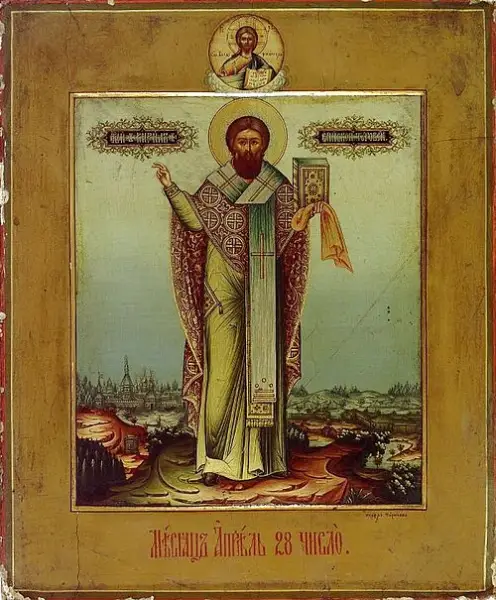
Overview
Kirill of Turov, remembered in the Russian tradition as Cyril of Turov, lived from 1130 to 1182 in the Principality of Turov, in what is now southern Belarus, and stands among the first and finest theologians of Kievan Rus'. Born to an affluent family in the busy town of Turov, he showed extreme piety from youth and entered a monastery while still a young man, where the community prized both his austerities and his skill in expounding the Scriptures. Tradition consecrates him bishop of Turov in the 1160s, and in 1169, with the Metropolitan's support, he took part in the deposition of Fedor, the occupant of the bishopric of Rostov; he is usually thought to have died in 1182, though even these dates are debated by scholars. For centuries his writings enjoyed extraordinary prestige, continuously copied and imitated well into the seventeenth century. The corpus attributed to him — festal homilies, monastic commentaries, letters, hymnological texts, penitential prayer canons, and an abecedarian prayer — represents the most accomplished mastery of Orthodox theology and the Byzantine rhetorical style in the literature of Kievan Rus'. His Easter sermon, in which the awakening of spring preaches the Resurrection, became the best loved of them all. He is honored as a saint in the Eastern Orthodox Church and the Greek Catholic Churches, with a feast on 28 April, and churches in Belarus and the Belarusian diaspora bear his name.
The Complete Life
A Merchant's Son of Turov
Kirill was born in 1130 in the thriving town of Turov, the seat of a principality that lay in the forest lands of what is now southern Belarus. The short Synaxarion Life, written no earlier than the mid-thirteenth century, is the only biographical source, and its terse, formulaic composition, drawing heavily on hagiographic convention, yields few historical details. That narrative makes him a child of well-to-do parents, a circumstance that gave him access to the bookish education that later shines through every page attributed to him. Even as a boy his piety was marked, and he left the world behind before reaching manhood of commerce and court into the monastery, the setting that would define his whole existence. In the cloister he was respected for two qualities in particular: his asceticism, the bodily discipline the Byzantine tradition demanded of its monks, and his learned interpretation of biblical texts, the gift that would make him the finest literary craftsman of his generation. All the early evidence thus presents a man formed in the monastery's rhythms of psalmody, reading, and repentance, the world of which his surviving works speak most intimately and most often.
§ Biographic details
Monk, Bishop, and the Affair of Rostov
The shape of Kirill's ecclesiastical career is contested. He is usually said to have been consecrated bishop of Turov in the 1160s, and it is as the Bishop of Turov that posterity has known him. The one datable event of his public life belongs to 1169: backed by the Metropolitan, he joined the effort that unseated Fedor from the see of Rostov — an episode to which his own writings allude in a rare, skillfully disguised admonition of a contemporary figure. Yet an alternative line of thought holds that he became a bishop only after 1182, remaining a simple monk throughout the 1160s and 1170s; it has even been suggested that his episcopal title was a later invention, arising from the desire to designate an appropriately high status for the author of such extremely popular and influential words. What is certain from the works themselves is that his heart remained monastic. Even if he wore the bishop's omophorion, his points of reference stay within the monastery walls, his most frequent addressees are monks, and his theme, above all others, is monasticism: repentance, humility, and the soul's return to God.
§ Biographic details
The Penitential Voice of Kievan Rus'
The spirituality that breathes through the works attributed to Kirill is profoundly penitential and thoroughly Byzantine. Most literature of Kievan Rus' drew on the Eastern Christian tradition that had reached the Rus' lands from Byzantium through Slavonic translations made mainly in Bulgaria, and Kirill mastered that rhetorical inheritance more completely than any contemporary. Franklin sums up the program Kirill set himself: to carry an inherited tradition forward untouched, winning authority through obedience to authority rather than rebellion against it. Quotation saturates his writing: Franklin counts roughly 370 scriptural citations and allusions in his English rendering of the sermons, and behind them stand John Chrysostom, Ephrem the Syrian, Gregory of Nazianzus, Epiphanius of Salamis, and the other churchmen available in Slavonic dress. Yet the tradition he served was no cold classicism. In his Lenten prayers and resurrection sermons the old forms warm into lyric freshness: the melting of spring ice becomes the melting of Thomas's doubt before the wounds of Christ, and the winter of sin gives way to repentance. He wrote always in the voice of the humble monk, calling himself the unworthy monk Kirill, fading before the true author of every word.
§ Style: Kirill's traditionalism
Death and the Shadowed Dates
Kirill is usually thought to have died in 1182, and the dates 1130 to 1182 have been commonly accepted for his life; but even these anchors are debated. Among notable scholars, Simon Franklin vigorously disputes the traditional chronology, and the alternative reconstruction would place his episcopate after 1182, making him a monk through the very decades in which most of the attributed works were composed. The facts of his life remain thin, and since nothing survives from writers who knew him, nearly everything is argued over: the Synaxarion Life, itself was written no earlier than the mid-thirteenth century and offers a formulaic sketch rather than a history. Beyond the affair of Rostov in 1169, no dated event of his later life survives. Whatever the exact sequence of his years, the tradition is unanimous that he ended his life in the odor of sanctity, honored within a generation of his death as a holy bishop and teacher, and that his grave at Turov became a place of veneration. The silence of the sources about his final years has proved no obstacle to his memory; it has only deepened the aura of the learned monk whose words outlived every uncertainty about the man himself.
§ Biographic details
Veneration and Feast
Kirill has been honored as a saint from the centuries following his death, his cult predating any formal canonization process and belonging to the ancient veneration of the Russian and Belarusian churches. He is venerated in the Eastern Orthodox Church and in the Greek Catholic Churches, and his feast is kept on 28 April in the Orthodox calendar. The Synaxarion Life of 28 April, though late and formulaic, testifies to the liturgical commemoration established in his honor within a few generations of his repose. In modern times his cult has become a particular mark of Belarusian Orthodox identity: several Belarusian Orthodox churches are named for St. Cyril, among them the Church of the Holy Bishop Cyril of Turov at the Cathedral House in Minsk, the Cathedral of St. Bishops Cyril of Turov and Lawrence of Turov at Turau itself, and the Church of the Holy Bishop Cyril of Turov at Svietlahorsk. The diaspora has carried his name abroad as well, to the Belarusian Greek Catholic church in London, the St. Cyril of Turau Cathedral in Brooklyn, and the Church of St. Cyril of Turau in Toronto, making him a patron of Belarusian believers wherever they have settled.
§ Churches named after St. Cyril
The Most Accomplished Master of His Age
Generations of readers kept Kirill of Turov in the first rank of Rus' authors; his pages were copied and imitated without pause, and East Slav writers were still learning from him as late as the seventeenth century. The judgment of Serge Zenkovsky has hardened into orthodoxy: among the writers of Kievan Rus', none matched Kirill's command of Orthodox theology or of the Byzantine manner, none his fluency in Greek or the heights of his prose. Take the usual attributions as true, and he stands as the most prolific author whose work survives from Kievan Rus'. Of everything under his name, the Easter sermon in which spring's awakening preaches the Resurrection — ice melting into faith like the doubting apostle's doubt — won the widest love. Scholarship has complicated the picture: the Corpus Cyrillianium at its core holds only eleven works agreed by the majority to be his, manuscripts are separated from composition by centuries, and C. M. MacRobert cautions that what survives may be not the oeuvre of one man but a whole devotional tradition of penitential spirituality cultivated among the East Slavs. Yet the questioning has not diminished his stature; it has only revealed how large a shadow one medieval teacher cast across the literature of an entire world.
§ Cyril of Turov
Timeline
- 1130
Born to a well-to-do family in the town of Turov.
§ Biographic details
- 1169
Helped the Metropolitan bring about the removal of Fedor from the see of Rostov.
§ Biographic details
- 1182
Usually thought to have died in this year, though some scholars dispute the traditional dates of his life.
§ Biographic details
In Their Own Words
The Church requires a great teacher and a wise interpreter to adorn the feast. But we are poor in word and dim in mind, and we lack the fire of the Holy Spirit to compose words to benefit the soul. Yet, for the love of the brethren that are with me, I shall say a few words concerning the renewal of the resurrection of Christ.
The Record
- Major works
- Festal homilies from Palm Sunday to the Sunday before Pentecost, including the sermon on spring and the Resurrection·A seven-day cycle of penitential prayers·Allegorical monastic commentaries·A Prayer Canon, a Canon of Olga, and an abecedarian prayer·Letters, including the admonition of Bishop Fedor of Rostov
- Patron of
- Honored as a patron saint of the Belarusian people
- Canonization
- Pre-congregation canonization; venerated as a saint in the Eastern Orthodox Church and the Greek Catholic Churches.
Prayer
Bibliography
Show 7 sources
- Franklin, Simon (1991). Sermons and Rhetoric of Kievan Rus'. Harvard Library of Early Ukrainian Literature. English Translations. Vol. V. Cambridge, MA: Distributed by Harvard University Press for the Ukrainian Research Institute of Harvard University. ISBN 9780916458416.
- Lunde, Ingunn (2001). Verbal Celebrations: Kirill of Turov's Homiletic Rhetoric and its Byzantine Sources. Slavistische Veröffentlichungen. Vol. 86. Wiesbaden: Harrassowitz. ISBN 978-3-447-04358-8.
- Lunde, Ingunn (2000). Ingunn Lunde (ed.). Kirill of Turov; Bishop, Preacher, Hymnographer. Slavica Bergensia. Vol. 2. Bergen: Department of Russian Studies, IKRR University of Bergen. ISBN 9788290249279.
- MacRobert, C. M. (2000). "In Search of a Canon". In Ingunn Lunde (ed.). Kirill of Turov; Bishop, Preacher, Hymnographer. Slavica Bergensia. Vol. 2. Bergen: Department of Russian Studies, IKRR University of Bergen. ISBN 9788290249279.
- Nadson, Alexander (1968). "Spiritual writings of St Cyril of Turaŭ". Eastern Churches Review. 1 (4): 347–358.
- Nadson, Alexander (1965). "The Writings of St. Cyril of Turau". Journal of Belarusian Studies. I (I): 4–15. doi:10.30965/20526512-00101002.
- Zenkovsky, Serge A. (1974). Medieval Russia's Epics, Chronicles, and Tales. New York: Dutton. ISBN 9780525483663.
Profile text adapted from the Wikipedia article, licensed CC BY-SA 4.0.
Pray with this saint every day
Save St. Kirill of Turov to your favorites, read the full profile, and get feast-day reminders in the Saints app.
Get the Saints AppFree on the App Store for iPhone and iPad