
768-853·Feast November 10 (Old Style, Georgian Church)
St. Konstanti Kakhi
Nobleman and Martyr (Georgian Orthodox Church)
Overview
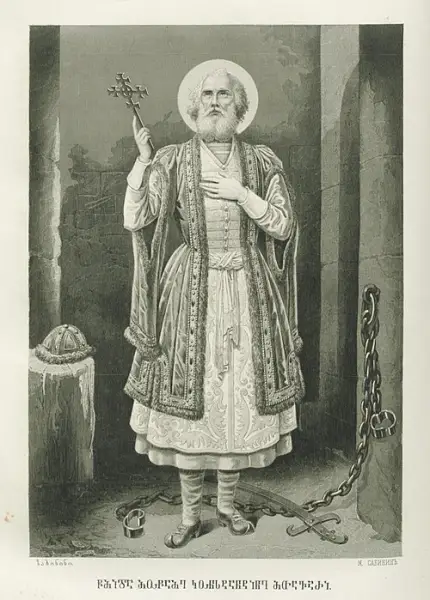
Konstanti Kakhi was born in 768 into a noble family of Kartli, in central Georgia, at a time when Abbasid power pressed hard on the Georgian lands and an Arab emir ruled from Tbilisi. His sobriquet points to origins in Kakheti. According to the medieval Life and Passion of Kostanti-Kakhay — whose anonymous monastic author claims to have lived in the martyr's own time, under the empress Theodora and her son Michael III — he grew wealthy and openly Christian, respected for generosity and for pilgrimages and gifts to Jerusalem. In 853, during the great Caucasian expedition of the Abbasid general Bugha al-Kabir, the eighty-five-year-old nobleman — accounted the leading and most distinguished man in all Kartli — was seized and sent to the caliph al-Mutawakkil at Samarra. There he refused both the offer of riches for converting to Islam and the threats of torture that followed. Two noblemen who had themselves apostatized were sent first to persuade him and then to behead him; on both visits they failed, and at last the caliph's own servant put the defiant prisoner to death on 10 November 853. His martyrdom is corroborated by a stone inscription at the Ateni Sioni church recording the captures of that year, and by the Armenian chroniclers Tovma Artsruni and Hovhannes Draskhanakertsi.
The Complete Life
Early Life
Konstanti Kakhi was born in 768 into a noble family of Kartli, in central Georgia, at a time when Abbasid power pressed hard on the Georgian lands and an Arab emir ruled from Tbilisi. His sobriquet, Kakhi, points to origins or connections in Kakheti, the eastern Georgian principality. The Life and Passion of Kostanti-Kakhay — the medieval hagiography from which most of his biography comes — describes him as growing wealthy and openly Christian in a period when that combination was possible but precarious. He was respected for generosity, and the Life records pilgrimages and gifts to Jerusalem: the marks of a nobleman of the old Georgian piety, whose wealth was deployed on the holy places rather than hoarded.
§ Biography
The Expedition of Bugha al-Kabir
In 853 the Abbasid general Bugha al-Kabir led his great expedition into the Caucasus, a campaign of terror that broke the Georgian and Armenian principalities and carried off their nobilities captive. Konstanti, now eighty-five years old and accounted the leading and most distinguished man in all Kartli, was seized and sent to the caliph al-Mutawakkil at Samarra. There he was offered riches for converting to Islam, and when he refused, threatened with torture. Two noblemen who had themselves apostatized were sent first to persuade him, and then — when persuasion failed — ordered to behead him; on both visits they failed, unable either to turn him or to kill him. At last the caliph's own servant put the defiant old prisoner to death on 10 November 853.
§ Introduction
The Cult
Konstanti was venerated as a martyr-saint of the Georgian Orthodox Church from the ninth century; his commemoration falls on 10 November, Old Style, in the Georgian calendar. This is a pre-congregation, Orthodox cult — not a Catholic canonization — though he is honored in Catholic and Anglican martyrologies as well. The anonymous author of the Life and Passion claims to have lived in the martyr's own time, under the empress Theodora and her son Michael III, and to have written of a man the Georgian church had already begun to invoke.
§ Introduction
Legacy
Konstanti's historical importance is unusually well documented for a ninth-century martyr. His capture is recorded in a Georgian inscription at the church of Ateni Sioni — a contemporary, epigraphic witness — and his martyrdom is mentioned by the Armenian chronicler Tovma Artsruni. Between the Georgian Life, the inscription and the Armenian annals, the old nobleman of Kartli is one of the few early medieval Georgian saints whose death can be checked against more than one source. In Georgian memory he stands for the church's endurance under the caliphate, and for the authority of age: an eighty-five-year-old refusing the richest offer the empire of his day could make.
§ Introduction
Timeline
- 768
Born to a noble family of Kartli
§ Biography
- 5 Aug 853
Bugha burns Tbilisi and kills Emir Sahak, as the Ateni Sioni church inscription records
§ Further historical evidence
- 26 Aug 853
Zirak, Bugha's lieutenant, takes Kakha and his son Tarkhuji prisoner, per the same inscription
§ Further historical evidence
- 10 Nov 853
Held at Samarra, he refuses al-Mutawakkil's offers of wealth and threats of torture, and is put to death aged about 85
§ Introduction
- 1882
Mikhail Sabinin first publishes the Life and Passion of Kostanti-Kakhay
§ The Life and Passion of Kostanti-Kakhay
- 1925
P. Peeters publishes a Latin translation of the Life and Passion
§ The Life and Passion of Kostanti-Kakhay
- 1978
N. Vachnadze and K. Kutsia publish a Russian translation of the Life and Passion
§ The Life and Passion of Kostanti-Kakhay
- 2004
M. Abashidze and S.H. Rapp publish an English translation of the Life and Passion
§ The Life and Passion of Kostanti-Kakhay
The Record
- Symbols
- Elderly nobleman in chains before the caliph·Cross held in refusal of apostasy
- Canonization
- Venerated as a martyr-saint of the Georgian Orthodox Church from the ninth century; not a Catholic canonization
Prayer
Bibliography
Show 6 sources
- 1 2 3 4 5 6 7 8 Thomas, David & Roggema, Barbara (ed., 2009), Christian-Muslim Relations. a Bibliographical History. Volume 1 (600-900) , pp. 852-6. BRILL , ISBN 978-90-04-16975-3 .
- ↑ Machitadze, Archpriest Zakaria (2006), "Great-Martyr Constantine-Kakhi (†852)" , in The Lives of the Georgian Saints Archived 2008-06-14 at the Wayback Machine . pravoslavie.ru . Retrieved on 2011-11-23.
- 1 2 3 4 Rayfield, Donald (2000), The Literature of Georgia: A History , pp. 47-8. Routledge , ISBN 0-7007-1163-5 .
- ↑ Peeters, P. (1925), "De S. Costantino Martyre in Babilonia (commentarius, praevius)". Acta Sanctorum , Novembris, t. IV: 541-554.
- ↑ Abashidze, Medea & Rapp, Stephen H. Jr. (2004), "The Life and Passion of Kostanti-Kaxay". Le Muséon 17, 1-2 : 137-173.
- ↑ Minorsky, Vladimir , "Tiflis", in: M. Th. Houtsma, E. van Donzel (1913-36; reprint 1993), E. J. Brill's First Encyclopaedia of Islam , 1913-1936 , vol. 8, p. 754. BRILL, ISBN 90-04-09794-5 .
Profile text adapted from the Wikipedia article, licensed CC BY-SA 4.0.
Pray with this saint every day
Save St. Konstanti Kakhi to your favorites, read the full profile, and get feast-day reminders in the Saints app.
Get the Saints AppFree on the App Store for iPhone and iPad