
c. 1714 – 1779·Feast August 24
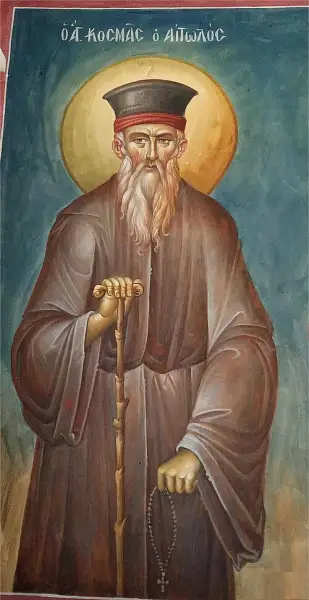
St. Kosmas the Aetolian
Equal to the Apostles and Teacher of the Greek Nation
Overview
Kosmas the Aetolian, also called Cosmas the Aetolian or Patrokosmas, was a Greek Orthodox monk venerated as a saint and honored as Equal to the Apostles. Born around 1714 in the village of Mega Dendron near Thermo in Aetolia, he studied Greek and theology, became a monk on Mount Athos, and attended the Theological Academy there before continuing his training in rhetoric in Constantinople. In 1760 Patriarch Serapheim II authorized him to begin missionary tours in Thrace, later extended across Western and Northern Greece, out of alarm at Christians converting to Islam. Over sixteen years he founded numerous church schools and urged the faithful to learn Biblical Koine Greek so they could understand the Scriptures. After the Orlov Revolt of 1770 he preached in what is now southern Albania, arousing the hostility of powerful local figures and the suspicion of the declining Venetian Republic. Charged with acting for Russia, he was arrested by the Ottoman authorities and put to death at Kolkondas by the Seman river's mouth in today's Albania on 24 August 1779 — never charged, never tried. He was proclaimed a saint by the Ecumenical Patriarchate on 20 April 1961 under Patriarch Athenagoras.
The Complete Life
A Village Boy from Aetolia
Kosmas was born around 1714 in Mega Dendron, a Greek village close to the town of Thermo in the mountainous region of Aetolia. What emerges clearly from his story is a young man of unusual appetite for learning. He applied himself to the Greek language and to theology, the twin foundations of serious ecclesiastical education available to Greeks living under Ottoman rule. His studies eventually drew him to Mount Athos, the monastic peninsula at the center of Orthodox spiritual and intellectual life. There he attended the local Theological Academy and embraced the monastic life, taking up the discipline of prayer that would mark the rest of his career. He did not remain on the Holy Mountain permanently. After roughly two years he departed, and for a time he continued his education in Constantinople, the historic seat of the Ecumenical Patriarchate, where he studied rhetoric. This combination of monastic formation and classical training — sacred learning joined to the arts of public speech — prepared him for the itinerant ministry that would later carry him across Thrace, mainland Greece, and the Albanian lands, and that would make his name a byword for preaching throughout the Orthodox East.
§ Life
A Commission from the Patriarch
The decisive turn in Kosmas's vocation came through the Patriarchate of Constantinople. In 1760 Patriarch Serapheim II, a hierarch with marked anti-Ottoman tendencies, gave Kosmas formal authorization to begin missionary tours among the villages of Thrace. The patriarch's concern was concrete and urgent: Orthodox Christians in the European provinces of the empire were abandoning their faith for Islam at a rate that alarmed church leadership, and communities risked being absorbed into the dominant religion of their rulers. Kosmas was sent, in effect, to hold the line. The assignment suited his gifts completely. Trained as a monk and schooled in rhetoric, he could preach to ordinary villagers in their own language and hold their attention. What began in Thrace soon widened: his travels eventually extended across the territories of Western Greece and Northern Greece, and later into the southern Albanian lands under Ottoman governance. For the remainder of his life he functioned as the Orthodox Church's most visible traveling preacher, a monk moving from town to town with the patriarch's blessing, teaching, founding schools, and calling the faithful back to the sacramental life of their church.
§ Life
Schools for an Enslaved People
For more than sixteen years Kosmas traveled and preached with relentless energy, and the visible monument of that labor was education. In village after village and town after town he established church schools, persuading local communities that the future of their faith depended on the instruction of their children. He called upon Christians to build schools and to learn Biblical Koine Greek, the language of the New Testament and of the church's worship, so that they could read the Scriptures with understanding and raise the general level of learning among a people living under foreign rule. His sermons reached deep into daily life. One measurable consequence of his preaching was the transfer of the weekly bazaar from Sunday to Saturday — a reform that restored the Lord's Day to worship but imposed real economic losses on Jewish merchants, who were barred by their religion from doing business on the Sabbath. Some researchers believe that this loss drew part of the Jewish community of Epirus into the opposition that eventually destroyed him. Yet his preaching also won him powerful friends: ordinary Christians revered him, and even some Turks gave him their support.
§ Life
The Preacher's Message
The preaching of Kosmas joined two emphases that can appear to pull in opposite directions: an uncompromising defense of Orthodox Christian identity, and a demand for justice that extended beyond the boundaries of his own community. In his sermons he spoke negatively of the Jews on more than one occasion, a flaw later readers have had to weigh alongside his achievements. Yet the same record preserves a teaching in which he insisted that God would repay anyone who injured Christians, Jews, or Turks for the wrongs they had done. He taught by example as much as by argument: a monk under vows, he owned nothing, lived from the hospitality of the villages he served, and covered enormous distances year after year. His prophecy gave his ministry an apocalyptic coloring that endured long after his death; one account records that he foretold the unification of Greece and Epirus. The texts that carry his voice — the five discourses known as the Didaches and the collections of Prophecies — survive only in second- or third-hand transcriptions, but they preserve the accent of a preacher who measured every human affair against the judgment of God.
§ Life
Enemies on Every Side
The last years of Kosmas's life were shadowed by powerful enemies. His preaching threatened those whose standing depended on the Ottoman order: the kotsampasides, Greek village elders whose local power was bound up with Ottoman authority, came to see the traveling monk as a danger, as did other rich and influential men whose position his message undermined. The Venetian Republic, then in its final stages of decline and still ruling parts of the territory where he worked, regarded him with suspicion; spy reports about him survive in the Venetian archives. In 1779 he visited Preveza, a town under Venetian rule, and founded a Greek school there — the only school the city possessed during the entire eighteenth century, and an act the Venetian authorities may have read as an assault on their rule. The Ottoman authorities then moved against him. Accused of acting as a Russian agent, he was seized and carried off to Kolkondas in the district of Fier, by the Seman river's mouth in today's Albania, where on 24 August 1779 he was put to death. No formal charges were brought against him and he was never put on trial, a procedural void that has fed competing theories about who wanted him dead up to the present.
§ Life
A Shrine, a Memory, a Mission
Kosmas's memory took root quickly after his death. In 1813 Ali Pasha, the Muslim Albanian lord who ruled Ottoman Epirus, southern Albania, and Macedonia in defiance of the Sultan, raised a church beside the execution site at Kolkondas and laid the saint's remains in it. In 1984 those remains were transferred from the monastery of St. Kosmas at Kolkondas to the Archaeological Museum of Fier, while other relics of the saint are kept at the Metropolitan Cathedral of Athens. His reputation has carried political weight as well as religious. The pilgrimage connected with the saint is revered in some Greek nationalist circles, associated with the Northern Epirus question and the hope of uniting that region with Greece; yet although Kosmas spread Hellenic culture, Orthodox Albanians continue to hold him in high regard for the spiritual message and encouragement he gave. Popular religious texts attributed to him — above all the five Didaches and the Prophecies — circulated widely, though no original manuscript in his own hand survives and none can be dated with certainty; they rest on his preaching and were copied for the most part after his death. The Orthodox Church of Constantinople proclaimed him a saint on 20 April 1961, during the tenure of Ecumenical Patriarch Athenagoras, honoring him as Equal to the Apostles.
§ Legacy
Timeline
- 1714
Born at Mega Dendron, a Greek village close to Thermo in Aetolia.
§ Life
- 1760
Received Patriarch Serapheim II's authorization to launch preaching missions across the villages of Thrace.
§ Life
- 1770
After the Orlov Revolt in the Peloponnese, began preaching in what is now southern Albania.
§ Life
- 1779
Visited Venetian-ruled Preveza and founded a Greek school, the only school in the city during the 18th century.
§ Life
- 24 Aug 1779
Executed by Ottoman authorities at Kolkondas, Fier District, without formal charges or trial.
§ Life
- 1813
Ali Pasha built a church near the site of the execution and placed Kosmas's remains there.
§ Legacy
- 20 Apr 1961
Proclaimed a saint by the Orthodox Church of Constantinople under Ecumenical Patriarch Athenagoras.
§ Legacy
- 1984
Remains transferred from St. Kosmas' Monastery in Kolkondas to the Archaeological Museum of Fier.
§ Legacy
The Record
- Major works
- The five Didaches·The Prophecies
- Canonization
- Proclaimed a saint by the Ecumenical Patriarchate of Constantinople on 20 April 1961, under Ecumenical Patriarch Athenagoras.
Prayer
Bibliography
Show 11 sources
- Ladouceur, Paul (2019-02-21). Modern Orthodox Theology: Behold, I Make All Things New. London: T&T Clark. p. 130. ISBN 9780567664815.
- Nitsiakos, Vasilēs G. (2008). Balkan Border Crossings: First Annual of the Konitsa Summer School. New Brunswick: Transactions Publishers. p. 405. ISBN 9783825809188.
- Chryssavgis, John (2016). Bartholomew: Apostle and Visionary. Thomas Nelson. p. 234. ISBN 9780718086893.
- "Saint Cosmas of Aetolia, Equal to the Apostles", Greek Orthodox Archdiocese of America
- "Repose of the New-Hieromartyr Cosmas of Aitolia, Equal of the Apostles". www.oca.org. Retrieved 2025-08-04.
- Elevating and Safeguarding Culture Using Tools of the Information Society: Dusty traces of the Muslim culture. Earthlab. p. 296. ISBN 978-960-233-187-3.
- Sakellariou, M. V., ed. (1997). Epirus, 4000 years of Greek history and civilization. Athens: Ekdotike Athenon. ISBN 978-960-213-371-2.
- Elsie, Robert (2000). A dictionary of Albanian religion, mythology, and folk culture. New York University Press. p. 60. ISBN 978-0-8147-2214-5.
- Elsie, Robert (2000). "The Christian Saints of Albania". Balkanistica. 13 (36): 48.
- Giakoumis, Konstantinos (2013). "An Enquiry Into the Construction, Deconstruction, Transubstantiation and Reconstruction of Christian Pilgrimages in Modern-Day Albania". Ηπειρωτικό Ημερολόγιο. 32 (32): 187.
- Δημητρίου, Ευσταθίου, Γεώργιος (2010). "Κοσμάς ο Αιτωλός και ομιλητική προσέγγιση διδαχών του": 12–16.
Profile text adapted from the Wikipedia article, licensed CC BY-SA 4.0.
Pray with this saint every day
Save St. Kosmas the Aetolian to your favorites, read the full profile, and get feast-day reminders in the Saints app.
Get the Saints AppFree on the App Store for iPhone and iPad