
15th century·Feast August 30
St. Kristos Samra
Ethiopian visionary, hermit of Lake Tana, and monastery founder
Overview
Kristos Samra was an Ethiopian female saint of the fifteenth century who founded a monastery bearing her name at Lake Tana. Born into a wealthy and pious family at Bulga in Shewa, her husband was the son of the priest who served the emperor himself, and she bore him eight sons and two daughters. Around the age of forty, after her prayer raised to life a maidservant she had killed in anger, she resolved to become a nun. After two years as a novice she withdrew to Lake Tana, living as a hermit and standing for hours each day in the lake's shallow waters — twelve years of this prayer in all. Moving among the lake's monasteries, including Narga Sellase and Tana Qirqos, she received visions in which she spoke with angels, saints, Christ, and the Virgin Mary; in the best known of them she journeyed to heaven and to hell, urging Christ and Satan to make peace with one another. Directed in a dream by the biblical Patriarchs, she founded a monastery at Gʷangut on the lake's southwestern shore, aided by the monk Yishaq. She later returned to solitude, standing in a pit three years and in the lake three more, and was buried at Gʷangut.
The Complete Life
A Noblewife of Shewa
Kristos Samra lived in fifteenth-century Ethiopia, and her hagiography records no exact dates for her birth or death. She first saw the world at Bulga in Shewa; her kin were prosperous, God-fearing people of a frontier province within the Christian empire of Ethiopia. Her upbringing placed her at the heart of the empire's religious establishment: her husband was the son of the priest who served the emperor himself, a match that reflects both her family's standing and the character of the Ethiopian Orthodox Tewahedo Church, in which priests may lawfully marry. She bore ten children — eight sons and two daughters — and for the first half of her life her world was the household, the raising of children, and the duties of a married woman of rank. Nothing in this beginning suggested the extraordinary career to come. She was a mother and a mistress of servants, living within the structures of family and court that defined the lives of Christian noblewomen of her era. Yet the same hagiography that records her marriage and motherhood would go on to record visions in which she conversed with Christ, his mother, angels, and the saints, and a monastic vocation pursued at the cost of every domestic tie.
§ Life
A Death Undone, a Life Redirected
The turning point came, according to her hagiography, through a catastrophe of her own making. When she was around forty years old, she lost her temper with a maidservant who behaved badly and pushed a burning stick into the woman's throat, and the servant died. Overwhelmed by terrible guilt, Kristos Samra prayed to God to restore the servant's life — and her prayer was answered; the maid was brought back to life. Amazed by what had happened, she asked herself how much more God would answer her prayer in a monastery than in the world. She resolved to become a nun and set out on the journey to the spiritual life, accompanied by the very maidservant she had injured, who insisted on going with her and carried her infant son. At the monastery the community informed them that no male could enter the convent — and the child was a boy. She left the infant outside; by God's will another nun came, saved the child, and raised him. Another version of the story says that Saint Michael the Archangel took the boy up to heaven. Kristos Samra passed the next two years in the novitiate before her profession as a nun, shutting the door on her former life.
§ Life
The Founding at Gʷangut
After her profession Kristos Samra made her way to Lake Tana, celebrated for the monasteries and ascetic monks and nuns gathered there, to live as a hermit. In a dream the biblical Patriarchs came to her and directed her to settle at Gʷangut, on the southwestern end of the lake, with a promise: all the world would one day come to bow at her feet there. In obedience she gave up the solitary life and founded a monastery, the house that bears her name. The work of building was not hers alone: a monk named Yishaq came to her aid, building a church, training her female novices, and celebrating the liturgy for the new community. Around this foundation a distinctive form of religious life took shape — a monastery on the lake founded by a woman, shaped by her visions, and served in its sacramental life by a male collaborator. Her authority as a founder rested not on clerical office but on the visions that had directed her and the ascetic reputation she had earned among the monks and hermits of Lake Tana. The monastery at Gʷangut became the place of her burial and the center of her lasting veneration.
§ Life
Standing Prayer and the Vision of Reconciliation
The spiritual practice of Kristos Samra was anchored in a form of devotion common among devout Ethiopians: standing in prayer for hours. As her first remarkable act as a hermit for twelve years she prayed standing each day for hours in the lake's shallows close to the bank. Living in solitude, she moved around Lake Tana, staying at its monasteries, among them Narga Sellase and Tana Qirqos. During these years the visions began for which she is remembered. She spoke with angels and saints, and with Christ himself and his mother the Virgin Mary. Her most famous vision was the boldest: she traveled to heaven and to hell and there pleaded with Christ and with Satan to end their feud with one another, so that humanity would no longer bear the cost of their enmity. The vision expresses the heart of her teaching — a conviction, as one modern scholar has said, in her confidence that a broken world could be made whole. Even after founding her monastery she returned to the severest discipline, three years spent standing in a pit, then three more standing in the water: prayer offered with the body as well as the voice.
§ Life
Return to Solitude and a Commissioned Life
The end of Kristos Samra's life withdrew from public sight as deliberately as her vocation had begun. Having founded the monastery at Gʷangut, she stepped back and withdrew again into solitude — three years spent standing in a pit, then three more standing in the lake. Her community by then had a church, trained novices, and the liturgy celebrated by the monk Yishaq; her own remaining years were given to the extreme standing prayer that had marked her from the beginning of her eremitical life. She died in the house she had founded and was buried at Gʷangut, the place from which the monastery took its name. Before her death she recounted her life story and her thirty visions to the scribe Filippos, so that her teaching would not perish with her. Filippos wrote the Gadle Kristos Samra, her life in the Ethiopic language, at Debre Libanos in the years between 1450 and 1508. English renderings of two passages of the work exist, and an Amharic printed translation is available as well — a rare continuity of access to the voice of a medieval African woman.
§ Life
Ethiopia's Most Venerated Saint
Kristos Samra occupies a singular place in Ethiopian religious memory. She is counted among the more than two hundred indigenous Ethiopian saints and is the earliest of the roughly fourteen female saints of Ethiopia. She is venerated by the Ethiopian Orthodox Tewahedo Church, the Eritrean Orthodox Tewahedo Church, and the Coptic Orthodox Church of Alexandria, her feast kept on 30 August, corresponding to the twenty-fourth day of nehase in the Ethiopian calendar. In modern times she has been called the most venerated saint in Ethiopia, and her feast-day pilgrimage draws thousands of travelers to Lake Tana. Scholars have claimed intellectual distinction for her as well. Some, such as Ephraim Isaac, consider her one of the first female philosophers of Ethiopia and of many other countries, a standing sometimes contrasted with that of her countryman Zara Yacob of the seventeenth century, who is also honored as the first philosopher of Ethiopia and of Africa. Her hagiography has been called one of a mere ten surviving lives of African women set down by African authors before the 1800s, and, being an as-told-to life, it reads as an intellectual autobiography. Students of comparative mysticism rank her with Julian of Norwich, Margery Kempe, Rabia of Basri, Lalla Aziza, and Mirabai among the great visionary women of the medieval world.
§ Popularity
In Their Own Words
If God hears my prayer while I'm in this worldly life, how much will he answer my prayer in a monastery?
The Record
- Major works
- Gadle Kristos Samra (The Life of Kristos Samra), hagiography dictated to the scribe Filippos
- Patron of
- Ethiopians
- Symbols
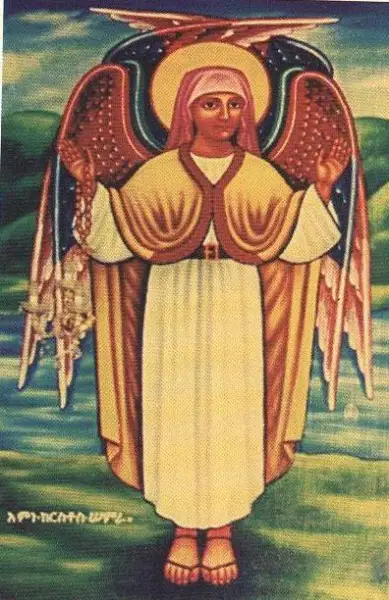
- Woman with two-sided wings
- Canonization
- Pre-congregation — venerated for centuries in the Ethiopian Orthodox Tewahedo Church; no formal canonization is recorded.
Prayer
Bibliography
Show 9 sources
- Belcher, Wendy (January 2018). "The Life and Visions of Krəstos Śämra, a Fifteenth-Century Ethiopian Woman Saint". African Christian Biography: Narratives, Beliefs, and Boundaries, ed. Dana Robert.
- de Birhan Media (2011). "Gedle Kristos Semra (Miracles/Hagiography Kirstos Semra)". Scribd. Retrieved 2020-08-08.
- Kinefe-Rigb Zelleke. 1975. "Bibliography of the Ethiopic Hagiographic Traditions." Journal of Ethiopian Studies 13, no. 2 (July): 57-102.
- Selamawit Mecca. 2006. "Hagiographies of Ethiopian Female Saints: With Special Reference to Gädlä Krestos Sämra and Gädlä Feqertä Krestos." Journal of African Cultural Studies 18, no. 2 (December): 153-167.
- Nosnitsin, Denis. 2007. "Krəstos Śämra." Encyclopaedia Aethiopica: He-N: Vol. 3, ed. Siegbert Uhlig, 443-445. Wiesbaden: Harrassowitz.
- Filəṗṗos. Atti di Krestos Samra [Ethiopic Original]. Ed. Enrico Cerulli. Corpus scriptorum Christianorum Orientalium. (Leuven, Belgium: Imprimerie orientaliste L. Durbecq, 1956).
- Marie-Laure Derat. 2012. "Chrétiens et musulmans d'Éthiopie face à la traite et à l'esclavage aux XVe et XVIe siècles." Traites et esclavages en Afrique orientale et dans l'océan Indien, ed. Thomas Vernet, Marie-Laure Derat, Henri Médard and Marie-Pierre Ballarin. Paris: Centre d'Etudes des Mondes Africains.
- R. E. Cheesman, Lake Tana and the Blue Nile (London: Macmillan, 1936).
- Gebre-Medhin, Solomon (2015-03-03). "Ethiopia: 'Ethiopia Is a Land of Tolerance, Hospitality and Justice,' Prof. Ephraim Issac". The Ethiopian Herald (Addis Ababa). Retrieved 2016-10-18.
Profile text adapted from the Wikipedia article, licensed CC BY-SA 4.0.
Pray with this saint every day
Save St. Kristos Samra to your favorites, read the full profile, and get feast-day reminders in the Saints app.
Get the Saints AppFree on the App Store for iPhone and iPad