
1875 – 1964·Feast Not recorded
St. Kuksha of Odessa
Holy elder and confessor of the Soviet persecution
Overview
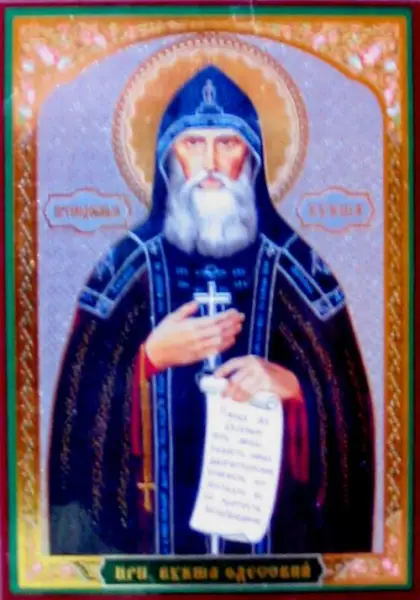
Kuksha of Odessa, born Kuzma Kirillovich Velichko, was an Orthodox hieromonk canonized by the Ukrainian Orthodox Church (Moscow Patriarchate) in 1995. He first saw the light at Arbuzynka, a village of the Kherson Governorate in the tsarist empire, on 25 January 1875, and made pilgrimages in his youth to the great monasteries of Russia and to the Holy Land, then joined the Russian monastery of Saint Panteleimon on Mount Athos in 1896. Tonsured in 1904 with the name Constantine, later Xenophont, he was expelled from Athos during the Imiaslavie dispute of 1912–1913 and entered the Kiev Pechersk Lavra. He received the Great Schema in 1931 under the name Kuksha and was ordained hierodeacon in 1934 and hieromonk the same year. In 1938 Soviet authorities sentenced him as a 'cult servant' to five years of forced labor in a Gulag subcamp in the Urals, followed by three years of exile. After returning to monastic life he was moved from Kiev to the Pochayiv Lavra, then to Chernivtsi Oblast, and finally to the Holy Dormition Monastery in Odessa in 1960. He died there on 24 December 1964 after breaking a hip, and was buried in the monastery cemetery.
The Complete Life
A Pilgrim's Heart in Kherson
The future Kuksha came into the world at Arbuzynka, in the Nikolaev Province of the Kherson Governorate, on 25 January 1875, and received the name Kuzma Kirillovich Velichko. His family was pious in a particular way: his mother as a girl had longed for the convent but wed at her parents' command, and she raised three sons — Kuzma, Theodore, and John — plus a daughter, Maria, praying that one of them would someday take monastic vows — a hope her eldest son fulfilled. As a young man Velichko walked to the great shrines of the Orthodox world: the lavras of Kiev and of Sergiyev Posad, the northern houses of Valaam and Solovki, and in 1895 Jerusalem and the Holy Land. He spent half a year in Jerusalem and toured every holy place in Palestine. Traveling home, he stopped at Mount Athos, where the pilgrims sought the blessing of the archimandrite of the Russian monastery of Saint Panteleimon. There Velichko made known his desire to join the monks. The archimandrite bade him come back in a year, presenting him with a little icon of Saint Panteleimon, the house's patron — an image Velichko treasured all his life.
§ Early life
Athos and the Monastic Name
In 1896, with his parents' blessing, Velichko arrived on Mount Athos and entered Saint Panteleimon Monastery as a novice, where he was placed in charge of the altar offerings, the prosphora breads prepared for the Eucharist. He returned to Jerusalem once more in 1897, this time with his mother, and two episodes on that journey were remembered as signs. At the Siloam baths, sought by childless pilgrims hoping God would grant them children, he tumbled into the pool, and the bystanders laughed, quipping that he would have many children of his own. In the Church of the Holy Sepulchre, as he worshipped among pilgrims anointing themselves with oil from the lamps, the central lamp spilled its oil over him, and the crowd pressed around to anoint themselves from his clothing. Back on Athos he served for eleven years in the monastery's pilgrims' guesthouse. He was tonsured on 5 April 1904 with the name Constantine and soon received the monastic name Xenophont. His Athos career ended abruptly when the Imiaslavie movement reached the monastery in 1912–1913: although Xenophont was uninvolved, the Greek authorities demanded that many foreign monks depart, and he left the Holy Mountain for Kiev.
§ Joining Saint Panteleimon monastery (1896)
Kiev, the Schema, and the Priesthood
In 1913 Xenophont entered the Kiev Pechersk Lavra, the ancient cave monastery on the Dnieper. The following year, after the outbreak of the First World War, he and other monks were put to work for ten months on the Kiev–Lvov railway before being allowed back to the monastery. His one great desire was to reach the Great Schema, the fullest expression of the monastic vocation, but his youth — he was only forty — stood in the way. The tonsure came at last through affliction. At fifty-six he fell suddenly and gravely ill, and those around him believed he was dying; on 8 April 1931 he received the schema under the name Kuksha, honoring a saint whose relics lie in the caves close by. He then recovered. Restoration of health opened the way to holy orders: he was consecrated a hierodeacon on 3 April 1934 and a hieromonk on 3 May of the same year. The monk who had begun as a keeper of altar breads on Athos now stood at the altar himself, and the name he had taken in the prospect of death became the name under which he would be glorified.
§ Great Schema tonsure as Kuksha (1931)
Confessor in the Gulag
When Soviet Ukraine's officials closed the Kiev Pechersk Lavra, Kuksha served at the church of Voskresenksaya Slobodka until the persecution reached him personally. In 1938 he was accused of being a 'cult servant' and sentenced to five years in the Vilva subcamp of the Usollag labor camp of the Gulag, in Molotov Oblast in the Urals. At sixty-three he labored fourteen hours a day at hard physical work in cold weather on inadequate food, alongside other priests and monks. Even there the sacraments found a way: Metropolitan Anthony of Kiev sent pieces of the consecrated Eucharist hidden among other breads, so that hundreds of convicted clergy could receive communion in the camps. Released on Saint George's Day in the spring of 1943, Kuksha was immediately sentenced to three years of exile in the village of Kungur in Solikamsky District. He received the blessing of the bishop of Solikamsk and frequently conducted church services in the village — a confessor who treated banishment as another parish. The pattern of his later life, moved from monastery to monastery by an state hostile to monasticism, never interrupted the round of prayer and service that had formed him on Athos and at Kiev.
§ First arrest by Soviet authorities (1938)
The Long Road to Odessa
In 1947 Kuksha returned to the Kiev Pechersk Lavra, but the years of quiet he hoped for never came. Four years on, the authorities moved him out of Kiev to the Pochayiv Lavra in Ukraine's west; for three years he led the dawn services in the monastery's cave churches. In the last days of April 1957, amid the Holy Week of the Lenten fast, he was moved again, to the Monastery of Saint John the Theologian in Khreshchatyk in Chernivtsi Oblast. When that monastery was closed three years later, its nuns were transferred into the monastery while the monks were sent onward to the Pochayiv Lavra; Kuksha himself reached the Holy Dormition Monastery in Odessa on 19 July 1960; Odessa remained his home for the four years that were left, which he passed as an elder of the brethren. In October 1964 his hip broke in a fall; left lying on the cold floor, he grew chilled, and pneumonia set in. He refused to take medicine, and on 24 December 1964 he died at Odessa at the age of eighty-nine. He was buried in the cemetery of the Holy Dormition Monastery, the community where his long pilgrimage ended.
§ Return to Ukraine (1947)
Glory After the Fall of the Soviet Union
Kuksha's glorification came only after the system that had persecuted him had itself passed away. He died in 1964 under Soviet rule and was buried quietly in the cemetery of the Holy Dormition Monastery in Odessa, where his sarcophagus now rests. After the collapse of the Soviet Union, the Holy Synod of the Ukrainian Orthodox Church glorified him as venerable in 1995, thirty years after his death. His veneration has since centered on the Holy Dormition Monastery in Odessa, his principal shrine, where the monks and pilgrims of the Ukrainian Orthodox Church (Moscow Patriarchate) keep his memory; the Moscow Patriarchate itself has marked his importance, as when the Patriarch of Moscow visited the Odessa monastery. Remembered as a holy elder and confessor of modern times, he stands among the witnesses of the twentieth-century persecution of the Russian and Ukrainian churches — a monk who passed from the pilgrimage roads of the tsarist empire through the Gulag of the Soviets to the altars of an independent Ukraine, bearing the same name and the same obedience throughout.
§ Death and canonization
Timeline
- 25 Jan 1875
Born Kuzma Kirillovich Velichko in the village of Arbuzynka in the Kherson Governorate of the Russian Empire.
§ Early life
- 1895
Pilgrimaged to Jerusalem and the Holy Land, living six months in Jerusalem and visiting Mount Athos on the return journey.
§ Early life
- 1896
Arrived on Mount Athos with his parents' blessing and became a novice at Saint Panteleimon Monastery.
§ Joining Saint Panteleimon monastery (1896)
- 1897
Visited Jerusalem a second time, accompanying his mother.
§ Joining Saint Panteleimon monastery (1896)
- 5 Apr 1904
Tonsured at Saint Panteleimon Monastery with the name Constantine, afterwards receiving the monastic name Xenophont.
§ Monastic vows as Xenophont (1904)
- 1913
Entered the Kiev Pechersk Lavra monastery after leaving Athos in the wake of the Imiaslavie dispute.
§ Kiev Pechersk Lavra monastery (1913-1935)
- 1914
After the outbreak of World War I, worked for ten months on the Kiev–Lvov railway with other monks before returning to the Lavra.
§ Kiev Pechersk Lavra monastery (1913-1935)
- 8 Apr 1931
Tonsured into the Great Schema while believed to be dying, receiving the name Kuksha.
§ Great Schema tonsure as Kuksha (1931)
- 3 Apr 1934
Consecrated a hierodeacon after recovering from his grave illness.
§ Great Schema tonsure as Kuksha (1931)
- 3 May 1934
Consecrated a hieromonk, one month after his ordination as deacon.
§ Great Schema tonsure as Kuksha (1931)
- 1938
Accused by Soviet authorities of being a 'cult servant' and sentenced to five years in the Vilva subcamp of the Usollag labor camp in Molotov Oblast.
§ First arrest by Soviet authorities (1938)
- 1943
Released from the labor camp on Saint George's Day in the spring, then sentenced to three years of exile in the village of Kungur.
§ First arrest by Soviet authorities (1938)
- 1947
Returned to the Kiev Pechersk Lavra monastery.
§ Return to Ukraine (1947)
- 1951
Moved under Soviet orders from Kiev to the Pochayiv Lavra in Ukraine's west.
§ Return to Ukraine (1947)
- Apr 1957
During Holy Week of Great Lent, transferred to the Monastery of Saint John the Theologian in Khreshchatyk, Chernivtsi Oblast.
§ Return to Ukraine (1947)
- 19 Jul 1960
Assigned to the Holy Dormition Monastery at Odessa, his home for his final four years.
§ Return to Ukraine (1947)
- Oct 1964
Fell and broke his hip, developing pneumonia after lying on the cold ground.
§ Death and canonization
- 24 Dec 1964
Died at the Holy Dormition Monastery in Odessa, refusing medicine, and was buried in the monastery cemetery.
§ Death and canonization
- 1995
The Holy Synod of the Ukrainian Orthodox Church glorified him among the venerable once the Soviet Union had fallen.
§ Death and canonization
The Record
- Canonization
- Glorified as venerable in 1995 by the Holy Synod of the Ukrainian Orthodox Church (Moscow Patriarchate).
Prayer
Bibliography
Show 3 sources
- "St. Kuksha of Odessa, Holy Elder and Confessor of Our Times". Pravoslavie.ru. 24 December 2015.
- "Venerable St. Kuksha of Odessa", Church of St. John the Baptist, Washington, D.C.
- "His Holiness Patriarch Kirill of Moscow and All Russia visits Monastery of the Dormition in Odessa", The Russian Orthodox Church
Profile text adapted from the Wikipedia article, licensed CC BY-SA 4.0.
Pray with this saint every day
Save St. Kuksha of Odessa to your favorites, read the full profile, and get feast-day reminders in the Saints app.
Get the Saints AppFree on the App Store for iPhone and iPad