
died 289·Feast July 7
St. Kyriaki
Great-Martyr of Nicomedia Under Diocletian
Overview
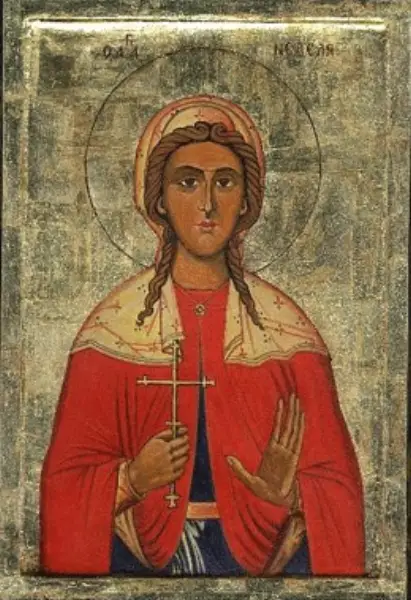
Kyriaki, whose name is the Greek word for Sunday, was a virgin martyr put to death under the emperor Diocletian. She was born at Nicomedia to Dorotheus and Eusebia, devout Christians who gave their daughter a name drawn from the day of her birth, the Lord's Day. Consecrated to God from childhood, she turned away every offer of marriage, declaring herself given to Jesus Christ. When a magistrate of Nicomedia whose son she had refused denounced her family, Diocletian had her parents arrested and exiled to Melitene, while Kyriaki was handed over for interrogation to the co-emperor Maximian and then to Hilarion, eparch of Bithynia at Chalcedon. Whipped, hung by her hair, and burned with torches, she was healed in prison by an appearance of Christ. Before the shattered idols of a pagan temple, an earthquake vindicated her prayer; fire and wild beasts refused to harm her under the eparch Apollonius; and at last she died by the sword in 289, twenty-one years old, offering her soul to God before the blade could fall.
The Complete Life
A Child of the Lord's Day
Kyriaki first saw the light of day at Nicomedia, a great city of Bithynia on the eastern shore of the Sea of Marmara, in the home of Dorotheus and Eusebia, a couple of Greek origin whose Christianity shaped every part of their household. Because the child arrived on a Sunday, her parents named her for the day itself — Kyriaki, the Greek word for the Lord's Day — a name that in Catholic tradition is rendered as Saint Dominica. The name proved prophetic: her whole existence would belong to the day of resurrection and to the Lord it honors. She grew up in a prosperous family, and from her earliest years she consecrated herself to God. Nicomedia in the late third century was no quiet place for such a vow; it was an imperial capital where the coming persecution of Diocletian would strike with special force. Within that city the daughter of Dorotheus and Eusebia matured into a young woman whose beauty drew suitors and whose faith drew attention of a far more dangerous kind, and the stage was set for the trial that would make her name known across the Christian world.
§ Life
A Bride of Christ Alone
As Kyriaki grew into a beautiful young woman, offers of marriage multiplied, and she refused them all with a single, unshakable answer: she had dedicated herself to Jesus Christ. In the world of Roman Asia Minor, where a wealthy daughter's marriage was a family alliance and a social asset, such a refusal carried real consequences. It brought one especially. A magistrate of Nicomedia wanted to betroth Kyriaki to his son, and her wealth made the match more attractive still. When she once again declined, his disappointment curdled into vengeance, and he denounced Kyriaki and her parents to the emperor Diocletian as Christians. Her consecration, freely chosen, thus became the immediate cause of her passion — the vow that shut the door on an ordinary life opened the way to an extraordinary one. What the magistrate intended as punishment became, in the economy of grace, her vocation confirmed: she would belong to Christ not only in refusal but in suffering, and the bride who would take no earthly husband would follow her bridegroom to a martyr's witness before the tribunals of the empire.
§ Life
Trial, Torment and Triumph at Chalcedon
Diocletian ordered the family arrested, and when Dorotheus and Eusebia refused to honor the pagan gods, Dorotheus was beaten; their steadfastness earned them only banishment, and husband and wife were sent away to Melitene, in the east of Anatolia. Kyriaki herself was dispatched to Nicomedia to face questioning before Diocletian's co-ruler Maximian. Whipping failed to shake her confession, so Maximian passed her to Hilarion, the eparch of Bithynia at Chalcedon, with instructions either to convert her or send her back. Promises and threats alike proved useless, and Hilarion ordered her tortured: she was suspended by her hair for hours while soldiers burned her flesh with torches, then thrown into a cell. During that night Christ came to her in a vision and restored her wounds. When Hilarion learned of it, he gave the credit to the pagan divinities and had her taken to their temple to return thanks; she offered instead a prayer that God bring down the images, and an earthquake crashed them to the floor and broke them to pieces. Blaspheming, Hilarion was struck dead by lightning. His successor Apollonius tortured her again: fire would not burn her, and wild beasts turned gentle before her. Sentenced to the sword, she asked time to pray, commended her soul to God and her memorial to the faithful, and died before the blade descended, twenty-one years old. Christians recovered her body and buried it.
§ Life
Veneration of the Great-Martyr
Kyriaki was never canonized by decree; the church's memory of her passion made her a saint, and she ranks among the Great Martyrs of the early persecutions. The Eastern Orthodox Church keeps her feast on 7 July, and she is venerated in both the Orthodox and Roman Catholic traditions. In the Orthodox East she is known under Slavic forms of the same Sunday name — as Sveta Nedela among Bulgarians and Macedonians — and the Saint Nedelya Cathedral in Sofia stands as one of the great churches that bear her title. A troparion in the fifth Byzantine tone, sung in her honor, greets her as a worthy sacrifice whose pure soul was offered to God and through whom Christ pours out graces abundantly on the faithful. Her principal shrine is the Church of St Kyriaki in Istanbul, and the cathedral of Monreale in Sicily numbered her among its sculpted saints. In Greece she is the particular protector of Servia, a town in Western Macedonia, where a church under her dedication serves the faithful.
§ Veneration
Churches and Places of Her Name
The memory of the Sunday martyr scattered her name across the map of the Orthodox world. Several settlements in Greece are called Agia Kyriaki in her honor, and an island of the same name lies in the Dodecanese. Churches dedicated to her include the church of Agia Kyriaki at Mavronoros in Grevena, the church at Rhodes, the church at Servia in Kozani, and a church in Athens itself, while far from Greece the chapel of St Domenica at Dingli in Malta keeps her Latin name alive and the Saint Nedelya Cathedral in Sofia, Bulgaria, ranks among the great monuments dedicated to her under her Slavic title. Her image has never ceased to be painted: nineteenth-century Bulgarian Orthodox icons show her as the Great-Martyr, a fifteenth-century fresco at Pobožje in North Macedonia depicts her, and a Serbian Orthodox icon of the saint survives in the Old Church of St. Nicholas at Javorani in Bosnia and Herzegovina. Each July the feast of 7 July renews this inheritance, joining Greek villages, Balkan cathedrals and a Maltese chapel in a single act of remembrance for the virgin of Nicomedia.
§ Churches
The Record
- Patron of
- Servia, a town in Western Macedonia, Greece
- Canonization
- Pre-congregation; venerated as a Great-Martyr of the early Church
Prayer
Bibliography
Show 5 sources
- Brodbeck, Sulamith. Les saints de la cathédrale de Monreale en Sicile. Iconographie, hagiographie et pouvoir royal à la fin du XIIe siècle. Rome: École française de Rome, 2010. P. 445.
- "St. Kyriake of Nicomedia", Antiochian Orthodox Christian Archdiocese of North America.
- "Feast Day of Agia Kyriaki", Greek City Times, July 7, 2020.
- "Kyriaki the Great Martyr", Greek Orthodox Archdiocese of America.
- Megas, G.A. (1958). Greek Calendar Customs. Press and Information Department, Prime Minister's Office. p. 140.
Profile text adapted from the Wikipedia article, licensed CC BY-SA 4.0.
Pray with this saint every day
Save St. Kyriaki to your favorites, read the full profile, and get feast-day reminders in the Saints app.
Get the Saints AppFree on the App Store for iPhone and iPad