
1855 – 1918·Feast Not specified in the source
St. Kyrion II
Catholicos-Patriarch of All Georgia and historian
Overview
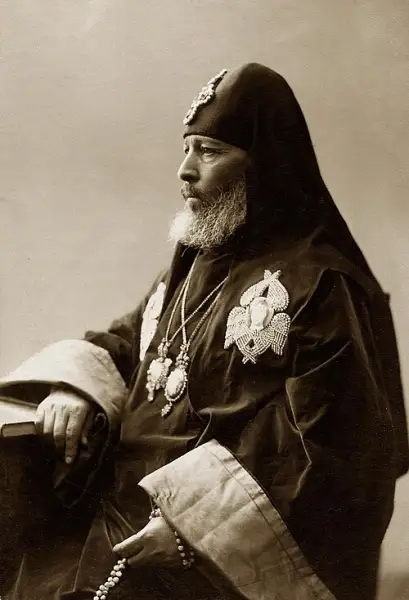
Kyrion II, born Giorgi Sadzaglishvili, was a Georgian churchman and historian who became the first Catholicos-Patriarch of All Georgia after the Georgian Orthodox Church restored its autocephaly from the Russian Orthodox Church in 1917. Educated at the seminaries of Tbilisi and Kiev, he spent his early career as a teacher of theology in Georgia, while publishing under pseudonyms pioneering studies of Georgian church history, discovering medieval Georgian manuscripts, and collecting coins and folklore. When his wife and children had died, he embraced the monastic life, rising to archimandrite and then bishop. A committed advocate of Georgian church independence, he suffered repeated exile under Imperial Russian authorities, being shuffled to posts in Ukraine and Lithuania and even stripped of his episcopal rank. Only the Revolution of 1917 allowed him to return home, where the restored Georgian church elected him its primate and consecrated him at Svetitskhoveli Cathedral on October 1, 1917. His patriarchate lasted less than a year: in June 1918 he was found murdered at Martqopi Monastery, a crime that has never been solved. The Georgian church canonized him as a martyr in 2002.
The Complete Life
A Priest's Son from Nikozi
The future patriarch was born Giorgi Sadzaglishvili on November 10, 1855, in the village of Nikozi, in what was then the Tiflis Governorate of the Russian Empire, into the family of a priest. His education followed the classic path of a Georgian churchman of the imperial era: he completed the theological seminary at Tbilisi in 1876 and went on to graduate from the seminary of Kiev in 1880. His administrative gifts were recognized immediately, and in that same year he was appointed deputy inspector of the Odessa Seminary, a post far from his homeland. In 1883 he returned to Georgia and combined two vocations for the next decade: service as a teacher in the theological schools of Gori, Kutaisi and Tbilisi, and official duties in the church. Alongside this work he built the reputation that still distinguishes him among Georgian hierarchs — that of a scholar. Writing in Georgian and Russian under a series of assumed names, including Sadzagelov-Iverieli, Iverieli and Nikozeli, he published studies of the history of the Georgian church and of Christianity in Georgia, brought to light unique medieval Georgian manuscripts, gathered old Georgian coins, recorded folklore, sponsored promising Georgian students, and corresponded with foreign scholars who shared his interest in his country.
§ Early life and career
Monk, Bishop, and Voice of Autocephaly
Personal tragedy redirected Giorgi Sadzaglishvili's life toward the monastic calling. After losing his wife and children, he received the tonsure, took the name Kyrion, and in 1896 was ordained archimandrite at Kvatakhevi Monastery. Episcopal office followed quickly: he served as bishop at Alaverdi from 1898 to 1901 and at Gori from 1901 to 1902. These were the years when the question of the Georgian church's status burned hottest. The autocephalous Orthodox Church of Georgia had been abolished by Imperial Russia in 1811 and replaced by an exarchate under Russian control, and a growing autocephalist movement demanded its restoration. Kyrion threw himself into that cause, becoming one of its most active and conspicuous proponents. The imperial authorities answered with displacement: in 1902 he was removed from Georgia altogether and sent to Kamenets-Podolsk, in present-day Ukraine, and in 1903 to Kovno, now Kaunas in Lithuania. From May 3, 1903, through to April 23, 1904, he served as bishop of Novomyrhorod and vicar of the Kherson Governorate. Punishment, however, only confirmed the justice of the cause in Georgian eyes, and his exile made him a living symbol of the church's suppressed independence.
§ Church career
Exile and Disgrace
The darkest chapter of Kyrion's career opened in 1908. In that year Archbishop Nikon, the Russian Exarch of Georgia, was murdered in Tbilisi, and the Russian authorities used the killing to justify driving Georgian bishops from their posts. Kyrion was stripped of his episcopal title, dispatched to Kuriazh in Ukraine, and afterwards confined within the Sanaksar Monastery in Mordovia — an eremitical house in the remote Volga region that functioned in effect as a prison for inconvenient hierarchs. He remained under this cloud for years, until in 1915 the authorities restored him to his rank and appointed him bishop of Polotsk and Vitebsk, still far from Georgia. Return came only through catastrophe: the February Revolution of 1917 in Saint Petersburg dissolved the old imperial machinery, and Georgia drifted into de facto secession from Russia. In September 1917 Kyrion was finally able to come home, and Georgians received him as their spiritual leader. The moment was propitious. On March 12, 1917, Georgian clergymen had already proclaimed the restoration of their church's autocephaly, and the church stood in need of a primate whose whole career had embodied that demand.
§ Church career
Catholicos-Patriarch and Martyr
On October 1, 1917, Kyrion was elected Catholicos-Patriarch of All Georgia and consecrated at Svetitskhoveli Cathedral, the ancient coronation church of the Georgian kings — the first to hold the restored office after more than a century of Russian rule. The Russian Orthodox Church's Most Holy Synod refused to recognize the restoration, and communion between the two churches was broken; Moscow would not acknowledge Georgian autocephaly until 1943. Kyrion's tenure as primate was brief and troubled. Beyond the external dispute with Russia, he faced opposition within Georgia itself from a group of clerics who defied his authority, so that the first patriarch of the restored church governed under pressure from every side. It ended suddenly. Early on June 27, 1918, Kyrion was found murdered at his residence in Martqopi Monastery, and his death has remained a mystery to the present day. He was laid to rest in the Sioni Cathedral of Tbilisi, the mother church of the capital. Whatever the identity of his killers, the church received him among its martyrs: the Georgian church's governing synod enrolled him among the saints on October 17, 2002, honoring the hierarch, honoring the hierarch who had given his life to the restored church within a year of its restoration.
§ Church career
Canonization and Commemoration
Kyrion's official recognition as a saint came more than eight decades after his death. On October 17, 2002, the Holy Synod of the Georgian Orthodox Church enrolled him among the saints, remembering him as a hieromartyr — a priest-bishop who died a violent death in the service of the church. The canonization closed a circle that had begun with his martyrdom in 1918 and vindicated the cause for which he had suffered exile, deposition, and confinement: the autocephaly of the Georgian church, which he lived just long enough to see restored and which no one has since taken away. He is venerated in the Eastern Orthodox Church, and particularly in Georgia, where his memory is bound up with the national church's independence. His funeral procession through Tbilisi on June 28, 1918, alongside his fellow hierarch St. Ambrosius, showed how deeply the people had already claimed him; the canonization of 2002 made that popular reverence permanent. As both scholar and martyr, he stands in the Georgian calendar as an example of learning placed at the service of faith and of a conscience that exile could not bend.
§ Church career
Scholar of a Nation's Church
Kyrion's legacy rests on two pillars: the church he led and the history he wrote. As primate he was the first to bear the office of Catholicos-Patriarch of All Georgia after its 1917 restoration, the man who took up an office abolished by imperial decree in 1811 and made it live again, though he governed for less than a year and died amid factional strife. The break in communion with Moscow that marked his patriarchate lasted a generation, resolved only when the Russian Orthodox Church recognized Georgian autocephaly in 1943 and restored relations between the two churches. As a historian, he helped Georgians understand the institution they were reclaiming: his pseudonymous publications on the history of the Georgian church and of Georgian Christianity, his discovery and study of unique medieval Georgian manuscripts, and his collecting of old coins and folklore gave scholarly depth to the national revival of the late nineteenth century. He gave support to promising Georgian students and worked alongside foreign scholars who shared his interest in his country, acting as a one-man bridge between Georgian learning and Europe. The unsolved mystery of his death at Martqopi has only deepened his aura, making the first patriarch of the restored church also its most enigmatic martyr.
§ Church career
Timeline
- 10 Nov 1855
Comes into the world as Giorgi Sadzaglishvili at Nikozi, in a priest's household
§ Early life and career
- 1876
Graduates from the Tbilisi theological seminary
§ Early life and career
- 1880
Graduates from the Kiev seminary and is appointed deputy inspector of the Odessa Seminary
§ Early life and career
- 1883
Returns to Georgia to teach in the theological schools of Gori, Kutaisi and Tbilisi while serving as a church official
§ Early life and career
- 1896
Becomes a monk, taking the name Kyrion, and is ordained archimandrite at Kvatakhevi Monastery
§ Church career
- 1898
Serves as Bishop of Alaverdi
§ Church career
- 1902
Removed from Georgia to Kamenets-Podolsk for his advocacy of Georgian church autocephaly
§ Church career
- 1908
Deprived of his episcopal rank after the murder of Exarch Nikon and confined successively to Kuriazh and the Sanaksar Monastery in Mordovia
§ Church career
- 1915
Restored to his rank and appointed Bishop of Polotsk and Vitebsk
§ Church career
- 12 Mar 1917
Georgian clergymen restore the autocephaly of the Georgian church while he is still in Russian exile
§ Church career
- 1 Oct 1917
Elected Catholicos-Patriarch of All Georgia and consecrated at Svetitskhoveli Cathedral
§ Church career
- 27 Jun 1918
Found murdered at his residence in Martqopi Monastery; buried at the Tbilisi Sioni Cathedral
§ Church career
- 17 Oct 2002
Canonized by the Holy Synod of the Georgian Orthodox Church
§ Church career
The Record
- Major works
- Historical studies of the Georgian Orthodox Church and Georgian Christianity, published in Georgian and Russian under the pseudonyms Sadzagelov-Iverieli, Iverieli and Nikozeli·Discovery and study of unique medieval Georgian manuscripts·Collection of old Georgian coins and recordings of Georgian folklore
- Canonization
- Canonized by the Holy Synod of the Georgian Orthodox Church on October 17, 2002
Prayer
Bibliography
Show 5 sources
- Кирион (Георгий Иеронимович Садзагелов) [Kirion (Georgy Yeronimovich Sadzagelov)]. Brockhaus and Efron Encyclopedic Dictionary, 1906 (in Russian).
- Босько, В. М. Визначні постаті степової Еллади. Кіровоград, 2004, p. 267.
- Lang, David M. A Modern History of Georgia. London: Weidenfeld and Nicolson, 1962, p. 178.
- წმინდანთა ცხოვრება — მღვდელმოწამე კირიონ II — სრულიად საქართველოს კათოლიკოს-პატრიარქი (The Life of Saints — The Priest Martyr Kyrion II — Catholicos Patriarch of All Georgia), in Georgian. Accessed April 6, 2007.
- Vardosanidze, Sergo. "Kyrion II", article in Georgian. Accessed April 6, 2007.
Profile text adapted from the Wikipedia article, licensed CC BY-SA 4.0.
Pray with this saint every day
Save St. Kyrion II to your favorites, read the full profile, and get feast-day reminders in the Saints app.
Get the Saints AppFree on the App Store for iPhone and iPad