
1040 – 1095·Feast June 27
St. Ladislaus I of Hungary
Knight-king and canonized lawgiver of Hungary
Overview
Ladislaus I, the second son of King Béla I of Hungary and Richeza of Poland, was born in Polish exile around 1040 and raised, as the chronicler Gallus Anonymus noted, almost as a Pole in his ways. He rose to prominence as a duke under his elder brother Géza I, fighting beside King Solomon against steppe raiders and then against Solomon himself when the royal cousins fell out. Proclaimed king in 1077 after Géza's death, he spent his reign restoring public safety after years of civil war, issuing famously severe laws against theft and violence, aligning Hungary with the opponents of Henry IV during the Investiture Controversy, and canonizing the first Hungarian saints in 1083. His victories over the Pechenegs and Cumans secured Hungary's eastern frontier for about 150 years, and his occupation of Croatia in 1091 began the long association of the two kingdoms. He died on 29 July 1095 close to the frontier with Bohemia, having set out to aid his nephews in Moravia. Canonized in 1192, Ladislaus became the model of the Hungarian knight-king, a patron saint of Hungary, soldiers, and the Székely people, and — after archaeogenetic study of his skull relic confirmed his identity in the twenty-first century — the first saint whose remains were validated by genetics.
The Complete Life
Born in Exile, Raised in Poland
Ladislaus entered the world away from the kingdom he would one day rule. His father was Béla, later king of Hungary; his mother was Richeza, or Adelaide, a daughter of the Polish ruler Mieszko II Lambert, and he was born in Poland because his father had withdrawn there in the 1030s, banished from Hungary. His elder brother was Géza; the boy bore a Slavic name, Ladislaus, derived from Vladislav, and the Polish chronicler Gallus Anonymus wrote that he was raised from childhood in Poland, to the point of turning almost into a Pole in his manner of living. His late twelfth-century Legend declared that his bodily and spiritual endowments already displayed God's gracious intent from the cradle. Around 1048 the family returned to Hungary, where Béla received from his brother, King Andrew I, the so-called Duchy comprising one third of the kingdom. The politics of the next decade swept the boy along: in 1057 or 1058 Andrew's son Solomon received royal anointing with the approval of Béla and his sons, but Béla, displaced from the succession, left for Poland in 1059 with his sons, returned with Polish reinforcements, defeated Andrew, and was crowned king on 6 December 1060. Solomon fled to the Holy Roman Empire, and the wheel turned again when Béla died on 11 September 1063.
§ Early years (before 1064)
Duke of the Eastern Marches
The young man's proving ground was the duchy his father had held. To avoid another civil war, Ladislaus and his brothers concluded an agreement with Solomon on 20 January 1064, accepting his rule in return for the old duchy of their father, and for the next seven years the cousins cooperated. Ladislaus and Géza divided its administration between them, Ladislaus apparently taking the regions around Bihar. It was in these years that the most beloved story of his life was set: after the combined forces of Solomon, Géza and Ladislaus crushed a raiding band of Pechenegs or Oghuz Turks at the Battle of Kerlés in 1068, the duke pursued a pagan warrior who was carrying off a Hungarian maiden, and, at his advice, the girl pulled the raider from his horse so that Ladislaus could kill him after a long struggle on foot. Relations with the king soured in the early 1070s. When Géza joined Solomon's campaign against Byzantium in 1072, Ladislaus stayed behind with half the ducal troops, prepared to strike hard on his brother's behalf. As war with Solomon became unavoidable, Ladislaus rode first to Kievan Rus' and returned without reinforcements, then persuaded Duke Otto I of Olomouc to bring Czech troops; with them the brothers crushed Solomon at the Battle of Mogyoród on 14 March 1074, Ladislaus commanding the men of Byhor on the left flank.
§ Duke in Hungary (1064–1077)
The Severe Lawgiver and the Canonizer
Proclaimed king on his brother Géza's death in April 1077, Ladislaus devoted his first years to the one thing the war-weary kingdom needed most: public safety. Shortly after his coronation he promulgated two law books drawn from the decisions of an assembly of magnates held at Pannonhalma, and their severity became proverbial. Thieves were to be hanged; those who fled to a church were led out and blinded; a man who stole a goose or a hen lost an eye; the children of condemned men above the age of ten were reduced to servitude. Draconian as they were, the laws testify to a king determined to make property and peace secure after decades of bloodshed, and they also regulated judicial procedure and the royal salt monopoly. Abroad, Ladislaus sided deliberately against Solomon's patron, Henry IV of Germany: he sheltered Bavarian rebels at Pope Gregory VII's request, married Adelaide, daughter of the German anti-king Rudolf of Rheinfelden, and promised 20,000 knights to Henry's opponents at Speyer in 1087. His crowning act of statesmanship was spiritual. In August 1083 he presided over the canonization of the first five Hungarian saints — among them King Stephen I, whose order had blinded Ladislaus's own grandfather — and, when Stephen's tomb would not open, released his prisoner Solomon, after which the stone lifted with ease.
§ Consolidation (1077–1085)
The Pious Knight-King
Holiness in Ladislaus took the form of the ideal the age called chivalry: Gábor Klaniczay observes that he appeared almost made to embody the knight-king ideal of his era, and Bishop Hartvik wrote that his character shone with seemly morals and was radiant with virtue. His piety was intertwined with visions and sacred places. Before the Battle of Mogyoród he was said to have beheld, in broad daylight, an angel setting a crown upon Géza's head, and an ermine of purest white leapt from a thorny bush onto his lance and breast as a sign of triumph. Near Vác, the stag with burning candles on its horns appeared to him and his brother, and it was Ladislaus who explained the vision: the creature was an angel from God, its horns wings, its candles feathers, commanding that a church of the Blessed Virgin be built where its feet had touched the earth. When pestilence swept the kingdom, his legend says, he loosed an arrow blindly into the air, and it struck a healing herb that cured the sickness, which Hungarians still call Saint Ladislaus's herb. In his letter to the Abbot of Monte Cassino he admitted that he could not advance his worldly standing without falling into grave sin — the self-knowledge of a warrior who knew his crown was stained.
§ Sainthood and veneration
Croatia, the Frontiers, and the Last March
The expansion of his last decade reshaped Central Europe. When the Croatian throne fell into dispute after the deaths of King Demetrius Zvonimir, whose wife Helen was Ladislaus's sister, and of his successor Stephen II, Ladislaus invaded Croatia in 1091 at Helen's request, occupying the whole land from the Drava to the Iron Alps without opposition, appointing his nephew Álmos to govern it, and creating a new diocese with its see at Zagreb. Only Petar Snačić's resistance in the Gvozd Mountains prevented complete conquest. In the same year the Cumans, incited — so the sources differ — by Byzantines or Ruthenians, plundered eastern Hungary under the chieftain Kapolcs; Ladislaus overtook them near the Temes river, offered the survivors baptism, settled many in Jászság, and killed the chieftain Ákos in a second battle near Severin. His relations with the Holy See then deteriorated, for the popes claimed Croatia as their fief and Ladislaus refused to acknowledge their suzerainty, while his deeds at Somogyvár showed him resisting the Gregorian demand for an independent church. In 1093 he intervened in Poland, capturing Duke Władysław Herman's son Boleslaus. In the spring of 1095 envoys, so the chronicle claims, begged him to lead a crusade; he did plan to aid his nephews in Bohemia, but fell gravely ill before reaching Moravia and died on 29 July 1095 close by the frontier with Bohemia.
§ Last years (1092–1095)
Canonization and the Relics of the King
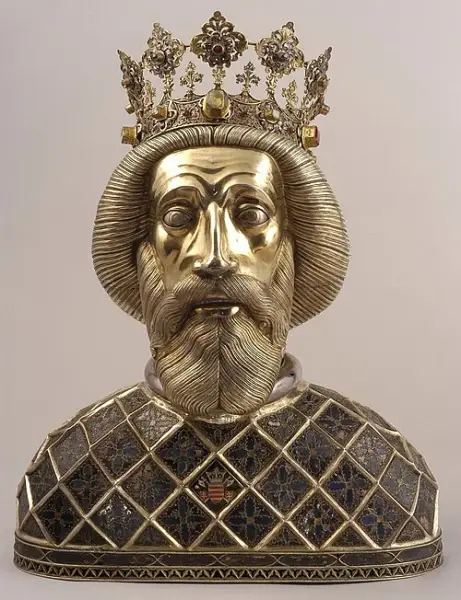
Veneration of Ladislaus gathered quickly around his tomb at Várad — so quickly that under King Stephen II, barely a generation after his death, his shrine in the cathedral was already a preferred venue for trials by ordeal. The formal canonization is dated 27 June 1192, but its circumstances are tangled: Thomas the Archdeacon attributed the decree to Pope Innocent III, an impossibility of chronology, and Celestine III's own bulls make no mention of Ladislaus, which suggests the saint was enrolled without papal authorization, while Hungarian tradition assigns the act to King Béla III, who had spent years at the Byzantine court, where Ladislaus's daughter the empress Irene was herself honored as a saint. At the ceremony a bondsman named Tekus opened the tomb and was granted his freedom, and parts of the royal head and right hand were severed as relics. His official legend, compiled after 1204, recorded a host of miracles. The relic of his skull, the most treasured in Hungary, passed through fire in 1406 unharmed, fled before the ravages of the Reformation in the sixteenth century, and came by way of Prague, Pozsony and Veszprém to Győr Cathedral, where it lies in a fifteenth-century herm — and where twenty-first-century genetics confirmed that the skull indeed belongs to the royal line.
§ Sainthood and veneration
The Making of a Christian Kingdom
For centuries, hagiographers and historians alike have placed Ladislaus at the center of the consolidation of the Hungarian Christian monarchy, even while chroniclers felt obliged to stress his personal suitability for rule because the strict legitimacy of his reign was open to question — the Illuminated Chronicle concedes that strict law between himself and Solomon favored him not at all — only accomplished fact stood behind him. His works outlasted the doubts. His victories over the Pechenegs and Cumans stopped the invasions of the steppe peoples until the Mongol assault of 1241, and under him the Székely warriors began settling the eastern borderlands. His conquest of Croatia began the association of the two kingdoms that lasted until 1918, and opened the period of expansion that made medieval Hungary a leading power of Central Europe. His cult became woven into the monarchy itself: it became the custom for every newly crowned king to go on pilgrimage to the royal tomb at Várad, and Louis I of the Anjou, campaigning in the Balkans, showed him particular devotion; King Sigismund chose to be buried beside his tomb. Artists never ceased to depict him — Simone Martini painted him, the Illuminated Chronicle illustrated his duel with the Cuman, and his statues guard Heroes' Square in Budapest — the incarnation, as the sources say, of the Hungarian ideal of chivalry.
§ Consolidation of the Christian monarchy
Timeline
- 27 Jun 1040
Is born in Kraków, in Poland, where his father Béla lived in banishment from Hungary
§ Early years (before 1064)
- 6 Dec 1060
His father Béla, who has returned with Polish support, is crowned King of Hungary after defeating Andrew I
§ Early years (before 1064)
- 11 Sep 1063
His father Béla I dies; Ladislaus and his brothers withdraw to Poland as German troops restore Solomon
§ Early years (before 1064)
- 20 Jan 1064
Signs a treaty with Solomon acknowledging his reign in exchange for their father's former duchy
§ Early years (before 1064)
- 1068
Fights at the Battle of Kerlés against Pecheneg or Oghuz raiders, the campaign with which his legend of rescuing an abducted Hungarian girl is connected
§ Sainthood and veneration
- 26 Feb 1074
King Solomon's army routs his brother Géza's troops at the Battle of Kemej while Ladislaus is returning with Czech reinforcements
§ Duke in Hungary (1064–1077)
- 14 Mar 1074
Leads the men of Byhor into the left wing at the Battle of Mogyoród, where Solomon is decisively defeated
§ Duke in Hungary (1064–1077)
- 1074
Repels Solomon's attack on Nyitra (Nitra) while administering the whole of his father's former duchy and acting as Géza's chief adviser
§ Duke in Hungary (1064–1077)
- 25 Apr 1077
His brother Géza I dies; Ladislaus is proclaimed king by Géza's supporters, with Polish forces helping to drive Solomon out
§ Consolidation (1077–1085)
- 1078
Marries Adelaide, daughter of Rudolf of Rheinfelden, the German princes' anti-king against Henry IV
§ Consolidation (1077–1085)
- 1079
Besieges and captures the fortress of Moson from Solomon early in the year
§ Consolidation (1077–1085)
- 1081
Solomon abdicates and acknowledges Ladislaus's reign in exchange for revenues sufficient to sustain royal dignity
§ Consolidation (1077–1085)
- Aug 1083
Presides over the canonization of the first five Hungarian saints, including Stephen I and Emeric, and frees the imprisoned Solomon at the ceremony
§ Consolidation (1077–1085)
- 1085
Defeats the Pecheneg forces of the chieftain Kutesk, whom Solomon had persuaded to invade Hungary, at the upper courses of the Tisza
§ Consolidation (1077–1085)
- Aug 1087
Sends envoys to the conference of German princes at Speyer, promising up to 20,000 knights against Henry IV
§ Expansion (1085–1092)
- 1091
Invades Croatia at his sister Helen's request, occupying nearly the whole land, appointing Álmos to govern it and erecting a new diocese at Zagreb
§ Expansion (1085–1092)
- 21 May 1091
Personally presides over the assembly of Hungarian prelates at Szabolcs, which recognizes the legitimacy of a clergyman's first marriage
§ Expansion (1085–1092)
- 1093
Marches into Poland on behalf of Zbigniew and captures the duke's younger son Boleslaus
§ Last years (1092–1095)
- 29 Jul 1095
Dies near the Hungarian-Bohemian border, having fallen seriously ill on the march toward Moravia
§ Last years (1092–1095)
- 27 Jun 1192
Is canonized; Thomas the Archdeacon credits Pope Innocent III with the decree, but the date is associated with Celestine III's pontificate and Hungarian tradition ascribes the act to King Béla III
§ Sainthood and veneration
- 1345
A late medieval legend recounts his appearance at the head of a Székely army that routed a band of plundering Tatars
§ Sainthood and veneration
- 1406
The wooden herm containing his skull is damaged by fire, but the skull itself survives unharmed
§ Herma of King Saint Ladislaus and genetics
- 4 Jun 2021
A sample is collected from the skull in the Győr herm for archaeogenetic analysis
§ Herma of King Saint Ladislaus and genetics
- 2023
Published genetic findings confirm the authenticity of the skull relic, making Ladislaus the first saint whose identity was confirmed by archaeogenetic testing
§ Herma of King Saint Ladislaus and genetics
In Their Own Words
If someone, freeman or bondman, should be caught in theft, he shall be hanged. But if he flees to the church to evade the gallows, he shall be led out of the church and blinded.
Truly that was no stag, but an angel from God.
Hungary had never had as great as king, so they repute And the land thereafter never bore that much and splendid fruit.
The Record
- Major works
- Two law books promulgated shortly after his coronation, issued from the assembly of magnates at Pannonhalma·Establishment of the diocese of Zagreb for the conquered territory of Slavonia·Dedication of Szentjobb Abbey to the Holy Dexter, the right arm of St Stephen I·Somogyvár Abbey, whose deed he granted in his own name
- Patron of
- Patron saint of Hungary, especially along the borders·Patron saint of the Székely people·Patron of soldiers·Invoked against pestilence
- Symbols
- Long sword·Banner·Royal crown·Defended by two angels·Kneeling before a deer
- Canonization
- Canonized on 27 June 1192; the act is attributed by different sources to Pope Celestine III and to King Béla III
Prayer
Bibliography
Show 8 sources
- Klaniczay, Gábor. Holy Rulers and Blessed Princes: Dynastic Cults in Medieval Central Europe. Cambridge University Press, 2002.
- Engel, Pál. The Realm of St Stephen: A History of Medieval Hungary, 895–1526. I.B. Tauris Publishers, 2001.
- Kristó, Gyula, and Makk, Ferenc. Az Árpád-ház uralkodói [Rulers of the House of Árpád]. I.P.C. Könyvek, 1996.
- Kontler, László. Millennium in Central Europe: A History of Hungary. Atlantisz Publishing House, 1999.
- Robinson, I. S. Henry IV of Germany, 1056–1106. Cambridge University Press, 1999.
- The Hungarian Illuminated Chronicle: Chronica de Gestis Hungarorum. Edited by Dezső Dercsényi. Corvina, Taplinger Publishing, 1970.
- Varga, Gergely I B, et al. "The archaeogenomic validation of Saint Ladislaus' relic provides insights into the Árpád dynasty's genealogy." Journal of Genetics and Genomics 50, no. 1 (2023): 58–61.
- Bárány, Attila. "The Expansion of the Kingdom of Hungary in the Middle Ages (1000–1490)". In The Expansion of Central Europe in the Middle Ages, ed. Nóra Berend. Ashgate Variorum, 2012, pp. 333–380.
Profile text adapted from the Wikipedia article, licensed CC BY-SA 4.0.
Pray with this saint every day
Save St. Ladislaus I of Hungary to your favorites, read the full profile, and get feast-day reminders in the Saints app.
Get the Saints AppFree on the App Store for iPhone and iPad