
c. 636 – c. 705·Feast September 17
St. Lambert of Maastricht
Bishop and martyr of the Meuse country
Overview
Lambert was bishop of Maastricht-Liège from about 670 until his violent death around 705, and one of the most consequential churchmen of the age when Merovingian power gave way to the Carolingians. Born to the noble family of Apre, lord of Loon, he was baptized by Bishop Remaclus, educated at Wintershoven, and groomed for the episcopate at the court of King Childeric II under the patronage of his uncle, Bishop Theodard. When Theodard was murdered soon after 669, the king's councillors made Lambert bishop in his place. The reversal of dynastic fortunes cost him his see: after Childeric's murder in 675 the faction of Ebroin expelled him, and he passed seven years in exile at the young Abbey of Stavelot before Pepin of Herstal's rise allowed his return. Back in office, Lambert preached the gospel along the lower Meuse with Willibrord, founded a convent at Munsterblizen with Landrada, and mentored the young Hubertus, his eventual successor. He denounced Pepin's liaison with Alpaida, the mother of Charles Martel, and was killed at Liège by the troops of Dodon, a kinsman of Alpaida, caught in the clan warfare of the day. Honored as a martyr for his defense of marital fidelity, his relics, translated by Hubertus, made Liège a great pilgrimage city.
The Complete Life
A Noble Son of Maastricht
Very little secure knowledge survives about Lambert's beginnings, and what is told comes largely from later tradition, above all the fourteenth-century chronicler Jean d'Outremeuse. According to this account, he was born around 636 at Maastricht, the child of Apre, lord of Loon, and of Herisplindis — a union of two noble city families. His religious formation was placed in the hands of the church from the start: his godfather at baptism was Remaclus, the local bishop who had made Maastricht a center of missionary Christianity, and his education was placed with Landoald, archpriest of Maastricht and master of the noble abbey school at Wintershoven. Through his family he was bound to the great ones of the realm — he was related to the seneschal Hugobert, whose daughter Plectrude became the lawful wife of Pepin of Herstal — and he moved at ease among the dynasty of mayors of the palace that held the Merovingian kings of Austrasia in tutelage. The early biographers left a striking portrait of the young man: prudent and comely, gracious in speech and bearing, sturdy and brave in fight, level-headed, warm of heart, chaste and lowly, and given to books — a courtier's polish joined to a monk's discipline.
§ Life
Bishop by the King's Councillors
Lambert's path to the episcopate ran through the royal court and family tragedy. He was often at the Merovingian court of King Childeric II as a protégé of his uncle Theodard, who had succeeded Remaclus as bishop of Maastricht, and his upbringing at once aristocratic and ecclesiastical fitted him for high office in the church. The murder of Theodard soon after 669 left the see vacant, and the councillors of Childeric II chose Lambert to fill it. Thus, at about the age of thirty, the nobleman's son became bishop of Maastricht-Liège, the ancient see of Tongeren, holding one of the most strategically important churches on the Meuse. His tenure, however, remained hostage to the blood-soaked politics of the age. When Childeric II himself was murdered in 675, the balance of court power swung to Ebroin, the majordomo of Neustria and the power behind the throne, whose faction drove Lambert from his see in favor of their own candidate, Faramundus. The bishop became an exile — an experience that, in the pattern of many early medieval saints, proved to be the making of his sanctity rather than the end of his ministry.
§ Life
Exile at Stavelot and Mission on the Meuse
Dispossessed of his cathedral, Lambert withdrew for seven years to the recently founded Abbey of Stavelot, among the Ardennes, where the monastic discipline he had admired since his school days at Wintershoven now shaped his own soul. His exile ended only when the turbulent politics of the Frankish world turned once more: Pepin of Herstal, Lambert's own kinsman by marriage, rose to be mayor of the palace, and the rightful bishop was allowed to return to Maastricht. His second tenure bore the fruits of those quiet years. In company with Willibrord, the English missionary who arrived on the continent in 691, Lambert carried the gospel down the lower stretches of the Meuse, preaching in the still half-pagan north — a partnership that tied the church of Maastricht to the great Anglo-Saxon mission of the age. Together with Landrada he established a convent at Munsterblizen, planting monastic life in the region. He also took charge of souls individually: the young aristocrat Hubertus, first-born son of Duke Bertrand of Aquitaine, became his spiritual directee, and under Lambert's guidance the future saint prepared for the office he would one day inherit — the bishopric whose martyrdom Lambert was still to win.
§ Life
The Bishop's Rebuke and a Martyr's Death
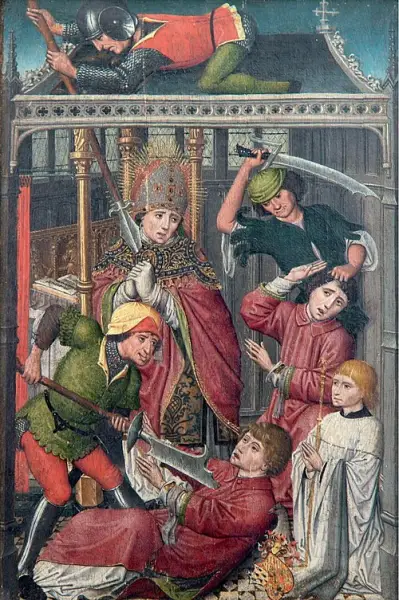
The catastrophe of Lambert's last years grew out of the private morals of the most powerful house in the Frankish world. Pepin of Herstal had taken up with Alpaida, his mistress or bigamous wife, who would one day bear Charles Martel, and Lambert is said to have denounced the adulterous liaison openly — a rebuke that aroused the enmity of Pepin, of Alpaida, or of both. The bishop, historian Jean-Louis Kupper argues, was in any case the casualty of a private feud between two clans contending for control of the Tongres-Maastricht see, in the wider turmoil that accompanied the passage from Merovingian to Carolingian rule. The blow came at Liège, where Lambert kept a residence: troops under Dodon, Pepin's domesticus or manager of state domains and a father or brother of Alpaida, killed him there. Sources disagree on the year, placing his death between 705 and 709. His two nephews, Peter and Audolet, died defending him and were themselves honored as saints. Whatever the precise entanglement of motives — and many historians question the late tradition linking Alpaida and Dodon — the church judged the matter simply: the bishop had died for the defense of marriage, and was revered as a martyr.
§ Life
Martyr and Saint of Two Rites
Lambert received no formal canonization; he belonged to the age in which the church recognized martyrs by acclamation and cult. He came to be venerated as a martyr for his defense of marital fidelity, and his memory was embraced by the whole of western Christendom: he is honored in the Catholic Church, the Eastern Orthodox Church, and the Anglican Communion, with his feast kept on 17 September in the Roman Catholic calendar. The veneration of his remains shaped the very geography of the region. Though buried at Maastricht, his successor Hubertus translated the relics to Liège, and the episcopal see itself followed them, so that Lambert's blood became the founding stone of the city that bears his name. To enshrine them Hubertus built a basilica near the bishop's residence, which grew into the great St. Lambert's Cathedral. There the cult flourished for a millennium: his relics, credited in medieval times with healing blindness, lameness of the feet and legs, and leprosy, were examined and re-enshrined repeatedly, and even in the twenty-first century the church of Liège continues to study them, opening the reliquaries in 2023 for a new examination that included a medical investigation of the saint's remains.
§ Relics
Patron of Liège and of Freiburg
Lambert's name remains woven into the civic and religious life of two countries. Liège numbers him among its chief patrons; the city's central square, the Place Saint-Lambert, marks the site of the cathedral that enshrined him — a cathedral torn down beginning in 1794 in the aftermath of revolution, its destruction scattering the saint's tomb, which was relocated to the Liège Cathedral, where it still resides. In Germany, Freiburg im Breisgau likewise honors him as its patron; a relic of his head has been preserved there since 1190 and where he is honored alongside the city's other protecting saints. His feast on 17 September has long overflowed the liturgy into folklore: in Münster the Lambertusfest has been celebrated for centuries as a two-week folk holiday culminating on the eve of the feast, when children build the peculiar local monuments called Lambertus pyramids — towers of branches decorated with lanterns — and dance and sing around them in the traditional songs known as Lambertussingen or Käskenspiel. A scattering of churches across Germany, Belgium, and the Netherlands carry his dedication, keeping alive the memory of the bishop-martyr of the Meuse wherever his name is invoked.
§ Patronage
Timeline
- 636
Is born at Maastricht, traditionally to Apre, lord of Loon, and to Herisplindis his wife
§ Life
- 669
Succeeds his murdered uncle Theodard as bishop of Maastricht soon after this year, chosen by the councillors of King Childeric II
§ Life
- 675
Is expelled from his see after the murder of Childeric II, the faction of Ebroin installing Faramundus in his place
§ Life
- 674
Begins seven years of exile at the newly established Abbey of Stavelot
§ Life
- 681
Returns to his see after Pepin of Herstal becomes mayor of the palace and political fortunes shift
§ Life
- 691
Preaches the gospel with Willibrord, who has newly come from England, along the lower stretches of the Meuse
§ Life
- 705
Is killed at Liège by soldiers commanded by Dodon, Pepin's manager of domains and a kinsman of Alpaida; sources place his death between 705 and 709
§ Life
- 1190
A relic of his head is venerated at Freiburg im Breisgau from this year
§ Patronage
- 1794
St. Lambert's Cathedral in Liège, raised over his tomb by his successor Hubertus, begins to be torn down
§ Life
- Oct 2023
His relics, kept in four glass jars in Liège, are opened again for examination, this time including a medical investigation
§ Relics
The Record
- Major works
- Founding of the convent at Munsterblizen, in conjunction with Landrada·Missionary preaching along the lower Meuse with Willibrord
- Patron of
- The city of Liège·Freiburg im Breisgau
- Symbols
- Martyr's palm
- Canonization
- Pre-congregation; venerated as a martyr from the early medieval period
Prayer
Bibliography
Show 6 sources
- Albers, Petrus Henricus. "St. Lambert." The Catholic Encyclopedia, Vol. 8. New York: Robert Appleton Company, 1910.
- Fouracre, Paul. The Age of Charles Martel. Routledge, 2016.
- Wasyliw, Patricia Healy. Martyrdom, Murder, and Magic: Child Saints and Their Cults in Medieval Europe. Peter Lang, 2008.
- Monks of Ramsgate. "Lambert of Maestricht". Book of Saints, 1921. CatholicSaints.Info.
- Arduino, Fabio. "San Lamberto of Maastricht". Santi e Beati, September 15, 2006.
- Scott, Anne M. Experiences of Charity, 1250–1650, 2016, p. 61.
Profile text adapted from the Wikipedia article, licensed CC BY-SA 4.0.
Pray with this saint every day
Save St. Lambert of Maastricht to your favorites, read the full profile, and get feast-day reminders in the Saints app.
Get the Saints AppFree on the App Store for iPhone and iPad