
1084 – 1154·Feast May 26
St. Lambert of Vence
Bishop of Vence and monk of Lérins
Overview
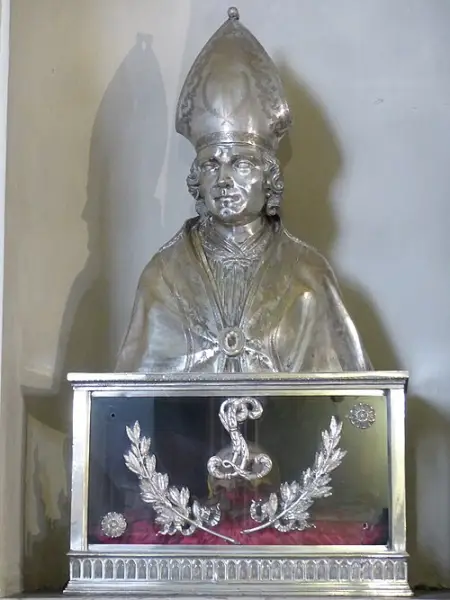
Lambert of Vence, also called Lambert of Bauduen and remembered by his family name Pelloquin, was a French bishop of the first half of the twelfth century. Born at Bauduen in Provence in 1084, he was left motherless from birth, and at the age of twelve he was given into the care of the Benedictine monks of Lérins, the ancient island abbey off the coast of Cannes that had trained generations of bishops for southern Gaul. Formed in the monastery's austere tradition, he was appointed Bishop of Vence in 1114 and governed that Provençal see for forty years, until his death at Vence in 1154. His episcopate is remembered chiefly for an act of devotional generosity: he dispatched to his native Bauduen relics of St Véran, a saint to whom he was especially devoted, binding his birthplace to his flock through the cult of the saints. His own relics remain enshrined at Vence, where the cathedral preserves a reliquary bust of the bishop and where he is honored with a feast on 26 May.
The Complete Life
A Motherless Child of Bauduen
Lambert's life began with loss. He was born at Bauduen, a village above the lake of Sainte-Croix in Provence, in the year 1084, and his mother died at his birth, leaving the boy motherless from his first days. His family name is recorded as Pelloquin, and he is remembered both as Lambert of Vence, from the see he governed, and as Lambert of Bauduen, from the place that formed him. When he was twelve years old his path turned toward the monastery: he was raised from that age by the Benedictine monks of Lérins, the venerable island abbey that for centuries had stood as one of the great schools of sanctity in Gaul. There, amid the rhythm of prayer and study that Lérins had preserved since the age of its founding fathers, the boy from Bauduen received the formation that would carry him to the episcopate. The twelfth century was a flowering age for the church of Provence, and the monks of Lérins supplied it with bishops; Lambert was to be one of their number. From Lérins he would have absorbed both the strict monastic observance and the warmth of learning for which the island house was famous across Provence.
§ Introduction
Forty Years on the See of Vence
In 1114 Lambert received appointment to the bishopric of Vence, a small but ancient diocese in the hills behind the Provençal coast, and he remained in the see until his death four decades later. The sources preserve few details of his governance, but what they do record is telling. He held a special reverence for St Véran, and during his episcopate he conveyed relics of that saint to Bauduen, the village of his birth — a gift that joined his two homes in a single communion of saints and gave the place of his birth a treasure of devotion. Beyond this act, his bishopric belongs to the long, patient work of shepherding a medieval diocese: ordering its clergy, sustaining its worship, and binding its parishes to the great monastic centers of the region. That his memory survived at all, in an age when thousands of bishops passed without trace, owes everything to the devotion his people kept for him after death — the surest evidence that his forty years of service were felt as holiness by those he served. Such generosity of spirit, recording nothing for himself and much for others, is the trait his biographers chose to preserve.
§ Introduction
Death and Enshrinement at Vence
Lambert died at Vence in 1154, closing an episcopate that had spanned the first half of the twelfth century. His body did not leave the city he had governed: his relics remain enshrined at Vence to this day, kept in the cathedral where a reliquary bust portrays the bishop in silvered dignity. The church honors him in the Roman Catholic communion with a feast on 26 May, and the faithful of the region have continued for nearly nine centuries to invoke the monk of Lérins who shepherded their grandparents. His cult, like that of many Provençal bishops, has never spread far beyond the hills of his diocese, but it has never been forgotten there either. In the quiet persistence of his shrine — through wars, revolutions, and the remaking of France around it — lies the final testimony to his life: that a bishop who loses his mother at birth, gives his boyhood to a monastery, and spends forty faithful years on a modest see can leave a memory that outlasts empires. The reliquary bust that holds his memory in the cathedral of Vence remains the visible center of that long, local, and affectionate devotion.
§ Introduction
Timeline
- 1084
Is born at Bauduen in Provence; his mother dies at his birth
§ Introduction
- 1114
Is appointed Bishop of Vence
§ Introduction
- 1154
Dies at Vence after forty years in the see; his relics remain enshrined in the city
§ Introduction
The Record
- Major works
- Transmission of relics of St Véran to Bauduen
- Canonization
- Pre-congregation; venerated locally in the Roman Catholic Church
Prayer
Bibliography
Show 2 sources
- "Saint Lambert de Vence". Nominis.
- "Lambert Péloguin of Vence". Saint of the Day (archived at the Wayback Machine).
Profile text adapted from the Wikipedia article, licensed CC BY-SA 4.0.
Pray with this saint every day
Save St. Lambert of Vence to your favorites, read the full profile, and get feast-day reminders in the Saints app.
Get the Saints AppFree on the App Store for iPhone and iPad