
c. 625 – 686·Feast June 15
St. Landelin
Converted brigand and founder of Lobbes Abbey
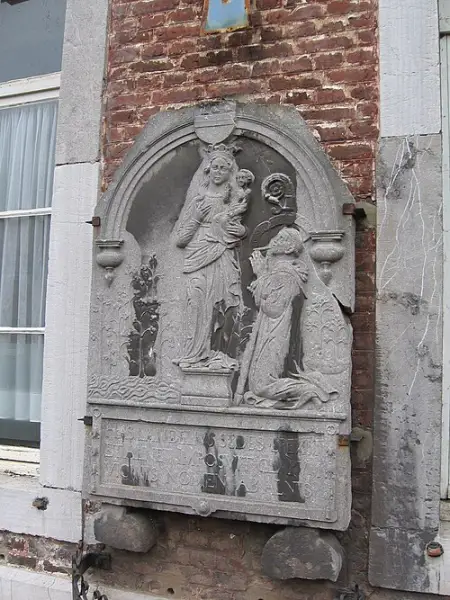
Overview
Landelin, a Merovingian noble turned monk, stands among the great monastic founders of the seventh-century Meuse and Sambre country. Born of noble stock around 625 at Vaux, near Bapaume, he was educated in learning and piety under St. Aubert, bishop of Cambrai, but fell away under the influence of worldly companions into a dissolute life and became a brigand. When one of his companions died without warning, the shock shattered him and brought about his conversion. Placed by Bishop Aubert in an austere monastery to do penance, he was raised to the diaconate and then, at thirty, to the priesthood, with charge to preach; but he begged instead for the solitude of a lonely spot beside the Sambre. Disciples gathered to him, and from his hermitage grew Lobbes Abbey, founded around 650 and organized about 654 with his disciple St. Ursmar as first abbot. Landelin went on to found Crespin Abbey while Aulne Abbey's foundation is likewise credited to him, making amends by his foundations to the region he had once harmed. Having secured his communities, he resigned his abbacy to devote his remaining years to austerities, dying in 686.
The Complete Life
From Noble's Son to Brigand
Landelin's first life was a study in wasted gifts. He was born around 625 at Vaux near Bapaume, into a noble family of the Frankish world, and his parents placed his education in the best hands available: under the tutelage of St. Aubert, bishop of Cambrai, he received training in learning and piety alike. The foundation did not hold against the company he kept. Led astray by the example of certain kinsmen, whose flattery played upon his passions, he drifted insensibly into the broad way of the world; from a life of pleasure and diversions he sank by degrees into grave disorders, and at length became a brigand — an armed robber on the roads of a country still only half-settled. The tradition does not soften the picture: the man who would found three abbeys began as an outlaw. His story has reminded Christians ever since that no education, and no bishop's patronage, can substitute for a converted heart, and that the descent into evil is a gradual one — step by step, flattery by flattery — until the fall seems complete.
§ Life
Conversion and the Call to Solitude
The turning came suddenly, as it often does. One of his companions in crime died without warning, and the death forced Landelin to reconsider the road he was traveling; from that shock he underwent a true Christian conversion. His old mentor did not abandon him to his own strength: Bishop Aubert placed the penitent in an austere monastery, where for some years he did penance for his former life in discipline and humility. The bishop then ordained him deacon, and when he had reached the age of thirty, priest, appointing him to preach to the people — a charge suited to one who knew from within the world he would now call others to leave. Landelin, however, had learned to distrust crowds and his own former haunts. He begged leave to withdraw to Laubach, today named Lobes, a solitary spot on the Sambre's banks, and there he gave himself to prayer and mortification. What he intended as a hidden life proved, as so often in the history of monasticism, impossible to keep hidden. The world that had ruined him was, by his own choice, never invited back into his confidence.
§ Life
Founder of Lobbes, Crespin, and Aulne
The hermitage on the Sambre became a school of souls. Several persons resorted to Landelin and began to copy his way of life; at first they dwelt in separate cells, but in time their gathering grew, about the year 654, into the great abbey of Lobbes — a house Landelin had begun to plant around 650, deliberately, it is said, in order to make amends to the region he had formerly injured as a brigand. He possessed the rare wisdom to know when his work was done: once the brotherhood had grown and the house's tomorrow stood secure, he set the foundations in place, entrusted the unfinished work to St. Ursmar, and installed that disciple as the community's first abbot of what would become one of the intellectual lights of the Low Countries. The same pattern followed elsewhere. He founded Crespin Abbey in the valley of the Haine, and tradition credits him as well with the foundation of Aulne Abbey on the Sambre. Later generations even sought his face in the artifacts of his age: the Italian scholar Paolo Serra linked him to the seventh-century Merovingian carved belt buckle known as the Landelinus buckle, bearing a Christ of the Apocalypse.
§ Life
Austerities and a Quiet End
Having given his abbeys to other hands, Landelin spent the years that remained in the way he loved best: hiddenness and penance. He gave up the abbot's office so as to spend his remaining life in the practice of austerity, returning in his last years to the stark discipleship of the desert — the same rigors to which Bishop Aubert had first assigned him as a penitent, now freely embraced as a choice of love rather than a sentence. He died in 686, some three decades after planting the first cells at Lobbes. The church of both East and West enrolled him among the saints, keeping his feast on 15 June, and he is venerated today in the Roman Catholic and Eastern Orthodox traditions alike. His cult honors him above all as the penitent founder: the nobleman's son who fell to brigandage, rose through conversion to the priesthood, and left behind him, in place of the wounds he had dealt his country, three monasteries whose prayer continued for a thousand years. In the annals of monastic Gaul, few conversions bear so abundant a harvest as the one that began beside a dead companion on a forest road.
§ Life
Timeline
- 625
Is born of noble stock at Vaux, near Bapaume, about this time
§ Life
- 650
Plants the monastery of Lobbes in Hainaut, seeking thereby to repay the region he had once harmed
§ Life
- 654
Having laid the foundation of the abbey of Lobbes, hands the unfinished abbey over to his disciple St. Ursmar, naming him its first abbot
§ Life
- 686
Dies after years given to the practice of austerities
§ Life
The Record
- Major works
- Lobbes Abbey, founded c. 650·Crespin Abbey·Aulne Abbey (credited foundation)
- Canonization
- Pre-congregation; venerated in the Roman Catholic and Eastern Orthodox Churches
Prayer
Bibliography
Show 6 sources
- Butler, Alban. "St. Landelin, Abbot". The Lives of the Saints, 1866.
- "Benedictine Abbey of Lobbes". The Catholic Encyclopedia.
- "Cambrai". The Catholic Encyclopedia.
- "Aulne Abbey". The Catholic Encyclopedia.
- "Landelin von Crespin". Ökumenisches Heiligenlexikon.
- Gaillard de Sémainville, Henri. "Landelinus, l'auteur de la plaque-boucle mérovingienne au Christ de l'Apocalypse découverte à Ladoix-Serrigny (Côte-d'Or) serait-il saint Landelin?" Revue archéologique de l'Est 68 (191) (2019): 349–354.
Profile text adapted from the Wikipedia article, licensed CC BY-SA 4.0.
Pray with this saint every day
Save St. Landelin to your favorites, read the full profile, and get feast-day reminders in the Saints app.
Get the Saints AppFree on the App Store for iPhone and iPad