
died c. 690–708·Feast July 8
St. Landrada of Austrasia
Ascetic foundress and first abbess of Munsterbilzen
Overview
Landrada of Austrasia, also remembered as Leandra, was a German ascetic who died between about 690 and 708 and who is honored as a saint in the Roman Catholic Church. The only daughter of noble parents connected with the family of Pepin of Landen, she turned away from the aristocratic life prepared for her: though still a child she was thought a model of Christian perfection, and when suitors came she declined them all, having resolved on a different kind of espousal. Leaving her home, she settled as a hermit in the forest near Munsterbilzen, in what is now northeastern Belgium, where she built her own hut, slept on the ground rather than in a bed, and lived on bread and water. St. Lambert, bishop of Maastricht-Liège, became her spiritual adviser, and with him she established a chapel in honor of the Blessed Virgin Mary on a spot shown to her in a vision of a cross descending from heaven. This chapel grew into Munsterbilzen Abbey, and Landrada became its first abbess, dying there about 690. A legend recorded by Sabine Baring-Gould tells that after her burial she appeared to Lambert in a dream and asked to lie at Wintershoven, to which her body was miraculously carried. In 980 her remains were translated to the church of St. Bavo in Ghent, and in 1624 fragments were returned to Wintershoven.
The Complete Life
A Noble Daughter Who Refused the World
Landrada came from the highest rank of seventh-century Austrasian society: an only daughter of German nobles, kinswoman of the house of Pepin of Landen, the family from which the mayors of the palace took their rise. Everything in her circumstances pointed toward an advantageous marriage and a life spent among the great households of the Meuse country. The sources that preserve her memory instead describe a child already set apart, regarded even in youth as a pattern of Christian perfection. When proposals of marriage arrived, as they must have arrived often for a woman of her station, she declined every one. Her hagiographer Sabine Baring-Gould put the reason in her own intention: she had already chosen a bridegroom who was not of this world. This decision, recorded by Baring-Gould and by Agnes Dunbar's dictionary of holy women, placed her in the company of the noble virgins of the Merovingian age, for whom renouncing a dynastic match was itself a public act, visible to family and court alike. Nothing is preserved of her parents' reaction or of the arrangements the family may have made; the tradition passes directly from the rejected offers to the departure from her father's house, as though the break with the world were accomplished in that single refusal.
§ Life
The Hermit of the Munsterbilzen Forest
Leaving home, Landrada withdrew into the forest near Munsterbilzen, in the northeastern corner of what is now Belgium, and there embraced a life of extreme asceticism. Baring-Gould records that she held herself far from every worldly pleasure and gave entire days to prayer, and Dunbar's account agrees in presenting the forest years as a time of unrelieved mortification. She raised her own dwelling with her hands, a hut in the wilderness, and refused herself even the ordinary softnesses of life: she would not sleep in a bed, would not use a bath, and ate bread and water and nothing else. For a noblewoman reared in comfort, the voluntary exchange of halls and service for a hut and hunger was a complete inversion of her inheritance, and it is this inversion that the sources single out as the mark of her conversion. The solitude did not cut her off from the church: it was in these years that St. Lambert, the bishop of Maastricht-Liège, began to visit her, to counsel her, and to oversee the unfolding of a vocation that had begun without any founder's plan. The forest settlement, at first only a hermit's enclosure, was becoming a place to which the church itself paid attention.
§ Life
A Cross Written in Stone
The tradition hands on a vision to explain the site of the convent. Agnes Dunbar tells that while Landrada stood at prayer in a solitary spot, she beheld coming down from the sky a cross wrought with exquisite skill, which sank into a neighboring stone as though that stone had been soft wax, while a voice declared the cross to be a gift intended for her. She understood the sign as the communication of the ground on which her work was to stand. With the cooperation of St. Lambert she established a chapel in that place in honor of the Blessed Virgin Mary; the sources insist that she built it with her own hands, so that the founder's labor was hers as much as the founder's vision. This chapel was the origin of Munsterbilzen Abbey, dedicated to the Mother of God, and when the community took shape Landrada stood at its head as first abbess. The partnership between the recluse and the bishop is characteristic of the missionary church of the age: Lambert, occupied with the difficult evangelization of the Meuse and Liège country, provided episcopal cover and counsel, while Landrada provided the holiness, the site, and the house. What had begun as one woman's flight from the world ended as a monastery, and the wilderness settlement became an institution with a future.
§ Life
Death, Funeral, and the Fiery Cross
Landrada died at her abbey about the year 690, and the earliest date her cult can be fixed by is the span the sources allow, between roughly 690 and 708. With her death the legend takes over. Baring-Gould recounts, as a tale of the people rather than of the records, that the abbess appeared after her passing to Bishop Lambert in a dream and told him to bury her at a spot he would recognize by the appearance of a fiery cross, which proved to be in Wintershoven. Lambert came to Munsterbilzen, where a great crowd had assembled for the funeral rites, and made her demand known; but the mourners would not surrender their abbess and insisted she remain in the abbey church, and the bishop yielded to them. Three days later he ordered a grave dug at Wintershoven all the same, and by what the account calls angelic instrumentality her body, together with a marble sarcophagus, was carried to the place designated. Whatever lies behind the story — a translation accomplished by night, a dispute between two communities over a coveted relic — it records in narrative form the conviction that Landrada's remains were precious to more than one church, and that her wishes, once known, outranked the affection of her own foundation.
§ Life
From Wintershoven to Ghent
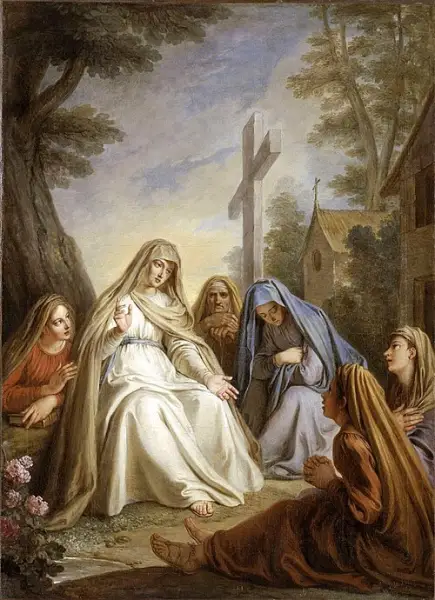
Landrada's cult settled into the liturgical geography of the Low Countries. Her feast, kept on 8 July, was observed at Munsterbilzen three days before it was kept anywhere else, a precedence that preserved the memory of the mother house. In 980 her body was translated again, from Wintershoven to the church of St. Bavo in Ghent, one of the great religious centers of the county of Flanders, and there her feast was celebrated every year; the translation made her, in effect, a patron of Ghent as well as of Munsterbilzen, and the sources name her patroness of both places. In 1624 some fragments of her remains went back to the church of Wintershoven, and the remaining parts were carried off and assigned to the church of Munsterbilzen, so that after eight centuries her relics were divided among the three places that claimed her. Her memory also reached beyond the liturgy: in 1747 the French painter Charles-Antoine Coypel pictured her teaching widows and young women in a canvas later kept at the château de Versailles, an image that presents her not as the forest ascetic but as a founder instructing the community that grew from her hut. The modern catalogs of Dunbar and Baring-Gould kept her name alive into the twentieth century.
§ Legacy
Timeline
- 690
Dies at Munsterbilzen Abbey, of which she was the first abbess
§ Life
- 980
Her remains are carried from Wintershoven to Ghent and laid in the church of St. Bavo
§ Legacy
- 1624
Fragments of her remains are given back to the church of Wintershoven
§ Legacy
In Their Own Words
a spot which he would find designed by the apparition of a fiery cross
The Record
- Major works
- Co-founder of Munsterbilzen Abbey, dedicated to the Virgin Mary
- Patron of
- Munsterbilzen·Ghent
- Symbols
- Prayer·A crucifix surrounded by rays of light·Clouds
- Canonization
- Pre-congregation; venerated in the Roman Catholic Church
Prayer
Bibliography
Show 3 sources
- Dunbar, Agnes B.C. (1901). A Dictionary of Saintly Women. Vol. 1. London: George Bell & Sons. p. 455.
- Baring-Gould, Sabine (1914). The Lives of the Saints (7th ed.). London: J. Hodges. pp. 191–193.
- Mulder-Bakker, Anneke B. (2002). "Saints without a Past: Sacred Places and Intercessory Power in Saints' Lives from the Low Country". In Mulder-Bakker, Anneke B. (ed.). The Invention of Saintliness. New York: Taylor & Francis. pp. 38–39. ISBN 0-415-26759-5.
Profile text adapted from the Wikipedia article, licensed CC BY-SA 4.0.
Pray with this saint every day
Save St. Landrada of Austrasia to your favorites, read the full profile, and get feast-day reminders in the Saints app.
Get the Saints AppFree on the App Store for iPhone and iPad