
died c. 661·Feast June 10
St. Landry of Paris
Bishop of Paris and founder of the Hôtel-Dieu
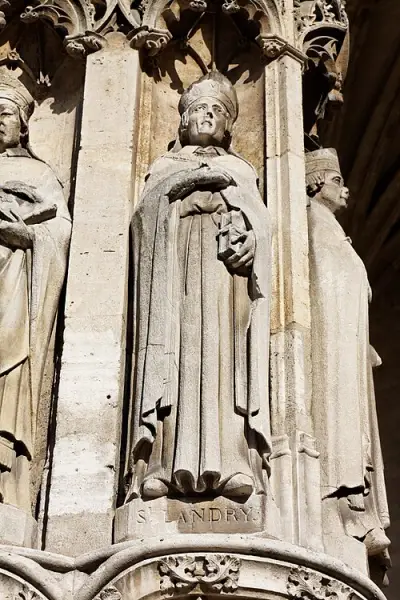
Overview
Landry, or Landericus, was Bishop of Paris in the middle of the seventh century and died about 661. Before his elevation he had served as chief clerk of the royal chancery, an office that trained him in the government of the Merovingian court, and in 650 he succeeded Audobertus on the episcopal throne of the city. His episcopate is remembered for charity in a time of catastrophe: when famine swept Paris in 650 and 651 he stripped himself of everything he owned, and even sold furniture and sacred vessels belonging to the church, so that the poor might be fed. To the same pastoral zeal the tradition attributes the founding of the first great hospital of Paris, dedicated to St. Christopher, the institution that grew into the Hôtel-Dieu de Paris, and the raising of the first church of Saint-Germain l'Auxerrois, destined to become the royal parish of the French monarchy. In 653 he stood among twenty-three bishops who subscribed the charter by which Clovis II exempted the abbey of Saint-Denis from episcopal jurisdiction. He was buried in Saint-Germain l'Auxerrois, where a chapel still bears his name and most of his relics rest. Miracles were reported at his intercession; his feast is kept on 10 June, and his memory crossed the Atlantic with the founders of St. Landry Parish in Louisiana.
The Complete Life
From the Chancery to the Episcopal Throne
Landry's path to the see of Paris ran through the machinery of government. Before anything is recorded of his pastoral life he appears as chief clerk of the royal chancery, the writing office of the Merovingian kings, where the charters and diplomas of the realm were drafted and kept. The office put him close to the court, to its patronage and its politics, and the later tradition treats it as a preparation rather than a distraction: the administrator of the king's documents became the administrator of a diocese. In 650 he succeeded Audobertus as Bishop of Paris, taking charge of one of the oldest Christian communities of the Frankish kingdoms, a city whose bishops since the time of St. Marcel and St. Germanus had stood between the people and the royal power. The sources preserve no account of his consecration or of the first acts of his government; what they preserve instead is the crisis that tested him almost at once, the famine that struck the Paris region in 650 and 651, in the opening years of his episcopate. It is from that test, endured at the very beginning of his office, that the whole portrait of the saint takes its character.
§ Life
Famine, Hospital, and the Church of the Kings
The famine of 650–51 found the new bishop unwilling to distinguish between what was his and what belonged to his church when the poor were starving. He sold all his personal possessions, then went further: furniture of the episcopal household and sacred vessels of the church itself were disposed of to buy bread. Alban Butler records the act as the defining deed of his episcopate. The same charity took architectural form. Landry is credited with the construction of the city's first great hospital, placing it under the patronage of St. Christopher; the institution endured, and its name and work passed into the Hôtel-Dieu de Paris, the hospital that still stands beside the cathedral of Notre-Dame. In 653 his name appears among twenty-three bishops who subscribed the charter by which King Clovis II granted the abbey of Saint-Denis exemption from episcopal jurisdiction, a milestone in the history of that royal monastery. The tradition also assigns to him the original church of Saint-Germain l'Auxerrois, hard by the Louvre, which the kings of France would one day take over as their own parish. Administering, feeding, building: the episcopate that emerges is that of a city shepherd who treated the wealth of the church as food for the hungry and shelter for the sick.
§ Life
Death and Burial at Saint-Germain l'Auxerrois
Landry died in 661, after roughly a decade governing the see of Paris. He was buried in the church he was believed to have built, Saint-Germain l'Auxerrois, and there his cult took root at once: the church maintains a chapel bearing his name in which most of his relics are kept to this day. The tradition records one exception to that completeness — in 1408 two bones from his remains were conceded to the parish of Saint-Landry, which had grown out of an oratory standing near the bishop's own dwelling, the place where he used to pray, so that the place of his private devotion received its portion of him four centuries after his death. His memory was woven into the public prayer of the city: he is honored with a proper office in the revised Paris Breviary — that formal acknowledgment of the Parisian church that its bishop belonged among the saints. Medieval devotion gathered around him the miracle collections typical of a beloved confessor; the Golden Legend preserves the story of Raoul Gracard, whose disfigured face, taken by all who saw him for leprosy, was restored after he had confessed, performed his penance, and kissed the sudary of the saint. Miracles of this kind, recorded and retold, carried his name far beyond the diocese he had governed.
§ Veneration
A Saint of Two Communions
Landry belongs to the long line of bishops whose sanctity was recognized by the uninterrupted devotion of the faithful rather than by any formal process: he died in 661 and was venerated as a saint from the moment his cult is visible in the records, and the Roman Catholic Church and the Orthodox Church both rank him among the canonized. His feast is kept on 10 June. The signs of that recognition accumulated over the centuries in the places that held his memory: the chapel of his name in Saint-Germain l'Auxerrois, the parish that grew from his oratory, the office composed for the Paris Breviary, and the miracle narrative taken up in the Golden Legend, the most widely read of medieval hagiographical compilations. No date of canonization, no decree, no bull exists, because none was needed; a bishop who sold the sacred vessels to feed the starving and founded the hospital of the city was a saint by common consent. His deeds stand as settled history of holiness, and both East and West keep his name on the same day, a rare convergence that testifies to how far the cult of the seventh-century pastor traveled from the banks of the Seine.
§ Veneration
The Saint Across the Ocean
Landry's memory made its most unexpected journey with the colonists and missionaries of the early modern world. In Opelousas, in south-central Louisiana, the parish church founded under his patronage — St. Landry Catholic Church — keeps a statue of the saint raised behind the high altar, and a window bearing his likeness set at the building's southwest corner, and the civil parish of St. Landry, of which Opelousas is the seat, took its name from the church. A French bishop of the seventh century thus became the godfather, as it were, of an American county and a community of Acadian descent. In Paris itself the traces of his episcopate remained written into the topography of the city: the Hôtel-Dieu grew from the hospital dedicated to St. Christopher, Saint-Germain l'Auxerrois stood for centuries as the parish of the French kings, and Port Saint-Landry, named for him, is remembered as the first dock of Paris on the Seine. Historians of Louisiana, reviewing the story of the Opelousas mother church, have had to answer the question John N. Harper posed in a Louisiana newspaper: among the several saints named Landry in the calendar, which one belongs to the Acadiana? The answer, attested by the church itself, is the bishop of Paris — the famine bishop whose charity crossed the sea.
§ Veneration
Timeline
- 650
Succeeds Audobertus as Bishop of Paris, after serving as chief clerk of the royal chancery
§ Life
- 650
During the famine of 650–51 sells his possessions and even church furniture and sacred vessels to feed the poor
§ Life
- 653
With 23 other bishops subscribes the charter of Clovis II exempting Saint-Denis Abbey from episcopal jurisdiction
§ Life
- 661
Dies and is buried at the church of Saint-Germain l'Auxerrois in Paris
§ Life
- 1408
Two bones from his relics are given to the parish of Saint-Landry, a chapel near his house
§ Veneration
In Their Own Words
We have seen and known that a man which men call Raoul Gracard was smitten suddenly, and had the head much great and swollen, and was so red in the face of him that all folk that saw him deemed and held him for a leper.
The Record
- Major works
- Foundation of the hospital dedicated to St. Christopher, later the Hôtel-Dieu de Paris·Building of the original church of Saint-Germain l'Auxerrois, Paris
- Patron of
- Paris·St. Landry Catholic Church, Opelousas, Louisiana
- Symbols
- Bishop's vestments·Model of the Hôtel-Dieu
- Canonization
- Pre-congregation; recognized as a saint by the Roman Catholic and Eastern Orthodox Churches
Prayer
Bibliography
Show 7 sources
- Butler, Alban. "St. Landry, Bishop of Paris, Confessor", The Lives of the Saints. 1866.
- "About our Patron, St. Landry", St. Landry Catholic Church, Opelousas, Louisiana. Archived from the original on 2023-09-25.
- Harper, John N., "There are four saints named Landry in Catholicism. Who was ours?", Daily Advertiser, November 4, 2013.
- The Golden Legend: The Life of Saint Landry.
- Hambrick, Keith S., Review of "The Mother Church of Acadiana", Louisiana History, Louisiana Historical Association, Vol. 36, No. 3 (Summer, 1995), pp. 365–368.
- Harper, John N. (2015–2022). "Who was Saint Landry? A History of Saint Landry, Bishop of Paris" (PDF).
- Michelin Green Guide Paris, Michelin Travel & Lifestyle, 2011. ISBN 9782067182202.
Profile text adapted from the Wikipedia article, licensed CC BY-SA 4.0.
Pray with this saint every day
Save St. Landry of Paris to your favorites, read the full profile, and get feast-day reminders in the Saints app.
Get the Saints AppFree on the App Store for iPhone and iPad