
c. 622/637 – c. 692/700·Feast April 17
St. Landry of Soignies
Bishop of Metz and abbot of Haumont and Soignies
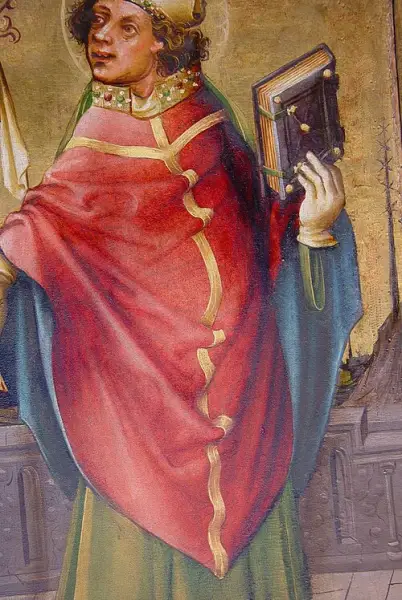
Overview
Landry — also written Landric or Landericus, and commonly known as St. Landry of Metz — was a Frankish noble of the seventh century who became a Benedictine abbot and the thirty-fourth Bishop of Metz. He was born in the pagus Hainoensis, in the kingdom of Austrasia, into one of the most saintly families of the age: his parents were St. Waltrude and Vincent Madelgarius (Madelgaire), who separated late in life to found monasteries; his siblings were Sts. Aldetrude and Madelberte, abbesses of Maubeuge, and Dentelin of Mons; his grandparents were Sts. Walbert IV and Bertille, and his aunt was St. Aldegund, first abbess of Maubeuge. Landry already held the episcopal throne of Meaux when his parents withdrew into monastic life, and when his father's health failed he was summoned to succeed him in the religious office. In 660 he took over the abbey of Haumont, founded by Madelgaire, and the monastery his father had established in the forest of Soignies, maintaining great regularity in both. In 675 he passed the monastery to Halidulphe, and he was appointed Bishop of Metz. He died at Soignies on about 17 April, between 692 and 700. His relics, kept in a Renaissance shrine, were venerated there for centuries and formally examined when the gilded reliquary was opened in 1864.
The Complete Life
Born into a Family of Saints
Few saints of the seventh century were born into so concentrated a company of holiness as Landry of Soignies. His father was Vincent Madelgarius, called Madelgaire, a court official of Dagobert I who ended his life as the monk Vincent of Soignies; his mother was St. Waltrude of Mons, whose cult at the collegial church of Sainte-Waudru made her one of the great patronesses of Hainaut. The children of the marriage were all numbered among the saints of the region: Aldetrude and Madelberte, successively abbesses of Maubeuge, and Dentelin, a child saint venerated at Mons. Through his grandparents, St. Walbert IV and St. Bertille, he belonged to the wider network of the great monastery of the Hainaut, and his aunt St. Aldegund, first abbess of Maubeuge, ruled the house his sisters would lead. The sources — the old lives collected by Lalieu, by Collin de Plancy, and by Baring-Gould — place his birth in the pagus Hainoensis, the country around Mons and Soignies in the kingdom of Austrasia, in a span the tradition gives as between about 622 and 637. In such a household the choice of a religious life was not a departure from the family tradition but its continuation; the gallery of Sainte-Waudru at Mons preserves the family group in paint, Madelgaire and Waudru with their four children, Landry second from the left.
§ Biography
From the See of Meaux to the Abbot's Cloister
Landry's first recorded office was episcopal: the sources state that when his parents entered their separate monasteries — Madelgaire withdrawing to the monastery he had founded, Waltrude to her convent at Mons — their son was already occupying the seat of the bishop of Meaux. The chronological outline in Devillers' memoir on the church of Sainte-Waudru leaves the date of that appointment unrecorded, but its sequence is clear: he held a diocese of the region between the Marne and the Oise while his father still lived. The turn came with Vincent Madelgaire's declining strength. As the founder of Haumont and of the forest monastery of Soignies grew frail, Landry was summoned from Meaux, and he resigned his see in order to take up, in his father's stead, the religious office that mattered more to the family's foundations. In 660 he took over the government of his father's monasteries, becoming Benedictine abbot of Haumont and of Soignies. The sources describe his administration in a single phrase that says much: he maintained great regularity in the houses — the discipline of the Rule, the hours, the work, kept whole in a foundation entering its second generation. Fifteen years later, in 675, he passed the monastery to Halidulphe, who then received it, closing his abbacy and leaving the foundation in other hands.
§ Biography
Abbot of Haumont and Soignies, Bishop of Metz
The tradition joins to Landry's abbacy a second episcopate: he was appointed the thirty-fourth Bishop of Metz, and under that title — St. Landry of Metz — he is most commonly known. Metz, the old Austrasian capital on the Moselle, had a long line of saintly bishops, and the numbering of its episcopal catalogue places him in the later seventh century, after his tenure of the abbacies of Hainaut. The length of his government of the see and the acts of his episcopate are unknown; what the sources preserve is the triple office — bishop, abbot of Haumont, abbot and restorer of Soignies — which made him one of those figures in whom the monastic and the episcopal ministries of the Frankish church met in a single man. The monastery in the forest of Soignies, founded by Madelgaire, grew in time into the collegiate church of Saint-Vincent, the great religious house of the town that bears the saint's family's memory in its patron; the seal of the chapter of Soignies long depicted St. Vincent with his two sons, Landry and Dentelin, an official image of the house's double descent from the father and the government of the son.
§ Biography
Death at Soignies
Landry died at Soignies, in the pagus Hainoensis of Austrasia — now the province of Hainaut in Belgium — on about 17 April, a date the sources place in the span between 692 and 700. The town of Soignies had by then become the family's religious center: his father Vincent had ended his days there as monk and pastor, and the monastery in the forest had grown into the settled church from which the town took its name and its importance. There Landry was venerated after his death, and there his feast was kept on the day of his passing, 17 April. Cahier's study of the characteristics of the saints in popular art records his cult among the episcopal saints of the southern Low Countries, honored in the land of his family rather than in the diocese of Metz whose chair he had occupied. The death date the tradition preserves, uncertain as its year is, fixes the end of a life that had held in turn every office the church of the age could give a nobleman's son — bishop of Meaux, abbot of two monasteries, bishop of the Austrasian capital — and had ended where it began, in the Hainaut country of his mother and father.
§ Death
The Shrine of 1864
Landry's sanctity was recognized from the generations immediately after his death, without any formal process: he appears in the calendars and the art-historical catalogs of the Frankish saints, and his remains at Soignies drew pilgrims across the medieval centuries. The records of the chapter preserve three recorded visits to the relics — in 1269, in 1406, and in 1595 — the dates on which the veneration of the saint at the collegiate church of Soignies left its trace in writing across the thirteenth, fourteenth, and sixteenth centuries. The cult acquired a visible monument in the shrine carved for his relics, a Renaissance work of intricate carving and gilding that held the saint's remains in the church of the town. On 1 October 1864 the shrine was opened by the Vicar General Charles-Joseph Voisin, an examination of the relics in the manner of the nineteenth-century restorations of the Belgian collegiate churches; the account of the opening, preserved in Marsoux's study of the pilgrimage sites of the region, stands as the most recent formal act in the documented history of the cult. No canonization decree exists for a saint of this age; his feast of 17 April, kept in the dioceses of the old Hainaut, rests on the unbroken devotion of the church of Soignies to the son of Waltrude and Madelgaire.
§ Death
Timeline
- 660
Leaves the see of Meaux and takes over as abbot of his father Madelgaire's monasteries at Haumont and Soignies
§ Biography
- 675
Passes the monastery to Halidulphe, who then receives it
§ Biography
- 17 Apr 692
Dies at Soignies, in the pagus Hainoensis of Austrasia
§ Death
- 1269
The relics at Soignies are venerated in a recorded visit of pilgrimage
§ Death
- 1406
A second recorded visit to the relics of St. Landry at Soignies
§ Death
- 1595
A third recorded medieval visit to the relics at Soignies
§ Death
- 1 Oct 1864
Vicar General Charles-Joseph Voisin opens the intricately carved and gilded Renaissance shrine of the saint at Soignies
§ Death
The Record
- Major works
- Government of the Abbey of Haumont, founded by his father Madelgaire·Government of the monastery in the forest of Soignies, now the Collegiate Church of Saint-Vincent
- Patron of
- Soignies, Belgium
- Symbols
- Bishop's vestments·Abbot's crosier
- Canonization
- Pre-congregation; venerated in the Roman Catholic Church
Prayer
Bibliography
Show 8 sources
- Lalieu, L. (1886). Vie de S. Vincent Madelgaire et de saint Wandru, son épouse, princes et patrons du Hainaut. Decallonne-Liagre.
- Collin de Plancy, J. A. S. (1878). Grande vie des saints. France: Louis Vivès, libraire éditeur.
- Baring-Gould, S. (1898). The Lives of the Saints. United Kingdom: J. C. Nimmo.
- Gossart, D. (1860). Précis de l'histoire des principaux Établissements religieux de l'arrondissement d'Avesnes. France: Prignet.
- Devillers, L. (1857). Mémoire historique et descriptif sur l'église de Sainte-Waudru à Mons. Masquillier.
- Vinchant, F. (1648). Annales de la province et comté d'Haynau. Belgium: de l'imprimerie de Jean Havart.
- Cahier, C. (1867). Caractéristiques des saints dans l'art populaire: A–F. France: Poussielgue.
- Marsoux, L. (1894). Chapelle et pèlerinage des Saintes Hosties à Marseille-le-Petit (Oise). France: D. Dumoulin et Cie.
Profile text adapted from the Wikipedia article, licensed CC BY-SA 4.0.
Pray with this saint every day
Save St. Landry of Soignies to your favorites, read the full profile, and get feast-day reminders in the Saints app.
Get the Saints AppFree on the App Store for iPhone and iPad