
died c. 375·Feast March 26
St. Larissa
Gothic Martyr of Athanaric's Persecution
Overview
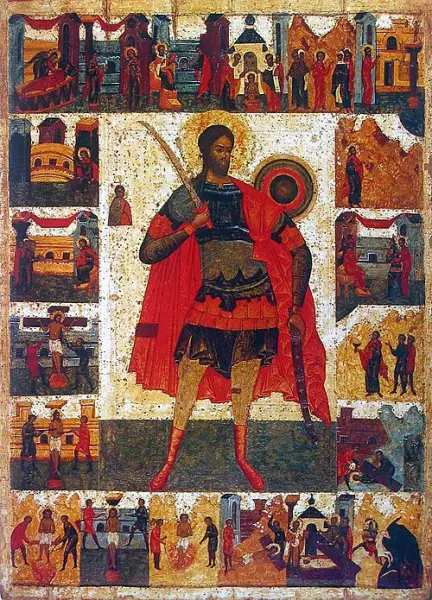
Larissa was one of the Christian Goths put to death in the persecution that the Terving ruler Athanaric unleashed against converted members of his own people in the fourth century. Her name survives in the manuscript lists of the twenty-six martyrs of the Gothic church: she appears among the seven laywomen, recorded in one tradition as a variant form of the name Baren or Beride. The historiographer Sozomenos records that Athanaric, alarmed lest the new religion dissolve the Gothic way of life, entrusted Winguric with its elimination from Gothic territory. In Crimea, Winguric mounted an idol on a chariot and wheeled it up to the tent where the Christians gathered for worship: whoever bowed to it lived, and all who stood firm perished in the flames. The fire claimed 308 lives, in or near the year 375, of whom only twenty-one are known by name, Larissa among them. A few years later Gaatha, a Christian widow of noble rank, collected the bones of twenty-six of the martyrs and brought them for keeping to Cyzicus. The Twenty-Six Gothic Martyrs are commemorated in Orthodoxy on 26 March.
The Complete Life
The Faith Among the Goths
Christianity reached the Goths earlier than most of the northern peoples of Europe, and it reached them by unexpected roads. Around the year 260, raiders from Gothic lands swept into Cappadocia and carried off prisoners; among these captives, according to Basil of Caesarea, were Christians who preached the gospel to the very warriors who had taken them, and were martyred for it. Bishop Dionysius of Caesarea sent messengers to ransom such captives, and a written record of those efforts still existed in Basil's day. By the fourth century the gospel had taken root among the Tervingi, one of the great Gothic peoples of the Danube frontier. Yet the faith remained a minority religion there, and it spread almost entirely among converted Goths themselves rather than among foreign residents. Precisely that character — a Christianity adopted from within — was what the Gothic authorities came to fear, and the converts of the fourth century, Larissa among them, would pay the price of belonging to their own nation and to Christ at once.
§ Introduction
Athanaric's Persecution and the Burning Tent
Two great outbreaks of anti-Christian violence are recorded in the fourth-century Gothic world: one in 347 or 348 under the ruler Aoric, and a second between 367 and 378 under Aoric's son Athanaric, who held the judgeship over the Tervingi. Athanaric's persecution had a distinctive shape. He did not persecute Christians in general — Christian foreigners were left untouched — but directed his fury specifically at converted Goths, for his purpose was not the destruction of Christianity as such but the defense of the Gothic nation and its ancestral gods. According to Sozomenos, he appointed Winguric to root the Christian faith out of the Gothic lands. At Crimea, Winguric had an image of the gods carried on a chariot and wheeled up to the tent in which the faithful held their services. Bow to the idol and live; refuse, and die. The Christians who refused were shut inside, and the tent was burned over their heads. Three hundred and eight people perished in the flames, in or close to the year 375. Among the dead was Larissa, one of the seven laywomen whose names the manuscript tradition preserves. The victims were all Goths, though many bore Syrian, Cappadocian or Phrygian names — perhaps baptismal names taken at conversion, and in any case a sign of how closely the young Gothic church was bound to the churches of Asia Minor.
§ History
Remembrance of the Twenty-Six
The Gothic church did not forget those who died in the fire. The twenty-one martyrs known by name comprise three clerics — Werekas, a priest, Batwin, a minister, and Arpulas, a monk — eleven laymen and seven laywomen, Larissa counted among the women as a form of the name recorded elsewhere as Baren or Beride. The company reaches its traditional twenty-six when we count as well Wereka's and Batwin's four children, plus an unnamed man who entered the tent to confess Christ just as it was set alight. Their memory was fixed in the Gothic calendar itself: the surviving calendar fragment prescribes for 29 October the remembrance of the martyrs who were burned with the priest Werekas and Batwin in a crowded church among the Goths, and for 23 October the remembrance of the many martyrs of the Gothic people together with Fridaric. Eastern Orthodox martyrologies enumerate the Twenty-Six Martyred Goths, extending the roll of the twenty-one by one Constans, a twelfth layman, and by the queen Gaatha, Dulcilla her daughter, and Agathon her son. Orthodoxy keeps the memory of all twenty-six on 26 March, the day kept in honor of Larissa and her companions.
§ History
Gaatha's Translation of the Relics
The most tangible inheritance of the burned martyrs came a few years after their death, in the years 383 to 392, when Valentinian and Theodosius ruled the empire together. Gaatha — widow of one of Winguric's own peers, a notable of the old religion whose Christian wife chose to honor the martyrs — joined her daughter Dulcilla, sometimes recorded as Duclida or Duklida, in an act of rare devotion. With the help of certain priests and a layman named Thyellas, the two women gathered the remains of twenty-six of the martyrs and had them translated to Cyzicus, a city of Asia Minor on the Sea of Marmara. The translation carried the memory of the Gothic confessors out of the land that had rejected them and entrusted it to the wider church, where their names — Larissa's among them — were copied, recited and celebrated on the calendars of the East. The persecution that produced them claimed other witnesses as well: Sabbas the Goth had suffered death for the faith in 372 in the district now called Wallachia in Romania; Nicetas the Goth won the same crown that year. The fragmentary Gothic calendar, the martyrologies of Orthodoxy and the lists of names transmitted by the manuscripts all testify that the church of the Goths, though scattered, kept the memory of its own heroes of faith alive.
§ History
Timeline
- 260
Christian captives taken in a Gothic raid on Cappadocia preach to their captors and are martyred, an early witness of the faith among the Goths
§ Introduction
- 347
A first recorded outbreak of persecution of Christians strikes the Gothic lands under the ruler Aoric
§ History
- 367
A second and greater persecution of converted Goths begins under Athanaric and continues until 378
§ History
- 372
Sabbas the Goth is martyred in the region of present-day Wallachia during the persecution
§ History
- 372
Nicetas the Goth also suffers martyrdom in the same wave of persecution
§ History
- 375
Larissa dies with 308 fellow Christians, burned alive in their tent-church on Winguric's orders in or near this year
§ History
- 383
Gaatha and her daughter Dulcilla gather the remains of twenty-six martyrs and transfer them to Cyzicus, a work carried out between 383 and 392
§ History
The Record
- Canonization
- Pre-congregation; commemorated among the Twenty-Six Martyred Goths of the early Gothic church
Prayer
Bibliography
Show 5 sources
- Cassia, Margherita (2019). "Between Paganism and Judaism: Early Christianity in Cappadocia". In Stephen Mitchell; Philipp Pilhofer (eds.). Early Christianity in Asia Minor and Cyprus: From the Margins to the Mainstream. Leiden: Brill. pp. 13-48.
- Cusack, Carole M. (1998). Rise of Christianity in Northern Europe, 300-1000. Continuum International Publishing Group. p. 42. ISBN 978-0-304-70735-5.
- Wolfram, Herwig; Dunlap, Thomas J. (trans.) (1990). History of the Goths. pp. 81-83.
- Heather, Peter; Matthews, John (1991). "Martyrs and Martyrologies", in Goths in the Fourth Century. pp. 96-123.
- Holweck, F. G., A Biographical Dictionary of the Saints. St. Louis, MO: B. Herder Book Co., 1924.
Profile text adapted from the Wikipedia article, licensed CC BY-SA 4.0.
Pray with this saint every day
Save St. Larissa to your favorites, read the full profile, and get feast-day reminders in the Saints app.
Get the Saints AppFree on the App Store for iPhone and iPad