
c. 499 – 570
St. Latro of Laon
Frankish bishop who succeeded his own father at Laon
Overview
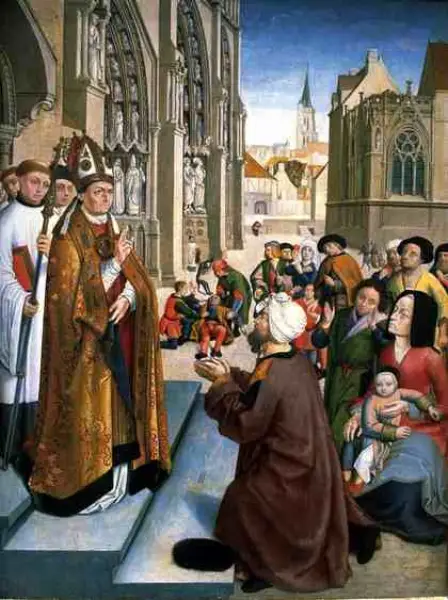
Latro — the name means, literally, “thistief,” and in French tradition he is called Latron or Larron — was a Frankish bishop of Laon who lived from about 499 to 570. He belonged to the earliest generation of the church of the Belgic lands after the conversion of the Franks: his father was St. Genebald, bishop of Laon, and Latro succeeded his father in the episcopal see, so that the bishopric passed directly from father to son. The sources preserve with it a stranger detail: it is alleged that Latro was conceived while his father was already a bishop, that is, during Genebald's episcopate, a report that has colored the memory of the family since the early catalogues. Art historians have added a pictorial conjecture to the written record: John Oliver Hand and Martha Wolff have theorized that the four figures in the right foreground of the Master of Saint Giles' painting of St. Remigius represent Genebald, his wife, and their two children, Latro and Vulpecula. Beyond his birth at Laon, his father's name, his succession, and the year of his death in 570, the record is silent.
The Complete Life
A Child of the Episcopal House of Laon
Latro was born at Laon about the year 499. His father was St. Genebald, who held the see of Laon as its bishop, and the written record preserves the report, carried from the earliest catalogues, that Latro was conceived while his father was already a bishop. The allegation is the strangest note in the family's history and the reason it was thought worth recording: an episcopal household in which a child was born to the reigning bishop, and in which that child would one day hold the same office. The tradition names a sister as well — Vulpecula — known, like nearly everything else about the family, through a single conjecture rather than a narrative: the art historians John Oliver Hand and Martha Wolff have theorized that the four figures in the right foreground of the Master of Saint Giles' painting of St. Remigius represent Genebald, his wife, and their two children, Latro and Vulpecula. If the conjecture is right, a painted memory of the household survives in a Netherlandish panel, standing at the edge of the scene of the apostle of the Franks. Of Latro's mother the sources give no name; of his childhood, education, and character they say nothing at all. The name he bore — Latro, literally “thistief,” French Latron or Larron — has struck readers as odd for a bishop, and the tradition notes the meaning without explaining it.
§ References
Father to Son on the Throne of Laon
On his father's death Latro succeeded St. Genebald as bishop of Laon, and the succession is the one public fact of his career: the episcopate of the see passed directly from father to son, in a manner the later church would come to forbid but which the sources record here without comment or embarrassment. The hereditary transmission of the office belongs to the earliest age of the Frankish church, when the episcopate of the old Gallo-Roman cities was settling into the hands of new families and discipline had not yet drawn the lines it would later insist on. Nothing is recorded of the year in which Latro took the throne, of his acts as bishop, or of the diocese he governed; his tenure is marked only by its end, in the year 570, when he died. What remains is a life reduced to three points — birth about 499 at Laon, succession to his father, death in 570 — and to the painted conjecture of the Master of Saint Giles' workshop, which would place the whole family, father, mother, son, and daughter, at the right hand of the scene of St. Remigius. A saint known this slightly is still a saint of the records: the catalogues kept his name with the title of the see he held, and the honorific of the altars — Saint Latro — has outlasted everything the office itself forgot.
§ References
Timeline
- 499
Is born at Laon, about this time
§ References
- 570
Dies, ending his tenure as bishop of Laon
§ References
The Record
- Symbols
- Bishop's vestments
- Canonization
- Pre-congregation; venerated in the Roman Catholic Church
Prayer
Bibliography
Show 2 sources
- Hand, John Oliver, and Martha Wolff. Early Netherlandish Painting. National Gallery of Art (U.S.). Cambridge University Press, 1986, p. 166.
- "St. Genebaldus". Heiligen Lexicon. Retrieved May 12, 2009.
Profile text adapted from the Wikipedia article, licensed CC BY-SA 4.0.
Pray with this saint every day
Save St. Latro of Laon to your favorites, read the full profile, and get feast-day reminders in the Saints app.
Get the Saints AppFree on the App Store for iPhone and iPad