
died c. 440·Feast June 20
St. Latuinus of Sées
First bishop of Sées in the age of tradition and doubt
Overview
Latuinus — written also Latrium, Lain, or Latuin — stands among the saints of the Roman Catholic Church and is reckoned the first bishop of Sées, holding the see, by the reckoning of the episcopal catalogue, from 400 to 440 in the fifth century. Of the man himself the early sources give nothing; what they give is a set of traditions, and a famous caution. A later tradition made him a bishop of the first century, a missionary sent to Sées by Pope Clement I himself — an account designed, as the Catholic Encyclopedia observes, to give the diocese a pedigree older than it actually possessed. A second Christian tradition has him dispatched to the region under Pope Boniface I, which would set his mission in the early fifth century, close to the dates the catalogue preserves. Local tradition adds that toward the close of the fourth century he raised an oratory where the present Chapelle Saint-Latuin stands in the diocese of Sées. Louis Duchesne, the great historian of the Gallican church, judged that for anything earlier than the year 900 the episcopal list of Séez — a document that survives only in sixth-century compilations — cannot be trusted; yet the devotion to Latuinus has never rested on the catalogue alone. It remains strong in the diocese to this day, attested by an annual pilgrimage to his chapel and by the altar and reliquary that hold his memory in the cathedral of Sées.
The Complete Life
The First Bishop of Sées
The episcopal catalogue of Sées, the list by which the diocese has always counted its shepherds, begins with Latuinus. By that reckoning he occupied the see from 400 to 440, in the first half of the fifth century, when the Christian church of northern Gaul was organized in the cities of the old Roman administration and the civitas of the Sagii received its first recorded bishop. The names under which he is honored vary across the sources — Latrium, Lain, Latuin — a sign of how far back the written tradition runs and how many hands recopied it. The catalogue itself, however, is early nothing else: the Catholic Encyclopedia passes on the verdict of Louis Duchesne: everything the list of Séez asserts before the year 900 rests on nothing but certain sixth-century compilations, and cannot be taken on trust. The first bishop of the diocese is therefore a name fixed to a chair, with the dates the tradition assigned and none of the acts of a ministry; yet the church of the diocese never treated that thinness as a disqualification, and the first occupant of the see has been invoked as a saint from whatever generation the list took shape down to the present day.
§ Veneration
Traditions of a Mission Sent from Rome
Around the name of Latuinus the later tradition wove two stories of a mission sent from Rome, each with its own purpose and its own era. The first and more audacious made him a bishop of the first century, a missionary dispatched to Sées by Pope Clement I, the third successor of Peter; the Catholic Encyclopedia states plainly the intent of this account — to make the diocese of Sées possess a tradition older than it actually had, an apostolic antiquity in competition with the ancient sees of Gaul. The second tradition sent him instead under Pope Boniface I, which places his mission in the opening years of the fifth century and brings it within reach of the dates the episcopal catalogue preserves. Between Clement and Boniface lies the whole distance between legend and chronology, and the tradition sets the two accounts side by side without adjudicating them. A third, local tradition supplies the one act of his life that geography can still point to: toward the close of the fourth century, it says, Latuinus raised an oratory where the present Chapelle Saint-Latuin now stands in the diocese of Sées, so that the first preaching of the faith in the diocese is attached to a piece of ground where his name is still spoken.
§ Veneration
The Chapel, the Fountain, and the Annual Pilgrimage
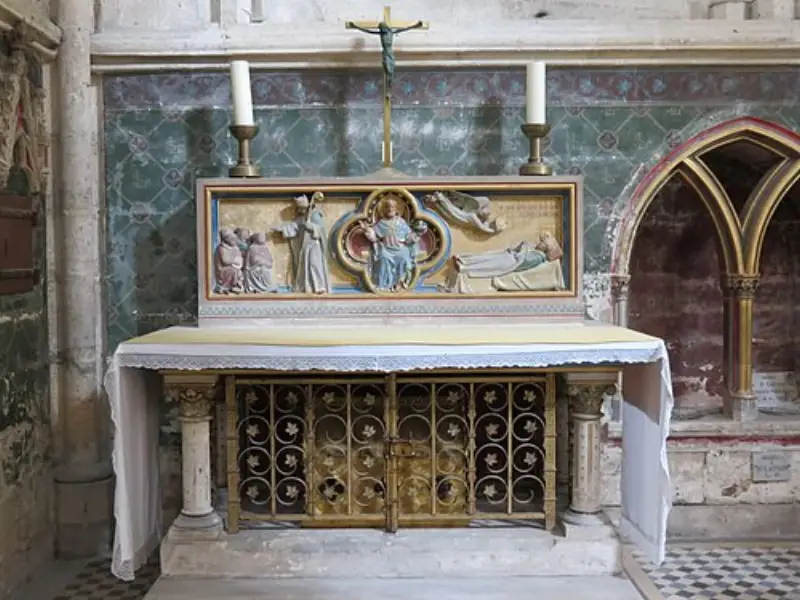
The measure of Latuinus is the devotion that has outlived every uncertainty about him. The devotion to the saint remains strong in the diocese of Sées to this day, evidenced by an annual pilgrimage to the Chapelle Saint-Latuin, the sanctuary that local tradition traces to an oratory he built at the close of the fourth century. The cathedral of Sées keeps an altar and reliquary in his honor — photographed in 2012 beneath his name — and he is portrayed in his episcopal attire, the single attribute the calendars give him. His feast is kept on 20 June. The devotion has gathered around it also the landscape of rural sanctity: an Ouest-France account of 2016 records the fountain of Saint Latuin and its water, to which the country people attributed a miraculous quality, one of those small natural shrines by which the memory of an early missionary persists in the countryside long after the learned have stopped arguing about his century. Whatever the historians conclude about the sixth-century compilations on which the episcopal list rests, the diocese continues to honor the man it counts as its first bishop, with a pilgrimage each year and a chair in the calendar that no later occupant has displaced.
§ Veneration
Timeline
- 400
By the reckoning of the episcopal catalogue, begins as first bishop of Sées
§ Veneration
- 440
Dies after holding the see of Sées for about forty years
§ Veneration
In Their Own Words
Louis Duchesne believed that for the period anterior to 900 no reliance can be placed on the episcopal catalogue of Séez, which we know by certain compilations of the sixth century.
The Record
- Major works
- Oratory on the site of the present Chapelle Saint-Latuin, diocese of Sées (by tradition)
- Patron of
- Diocese of Sées·Chapelle Saint-Latuin
- Symbols
- Episcopal attire
- Canonization
- Pre-congregation; venerated in the Roman Catholic Church
Prayer
Bibliography
Show 4 sources
- "Saint Latuin". Nominis.
- "CATHOLIC ENCYCLOPEDIA: Seez". www.newadvent.org.
- "chapelle St Latuin". Archived from the original on 2007-09-29. Retrieved 2007-12-13.
- "La fontaine Saint Latuin et son eau miraculeuse". Ouest-France.fr. August 4, 2016.
Profile text adapted from the Wikipedia article, licensed CC BY-SA 4.0.
Pray with this saint every day
Save St. Latuinus of Sées to your favorites, read the full profile, and get feast-day reminders in the Saints app.
Get the Saints AppFree on the App Store for iPhone and iPad