
6th century·Feast September 22
St. Laud of Coutances
Sixth-century Norman bishop invoked for healing blindness
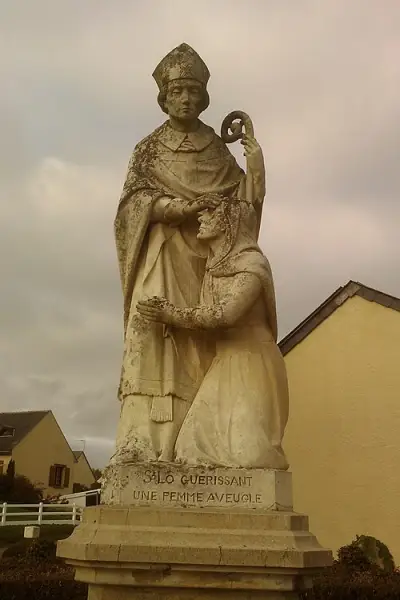
Overview
Laud of Coutances — a name transmitted in several forms, among them Lauto, Laudo and Launus, and popularly rendered Saint Lô — served as the fifth bishop of the see of Coutances in Normandy. He was a native of Courcy, a village close to the episcopal city, and was born at some point during the sixth century. Around the year 525 he assumed leadership of the diocese, and within a few years he took part in a gathering of bishops convened at Angers, dated either 529 or 530. His memory has remained unusually durable in the landscape of western Normandy: Briovere, the settlement linked with his cult, eventually adopted his name and survives today as the town of Saint-Lô. Popular devotion regarded him chiefly as a healer, and sufferers from diseases of the eyes, above all blindness, were commended to his intercession. A spring at Courcy that tradition associates with him continues to draw pilgrims. Both the Roman Catholic and Eastern Orthodox Churches number him among the saints; the French Martyrology keeps his commemoration on September 21 and the Roman Martyrology on September 22.
The Complete Life
A Son of the Coutances Countryside
The sixth century in northern Gaul was an age in which the Church was still knitting together the fragments of a broken Roman world, and it was into that world that Laud was born at Courcy, a short distance from Coutances. The sources that preserve his memory give no details of his family or childhood; what they record is the enduring fact of his local origins. He was not a bishop imported from afar but a man of the very countryside whose souls he would later shepherd, a circumstance that surely shaped the affection in which he was held. The village of his birth keeps its connection with him to this day, for the spring that rises there under his patronage has been a goal of pilgrims seeking relief from illness, particularly afflictions of the eyes. Devotion of this practical, healing kind grew up around many early bishops of Gaul, and in Laud's case it took root so deeply that his name became fixed to the land itself. Variations of his name — Lauto, Laudo, Launus — travelled through medieval documents, while ordinary people came to call him simply Saint Lô, the name that a Norman town still carries.
§ Laud of Coutances
Fifth Bishop of Coutances
Around the year 525 Laud received the burden of the see of Coutances as its fifth occupant. The diocese stretched across the western reaches of the Cotentin peninsula, a territory where Christian institutions had survived the collapse of imperial administration but where episcopal leadership remained demanding and exposed. Of his conduct in office the surviving notices are brief, yet one episode places him squarely within the corporate life of the Frankish Church: he joined a council of his fellow bishops at Angers, a gathering dated either 529 or 530. Such councils addressed discipline, doctrine and the care of the people, and Laud's presence among his colleagues shows a bishop engaged with the wider church beyond his own diocese. He governed Coutances in these years without recorded scandal or division, and the tranquillity of the record itself may be the best testimony to his stewardship. When he died is unknown; the sources fall silent after his episcopate. But the church of Coutances reckoned him among its founding worthies, honoured him as a saint soon after his death without any formal process, and handed his memory on to the generations who built the cult of Saint Lô in the heart of Normandy.
§ Laud of Coutances
Saint Lô: Town, Spring and Pilgrimage
Few early bishops left so plain a mark on a map. Briovere, the town associated with the saint's life and cult, gradually took his name and is known today as Saint-Lô, now among the principal towns of Normandy. The association between bishop and place gave his memory a civic permanence that outlasted the medieval world. Alongside the town stands the healing tradition. Popular religion regarded Laud as a specialist in the cure of eye complaints, and above all of blindness; those whose sight failed, or whose eyes suffered disease, were commended to his intercession. The spring at Courcy that tradition dedicates to him remains a site of pilgrimage, a quiet witness to a devotion now more than a dozen centuries old. His feast entered the calendars of the Church with a curious double dating: the French Martyrology commemorates him on September 21, while the Roman Martyrology keeps September 22. Veneration crossed the Channel as well. Two churches in England are known to honour him — St. Laud's Church at Sherington and the church of St. Laudus in the parish of Mabe in Cornwall — lonely but enduring English memorials of a Norman bishop whose healing reputation carried his name far beyond his own diocese.
§ Laud of Coutances
Timeline
- 525
Became the fifth bishop of Coutances, leading the Norman diocese.
§ Laud of Coutances
- 529
Took part in a council of bishops held at Angers in 529 or 530.
§ Laud of Coutances
The Record
- Patron of
- invoked for maladies of the eyes, especially blindness
- Canonization
- Pre-Congregation; venerated as a saint since the early medieval period
Prayer
Bibliography
Show 3 sources
- Smith, Sir William; Wace, Henry (1882). A Dictionary of Christian Biography, Literature, Sects and Doctrines, Being a Continuation of "The Dictionary of the Bible": Hermogenes, Myensis. Vol. 3. J. Murray. p. 627.
- "St Laud's Church", Sherington Historical Society.
- Gancel, Les Saints qui guérissent en Normandie, 1998, ISBN 2-7373-2293-6.
Profile text adapted from the Wikipedia article, licensed CC BY-SA 4.0.
Pray with this saint every day
Save St. Laud of Coutances to your favorites, read the full profile, and get feast-day reminders in the Saints app.
Get the Saints AppFree on the App Store for iPhone and iPad