
c. 1400 – 1453·Feast 29 May
St. Laura of Constantinople
Trinitarian abbess martyred at the fall of Constantinople
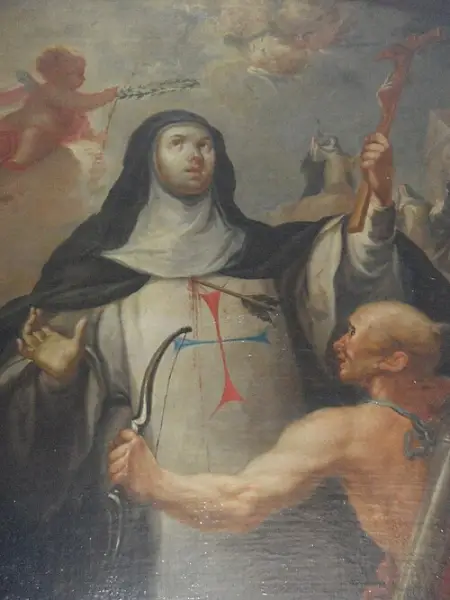
Overview
Saint Laura of Constantinople, who died on 29 May 1453, was a Roman Catholic nun living in the Byzantine capital, belonging to the Order of the Holy Trinity. Her birth fell around 1400, and she bore the name Theodolinde Trasci in the world and came from a noble family: her father, Michael, was a Latin knight, and her Albanian mother was named Helena, though some accounts place her birth in Greece. After entering religious life in Constantinople she took the name Laura of Saint Peter and was raised to be abbess of her convent while still only thirty, an office her early biographers say she filled with excellent virtues of governance and piety. Her life ended in the catastrophe that engulfed the city: when the Ottoman Turks stormed Constantinople on 29 May 1453, Laura was martyred by scalding, while the other fifty-two sisters of her convent were put to death by beheading or mortally wounded. The Church keeps her memory, together with that of her community, on 29 May.
The Complete Life
Theodolinde Trasci, Daughter of a Knight
Before she was Laura, she was Theodolinde Trasci, a child of the late Byzantine world where Latin and Greek Christendom met and intermarried. She was born into nobility: her father, Michael, was a Latin knight — a Western soldier of the crusading tradition settled in the East — and her mother, Helena, was Albanian. Some traditions give Greece as her birthplace, while the catalogues of the Order of the Holy Trinity associate her birth with Constantinople itself; either way, her upbringing joined the Latin and Balkan worlds of the fifteenth-century East. The century into which she was born was one of advancing peril for the Christian East, as the Ottoman Turks tightened their grip around the shrinking Byzantine capital. Into a family formed by the cross-cultural Christianity of the region, Theodolinde grew toward a decision that would define her: she would leave the noble world of her parents and give herself to God as a religious in Constantinople, joining the Order of the Holy Trinity, the Trinitarians, an order founded for the redemption of captives — a mission whose meaning the approaching Turkish conquest would make devastatingly concrete for her and her community.
§ Ancestry and early life
Abbess Laura of Saint Peter
In Constantinople the young nun received a new name, Laura of Saint Peter, the name under which history remembers her. Her gifts were evident early and of an administrative as much as a contemplative kind: she rose within her community until, at the age of thirty, she became its abbess. The sources describe the judgement of her tradition in a memorable phrase, crediting her with excellent virtues of governance and piety — the twin qualities the office demanded. To govern a convent was to steward property, discipline and the daily round of prayer; to do so with piety was to bind authority to holiness. Under her leadership the convent of Trinitarian sisters lived out its vocation in the shadow of the advancing Ottoman siege lines. Fifty-two sisters formed her community, a company of women who had chosen the consecrated life in a city whose fall everyone could foresee. Laura's own formation had prepared her for exactly such an hour: a Latin knight's daughter, an Albanian mother's child, an abbess trained in governance — all of it converging on the role she would play when the catastrophe finally came to the walls of Constantinople in May 1453.
§ Monastic life
Martyrdom, 29 May 1453
On 29 May 1453 the army of the Ottoman Turks breached the walls and took Constantinople, ending the Byzantine Empire. In the sack of the city the convent where Laura ruled as abbess suffered the fate of so many consecrated places: the community was put to death. Laura herself was martyred by scalding — killed, according to the order's records, by boiling liquid poured upon her. Her fifty-two sisters died with her, each either beheaded or mortally wounded, so that the convent perished entire with its abbess at its head. The date of their deaths, 29 May, became the day of their annual commemoration, and the Church has kept the feast of Saint Laura of Constantinople on that day ever since. Her martyrdom belongs to the long calendar of victims of the fall of the city, but her memory is distinctive: she stands among the very few named women of that catastrophe whose suffering the Church preserved, and she is honoured as the last abbess of a Trinitarian house in Constantinople, giving her life within hours of the empire's end, in the first dawn of 29 May 1453.
§ Martyrdom
Timeline
- 1400
Born at Constantinople in the Byzantine Empire, into a noble family.
§ Life
- 29 May 1453
Martyred by scalding when the Ottoman Turks captured Constantinople; her fifty-two sisters were beheaded or mortally wounded.
§ Martyrdom
In Their Own Words
excellent virtues of governance and piety
The Record
- Canonization
- Pre-congregation martyr; no formal canonization process is recorded
Prayer
Bibliography
Show 4 sources
- De Renzis N., Storia di Santa Laura da Costantinopoli nel quattrocentosettantacinquesimo anno della Sua morte, Tip. Editrice R. Riccio Cosenza 1925.
- Calvo S., Resumen de las prerrogativas del Orden de la Ssa Trinidad, Josef Longas Pamplona I p. 219.
- Francisco de la Vega y Toraya, Chrónica De La Provincia De Castilla, Leon Y Navarra, Del Orden ..., Volumen 2, p. 150.
- "May 29 – Saint Laura of Constantinople", 28 May 2018.
Profile text adapted from the Wikipedia article, licensed CC BY-SA 4.0.
Pray with this saint every day
Save St. Laura of Constantinople to your favorites, read the full profile, and get feast-day reminders in the Saints app.
Get the Saints AppFree on the App Store for iPhone and iPad