
died 2 February 619·Feast 3 February
St. Laurence of Canterbury
Second Archbishop of Canterbury of the Gregorian mission
Overview
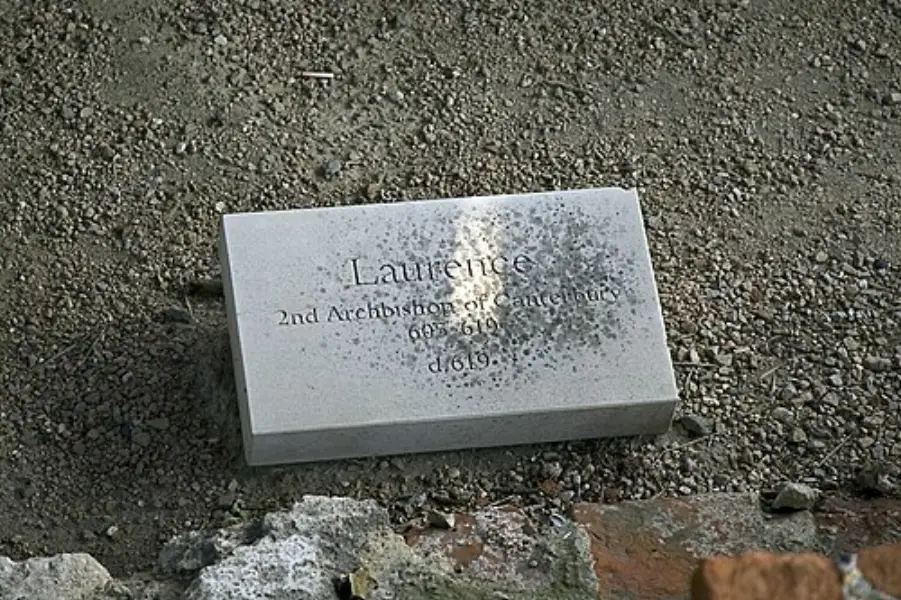
Laurence — sometimes written Lawrence, or in Latin Laurentius — died on 2 February 619 as the second Archbishop of Canterbury, an office he held from about 604. A Roman monk, he joined the Gregorian enterprise that Pope Gregory the Great sent out in 595 to win the Anglo-Saxon peoples from their paganism, reaching England either with Augustine's first company in 597 or, as other sources hold, with the second group in 601. He served as Augustine's trusted envoy to Pope Gregory the Great, carrying back the famous Libellus responsionum, and Augustine consecrated him archbishop while still alive to guarantee the mission's continuity — an irregular act outside canon law that Bede compared to St. Peter's consecration of Clement. Laurence's archiepiscopate was tested twice over: by the refusal of the native British and Irish bishops to accept Roman Easter practice, which his letters could not resolve, and by the apostasy of King Eadbald after Æthelberht's death in 616, when the missionaries Mellitus and Justus fled to Gaul. Laurence stayed, reconverted the king, and died in office on 2 February 619. He was buried at St Augustine's Abbey, revered as a saint, and succeeded by Mellitus.
The Complete Life
A Roman Monk on Mission
Laurence's origins are almost wholly unknown beyond one fact: before the journey to England, his life had been that of a monk in Rome. From that hidden monastery life he was drawn into the boldest papal enterprise of the age — the mission dispatched by Pope Gregory the Great in 595 to convert the Anglo-Saxon peoples from their paganism. He landed at Thanet in Kent with Augustine in 597, though some sources contend that he first arrived in 601 and did not belong to the first company at all. What is certain is the trust he quickly earned. Bede records that Augustine sent Laurence back to Pope Gregory to report the conversion of King Æthelberht of Kent and to carry a letter of questions for the pope; departing sometime after July 598 and returning by June 601, Laurence brought back Gregory's answers, the document known as the Libellus responsionum, which Bede wove into his Ecclesiastical History. He is probably the priest Laurence mentioned in Gregory's letter to Queen Bertha, praising her role in converting her husband. He came back to England in the summer of 601 with Mellitus and the second group of missionaries, and so stood at the centre of the mission's decisive early years.
§ Early life
Consecrated to Succeed Augustine
When Augustine died in about 604, Laurence succeeded him in the see of Canterbury — but the succession had been arranged in advance and against the rules. Augustine had consecrated Laurence during his own lifetime, something canon law forbade, because he feared that any vacancy in the office would cripple the fragile mission in Britain. Bede, telling the story, compared Augustine's action to St. Peter's consecration of Clement as Bishop of Rome during Peter's lifetime — a comparison one modern scholar reads as Bede's oblique commentary on the practices of his own day. The irregularity left a shadow: since Laurence never received the pallium from Rome, the papacy may have regarded him as uncanonical. Whatever the canonical doubts, the practical wisdom of the arrangement proved itself. Laurence ruled Canterbury from about 604 until his death in 619, guiding the mission through its first transition of leadership. In 610 his standing received papal recognition in practice, when letters from Pope Boniface IV reached him addressed as archbishop and Augustine's successor — correspondence prompted by Laurence's having sent Mellitus to Rome earlier that year to seek the papacy's counsel on matters concerning the English Church.
§ Archbishop
Letters to the Britons and the Building of the Abbey
Laurence's archiepiscopate was defined by two unfinished tasks: reconciling the native British Church and establishing the physical church of Kent. In 613 he consecrated the monastery church that Augustine had built at Canterbury, dedicating it to saints Peter and Paul; it would later be re-consecrated as St Augustine's Abbey. On the wider stage he strove, without success, to settle differences with the native British bishops. He wrote to the bishops of the lands of the Scots and the Britons, urging them to keep Easter on the Roman date rather than their traditional reckoning — a salvo in the Easter controversy — and the letter survives in Bede's history. The response from the Celtic churches was cold. Laurence himself recorded that in 609 the native bishop Dagan would neither eat with him nor shelter under the same roof, so deep ran the division between the two traditions. Efforts to carry the mission beyond Kent fared no better against the politics of the age: King Rædwald of East Anglia, the new overlord of the southern kingdoms, had embraced Christianity only halfway, placing a Christian altar in a pagan temple, and Mellitus found it impossible to return to his see of London.
§ Archbishop
The Pagan Reaction and the Conversion of Eadbald
The crisis of Laurence's episcopate came in 616 with the death of King Æthelberht of Kent. The king's son and successor, Eadbald, abandoned Christianity and returned to Anglo-Saxon paganism, unleashing a backlash that drove many of the missionaries into exile: Mellitus, Bishop of London, and Justus, Bishop of Rochester, withdrew to Gaul. Laurence himself resolved to follow them — but, according to Bede, was visited in the night by St. Peter, who chastised him and scourged him, leaving marks on his body that remained after the vision ended. When Laurence showed the marks to Eadbald, the king was converted on the spot. Bede hints that the deaths of pagan leaders in battle may have weighed as much as the vision; the historian Benedicta Ward reads the story as a lesson that suffering recalls Christ's own, and David Farmer suggests its elements may blend the Quo vadis tradition with material from Jerome. Modern historians have found political motives beneath the religious drama — Eadbald's repudiation of his father's pro-Frankish policy, or the objection to his marriage to his father's widow. Whatever the mixture, within a year of his accession the king was Christian again, and the Kentish church had survived.
§ Pagan reaction
Burial, Translation and Memory
Laurence's death came on 2 February 619; Canterbury laid him to rest in the abbey of Saints Peter and Paul, the very church he had consecrated, later renamed St Augustine's. In 1091 his relics were translated to the new church of St Augustine's, where his shrine occupied the central axial chapel of the abbey church, close beside the shrine of his predecessor Augustine. A Vita written around the time of the translation, by Goscelin, preserved his story largely from Bede. The ninth-century Stowe Missal commemorates his feast alongside Mellitus and Justus; the feast on 3 February was his, and the anniversary of his translation on 13 September had its own observance as well. In 1915 his tomb was opened. History's verdict on his fifteen years as archbishop has been measured: he is remembered chiefly for failing to secure agreement with the Celtic Church and for bringing Eadbald back to the faith after Æthelberht's death. Yet survival was itself the achievement — the Gregorian mission could easily have died with its founder, and it was Laurence, the Roman monk who stayed when his colleagues sailed away, who handed it on intact to Mellitus, the third Archbishop of Canterbury.
§ Death and legacy
Timeline
- 595
Named among the Gregorian mission dispatched from Rome to convert the Anglo-Saxons to Christianity.
§ Early life
- 597
Landed at Thanet in Kent with Augustine, according to the sources that place him in the first group of missionaries.
§ Early life
- 598
Sent by Augustine back to Pope Gregory I, setting out after July 598 to report the conversion of King Æthelberht.
§ Early life
- 601
Returned to England by June 601 carrying Gregory's replies, the Libellus responsionum, together with Mellitus and the second band of missionaries.
§ Early life
- 604
Succeeded Augustine as Archbishop of Canterbury, having been consecrated by him during his lifetime.
§ Archbishop
- 609
Recorded that Bishop Dagan refused to eat with him or share his roof because of the differences between their Churches.
§ Archbishop
- 610
Received letters from Pope Boniface IV addressed to him as archbishop, after sending Mellitus to consult the papacy.
§ Archbishop
- 613
Consecrated the monastery church Augustine built at Canterbury, dedicated to saints Peter and Paul, later St Augustine's Abbey.
§ Archbishop
- 616
Faced the pagan reaction of King Eadbald after Æthelberht's death, and reconverted the king while other missionaries fled to Gaul.
§ Pagan reaction
- 2 Feb 619
Died at Canterbury; his body was laid to rest in the abbey of Saints Peter and Paul, afterwards known as St Augustine's.
§ Death and legacy
In Their Own Words
censured by apostolic authority
The Record
- Major works
- Letter to the bishops of the Scots and Britons urging Roman observance of Easter
- Canonization
- Pre-Congregation; revered as a saint from the time of his death in 619
Prayer
Bibliography
Show 10 sources
- Bede (1988). A History of the English Church and People. Translated by Sherley-Price, Leo. New York: Penguin Classics. ISBN 0-14-044042-9.
- Blair, Peter Hunter (1990) [1970]. The World of Bede (Reprint ed.). Cambridge, UK: Cambridge University Press. ISBN 0-521-39819-3.
- Brooks, Nicholas (1984). The Early History of the Church of Canterbury: Christ Church from 597 to 1066. London: Leicester University Press. ISBN 0-7185-0041-5.
- Brooks, N. P. (2004). "Laurence (d. 619)". Oxford Dictionary of National Biography (October 2005 revised ed.). Oxford University Press. doi: 10.1093/ref:odnb/16166.
- Farmer, David Hugh (2004). Oxford Dictionary of Saints (Fifth ed.). Oxford, UK: Oxford University Press. ISBN 978-0-19-860949-0.
- Kirby, D. P. (2000). The Earliest English Kings. New York: Routledge. ISBN 0-415-24211-8.
- Stenton, F. M. (1971). Anglo-Saxon England (Third ed.). Oxford, UK: Oxford University Press. ISBN 978-0-19-280139-5.
- Ward, Benedicta (1990). The Venerable Bede. Harrisburg, PA: Morehouse Publishing. ISBN 0-8192-1494-9.
- Wright, J. Robert (2008). A Companion to Bede: A Reader's Commentary on The Ecclesiastical History of the English People. Grand Rapids, MI: Eerdmans. ISBN 0-8028-6306-6.
- Yorke, Barbara (2006). The Conversion of Britain: Religion, Politics and Society in Britain c. 600–800. London: Pearson/Longman. ISBN 0-582-77292-3.
Profile text adapted from the Wikipedia article, licensed CC BY-SA 4.0.
Pray with this saint every day
Save St. Laurence of Canterbury to your favorites, read the full profile, and get feast-day reminders in the Saints app.
Get the Saints AppFree on the App Store for iPhone and iPad