
died c. 545·Feast February 7
St. Laurence of Siponto
Bishop of Siponto and Founder of the Shrine of Monte Gargano
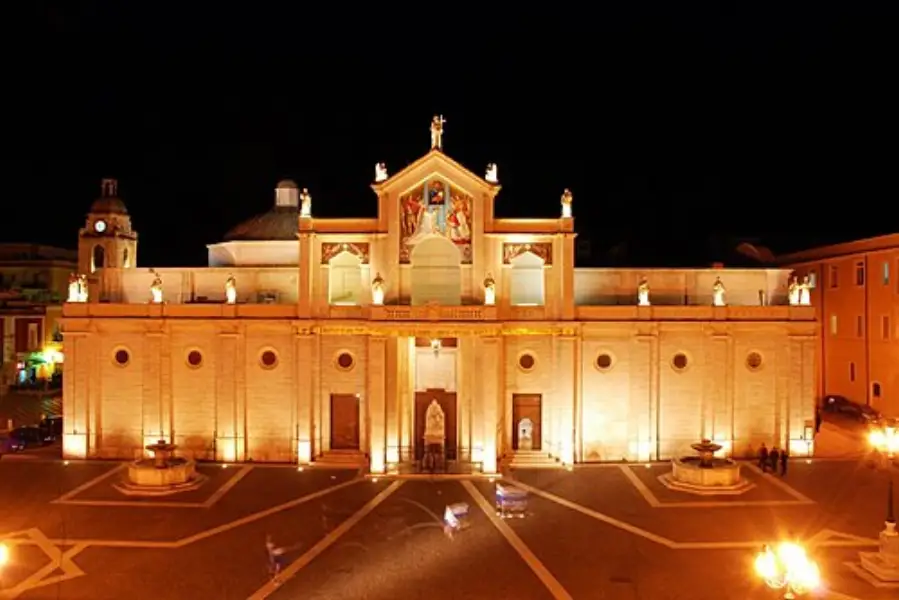
Overview
Laurence of Siponto, also called Laurence Maioranus, was a bishop of the late fifth and early sixth century whom tradition remembers as the founder of the celebrated shrine of Saint Michael the Archangel on Monte Gargano. A ninth-century life relates that he came from Constantinople and that when the see of Siponto fell vacant, Emperor Zeno named his kinsman to the bishopric around 491. Whether he was consecrated in Constantinople or in Rome by Pope Gelasius I remains uncertain. He reached his Italian see bearing relics of Saint Agatha and Saint Stephen, obtained material support and craftsmen from the emperor, and built a church and baptistry. Shortly after taking office he experienced visions of Saint Michael that led to the establishment of the shrine on Mount Gargano, and he is credited with persuading the Gothic king Totila to spare Siponto. He died on 7 February, probably around 545. Although no contemporary evidence for his episcopate survives, his cult flourished from the eleventh century, and he is honored today as patron of Manfredonia and of the Archdiocese of Manfredonia-Vieste-San Giovanni Rotondo.
The Complete Life
Origins in Constantinople
Nearly everything known of Laurence's origins comes from a life written in the ninth century, centuries after his death. According to that account he was a native of Constantinople, the capital of the Eastern Roman Empire, and a relative of the emperor. When the bishopric of Siponto, a city on the Adriatic coast of southern Italy, became vacant, the people of the city sent word to Constantinople asking for a successor. Around the year 491 the Emperor Zeno answered their request by appointing his own kinsman Laurence to the see. The sources leave open where he received episcopal consecration: he may have been made a bishop in Constantinople itself, or in Rome at the hands of Pope Gelasius I. What the tradition preserves with confidence is what he carried with him on the journey west — the relics of Saint Agatha, the famous martyr of Catania, and of Saint Stephen, the first Christian martyr. Modern historians caution that no contemporary record of a Bishop Laurence of Siponto survives, and that every trace of his cult reaches back only to the mid-eleventh century; yet the outline of the ancient life became the foundation of everything later generations believed about him.
§ Life
A Bishop Builds His Church
Laurence's first labors as bishop were material as much as spiritual. From the emperor he obtained both funding and skilled workmen, and with them he raised a church and a baptistry for his flock at Siponto — a sign, according to the tradition, of the close ties between the new bishop and the imperial court that had sent him. Shortly after his appointment in 491 came the events for which he is best remembered. Laurence received visions of Saint Michael the Archangel, and from those apparitions arose the sanctuary of Monte Gargano, the rocky promontory above Siponto that became one of the most celebrated shrines of western Christendom and a destination of pilgrims for well over a thousand years. His episcopate was also tested by war. When the Gothic king Totila campaigned in Italy during the middle of the sixth century, Laurence was credited with going to meet him and persuading him to spare the city of Siponto from destruction. A fresco in the cathedral of Manfredonia later depicted this dramatic encounter between the aged bishop and the Gothic conqueror, preserving in paint the memory of a pastor who risked himself for his people.
§ Life
The Shrine on the Mountain
The visions that came to Laurence shortly after he took possession of his see placed a cave on Mount Gargano at the center of his life's work. There, in accordance with the apparitions of Saint Michael, the shrine was established that bears the Archangel's name and that Laurence is credited with founding. The sanctuary of Monte Gargano grew into one of the great pilgrimage centers of medieval Europe, and its association with the bishop of Siponto remained a fixed part of the story told about him. The historian Richard F. Johnson's study of the Archangel in medieval legend places these events within the broader tradition of Michaelic apparitions in the West, of which Gargano is the earliest and most influential. Whatever the exact circumstances, the tradition is unanimous in making Laurence the human instrument of a shrine that he did not own but served: a bishop who received a heavenly message, acted upon it, and thereby gave southern Italy — and eventually all of Europe, Monte Gargano standing with Mont-Saint-Michel among the great sanctuaries of the Archangel — a place of prayer that endures to the present day.
§ Life
Veneration and Relics
Laurence died on 7 February, in the year given by the tradition as about 545, and was buried at Siponto, where his remains lay beneath the high altar of the cathedral. The historical record of his cult becomes substantial only after 1066, the year in which Siponto's diocese was detached from Benevento and set up anew; two biographies of the saint belong to that era, marking the moment when his memory took on formal literary shape. In 1327 Bishop Matteo Orsini translated the relics from the old cathedral of Siponto to the new cathedral of Manfredonia, the city that had arisen nearby and that regards Laurence as its principal patron, with its Duomo dedicated to him under the name of San Lorenzo Maiorano. In 1620 Turkish forces attacked and destroyed the first cathedral by fire, and the saint's body was lost with it, except for the right arm, which was rescued and remains in the cathedral today. The Archdiocese of Manfredonia-Vieste-San Giovanni Rotondo honors him as its patron, and his feast is kept on 7 February, keeping alive the memory of the bishop of the Gargano.
§ Veneration
Timeline
- 491
Emperor Zeno appoints his kinsman Laurence to the vacant bishopric of Siponto
§ Life
- 491
Bringing relics of Saint Agatha and Saint Stephen, he arrives in Siponto and obtains imperial material and workmen to raise a church and baptistry
§ Life
- 491
Visions of Saint Michael the Archangel lead to the founding of the shrine on Monte Gargano
§ Life
- 7 Feb 545
Laurence dies at Siponto, traditionally on 7 February
§ Life
- 546
Remembered for persuading the Gothic leader Totila to spare the city of Siponto
§ Life
- 1066
The Diocese of Siponto is separated from Benevento and re-established; two lives of Laurence date from this period
§ Life
- 1327
Bishop Matteo Orsini translates Laurence's relics from Siponto Cathedral to the cathedral of Manfredonia
§ Veneration
- 1620
Turkish forces burn the first cathedral of Manfredonia; the saint's body perishes except for the right arm
§ Veneration
The Record
- Major works
- Foundation of the shrine of Saint Michael the Archangel on Monte Gargano·Church and baptistry built at Siponto with imperial support
- Patron of
- patron of the city of Manfredonia·patron of the Archdiocese of Manfredonia-Vieste-San Giovanni Rotondo
- Symbols
- bishop's vestments·apparition of Saint Michael the Archangel·reliquary
- Canonization
- Pre-congregation canonization; his cult is attested from the mid-eleventh century onward
Prayer
Bibliography
Show 6 sources
- Lanzoni, Francesco. Le diocesi d'Italia dalle origini al principio del secolo VII (an. 604). Faenza: F. Lega, 1927, p. 279.
- Borrelli, Antonio, "San Lorenzo Maiorano Vescovo di Siponto", Santi e Beati, January 28, 2004.
- Cosentino, Salvatore (ed.). Ravenna and the Traditions of Late Antique and Early Byzantine Craftsmanship: Labour, Culture, and the Economy. Walter de Gruyter GmbH & Co KG, 2020. ISBN 9783110684438.
- Johnson, Richard F. Saint Michael the Archangel in Medieval English Legend. Woodbridge: Boydell, 2005, pp. 110-15.
- Holweck, Frederick George. A Biographical Dictionary of the Saints. B. Herder, 1924, p. 593.
- Oldfield, Paul. Sanctity and Pilgrimage in Medieval Southern Italy, 1000-1200. Cambridge University Press, 2014, pp. 68-69. ISBN 9781139915793.
Profile text adapted from the Wikipedia article, licensed CC BY-SA 4.0.
Pray with this saint every day
Save St. Laurence of Siponto to your favorites, read the full profile, and get feast-day reminders in the Saints app.
Get the Saints AppFree on the App Store for iPhone and iPad